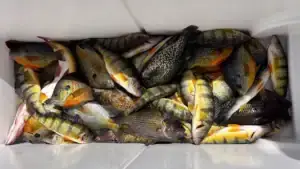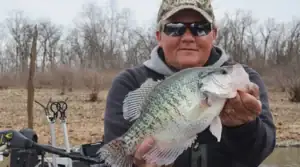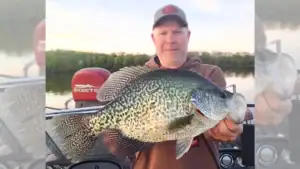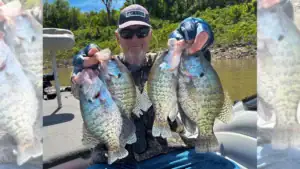
Dan Spengler is on a quest to catch one of fishing’s most-elusive trophies: a giant bluegill.
Spengler, who designs lures for Pure Fishing and Berkley, loves using his baits to catch smallmouth bass, walleyes, and even muskies that put up a giant fight. But lately, he has devoted hours to chasing big, saucer-sized bluegills, that fish at the other end of the angling spectrum.
He’s not talking about the little panfish that many of us grew up catching. We’re talking about the survivors that grew into mega-sized monsters.
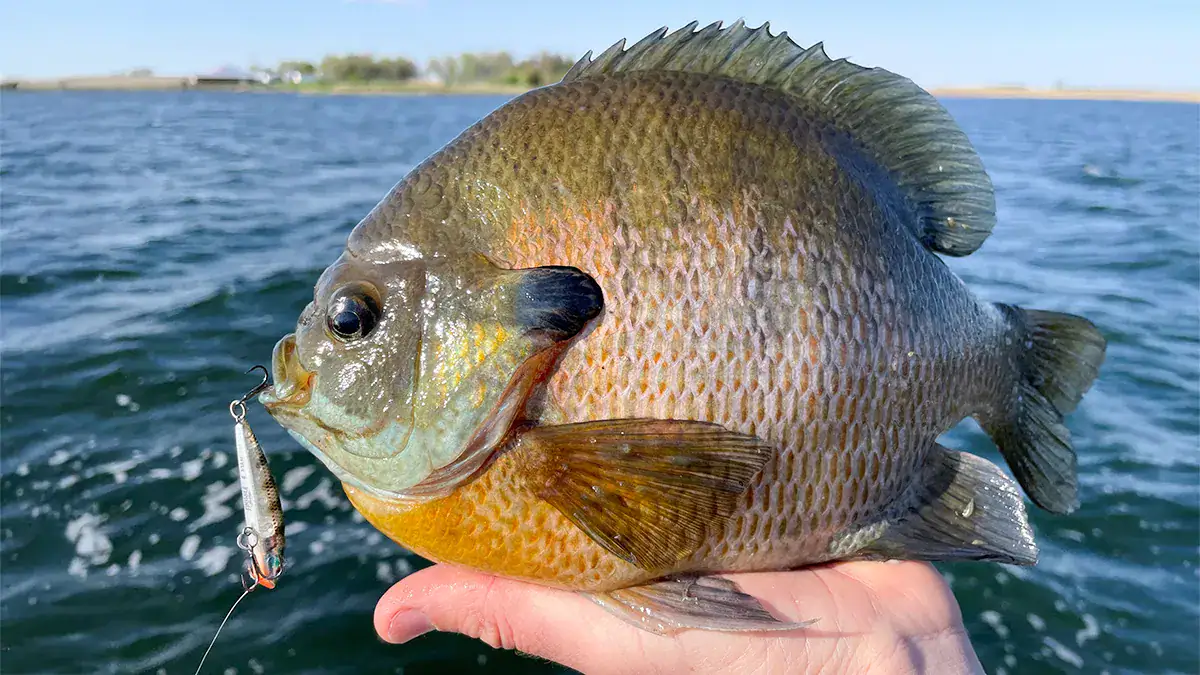
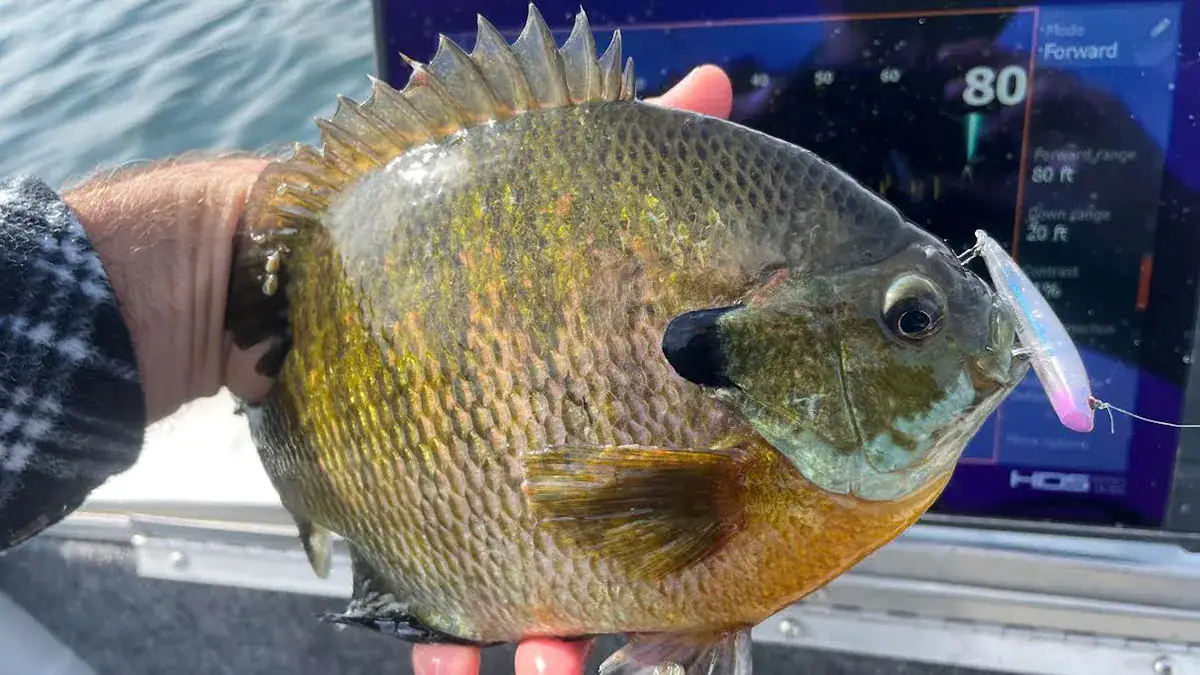
“Once a bluegill gets over 10 inches, they stop growing long and just get tall,” Spengler told Wired2fish. “They grow thick and they look like saucers.
“They often have good genetics, and they have survived predation and competition for food. They’re rare; you don’t find them in every body of water. But that’s why I like chasing them so much.”
A Lifelong Pursuit
Spengler’s passion for catching mega-sized bluegills started during his childhood. He grew up fishing gravel pits and small bodies of water in northwest Iowa, not far from Berkley’s headquarters in Spirit Lake.
It was one of those scenes right out of small-town Americana. Spengler and his friends rode their bikes to the region’s fishing holes and fished for bass, bluegills, and catfish.
Spengler became intrigued with big bluegills when he stumbled onto one pit that had some trophies in it.
“I ended up catching four 10-inch bluegills out of one pit and they fought like crazy,” he said. “I can still remember that moment in time when I was reeling in a giant bluegill and it just broke the six-pound test line I was using. Not at the knot, just broke the line.”
Where Passion and Profession Meet
Fast forward to years later when Spengler attended South Dakota State University and majored in fisheries. He learned from some of the top fisheries minds in the nation, and was soon hired by Berkley to serve as a lure designer.
He traveled extensively, field-testing his prototype lures. And the more he visited lakes off the beaten track, the more he learned about the unique needs of big bluegills.
A landmark moment came while fishing with friends on a North Country lake. Using his forward-facing sonar, Spengler noticed a school of fish that looked different from the anglers’ targeted smallmouth bass and walleyes.
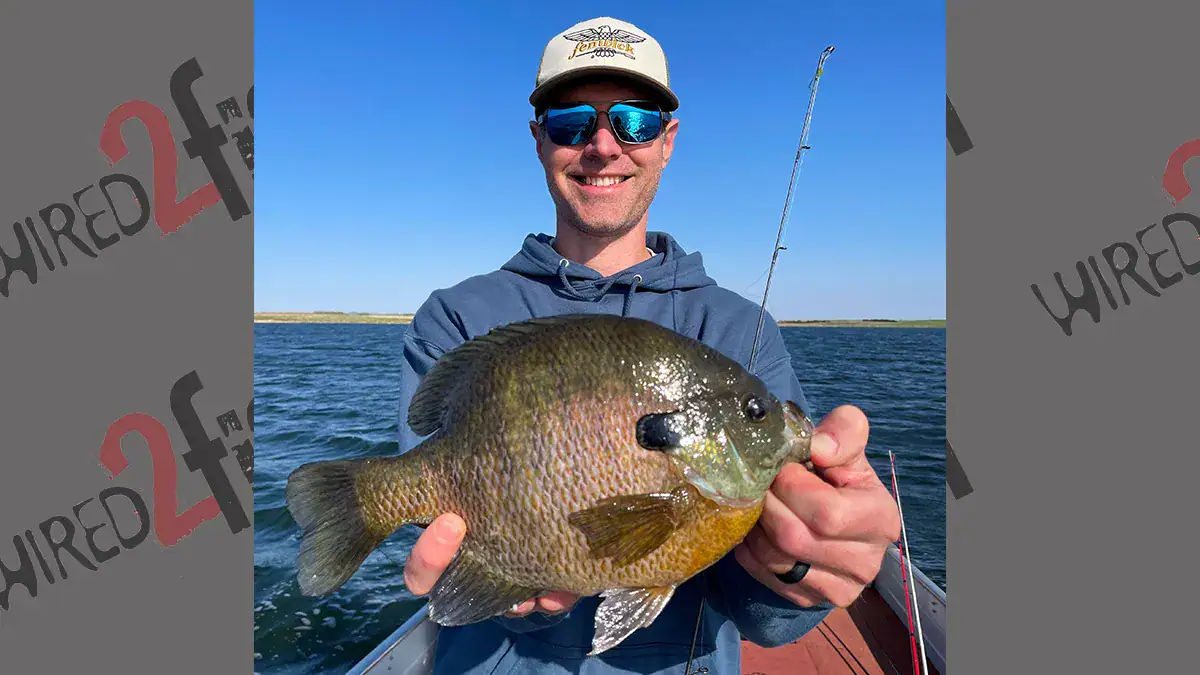
His friends tried fishing night crawlers under slip bobbers but failed to find success. Spengler tied on a small minnow-style hard bait he had just designed, the Finisher 4. On his first cast, he caught his personal-best bluegill, a fish that weighed 1 pound, 10 ounces.
“I thought, ‘That fish would look great on my wall,’” Spengler said. “But I threw it back.
“My goal is to catch a two-pound bluegill, and it takes time for them to grow to that size. Ever since then, every bluegill I’ve caught 10 inches or longer goes back.”
In the process, though, Spengler has learned some important information about catching line-stretching bluegills.
“The fisheries biologist in me believes that bluegills change their forage base as they get bigger,” he said. “They go to a fish-based diet and that’s why they get so big. They’re cruising around, eating minnows.
“This was pre-spawn. The bigger ones seemed to move around pelagically (off-shore, in open water).”
An Angler’s Advice
Since then, Spengler has caught dozens of other giant bluegills by taking a target-specific approach.
The first thing he stresses is that these giant bluegills aren’t everywhere. In fact, the waters that produce giant bluegills are few and far between.
His keys to success:
- Before the first cast: Spengler does his research. He gets on the Internet and studies surveys put out by the fisheries departments of state agencies. “They’ll break down what the regions have to offer, and I’ll determine which areas are target-rich lakes for big bluegills,” he explained.
- The ingredients: Quantity doesn’t necessarily equate to quality with bluegills. The best lakes often have low-density populations of panfish that are kept in check by larger predators such as largemouth bass. But the bluegills that avoid predation often grow to large sizes.
- Food base: Spengler also looks for lakes that have plenty of forage a bluegill can prey upon. In other words, small items that its mouth can easily inhale.
- The time to go: Spengler likes to time his trips for the pre-spawn and spawn. Because bluegills are colony nesters, their beds are easy to find in clear water. Look for a series of craters in the shallows with a sandy or gravel bottom. “They won’t nest in muck,” Spengler said. “They need something more stable. In some lakes, I look for areas with bullrushes. I’ve had phenomenal fishing in those areas.”
- Before the spawn: Even before the spawn, those nests from the previous years can offer clues as to where the bluegills will be. Spengler likes to use the side imaging on his electronics to search for the areas with craters. Then he will search for cruising bluegills in nearby deeper water, knowing they will probably return to the same area to spawn again.
- Water temperature: When the water temperature gets to 63 degrees, Spengler is in his boat searching for bluegills in some phase of the spawn. But that window isn’t always a limited one: Spengler has found bluegills on the beds in water as warm as the upper 70s.
- Equipment: Spengler uses a light-action Fenwick spinning rod, and a small spinning reel spooled with four-pound Berkley FireLine Crystal with a 4-pound fluorocarbon leader.
- Baits: That equipment allows Spengler to make long casts with small hard baits such as the Berkley Finisher 4, which is only 1.57 inches long and weighs 3/16th of an ounce. Spengler designed the bait to target big bluegills and finicky bass. Described as a micro-jerkbait, the Finisher 4 sinks slowly with an erratic motion that resembles a sluggish minnow. “It has a flat belly, so it quivers as it falls,” Spengler said. “Flick your wrist, and it puts a lot of action on the bait.”
- Electronics: As with other baits in the Finisher family, the Finisher 4 was designed as friendly to forward facing sonar. Spengler often uses his unit, which shows live activity of the fish below, to locate roaming schools of big bluegills. Then he makes long casts to the fish.
Fishing for the Fun of It
He knows the world record is probably out of reach. That bluegill, caught at Ketona Lake in Alabama in 1950, weighed an amazing 4 pounds, 12 ounces.
For the time being, Spengler just has his sights set on catching and releasing a bluegill weighing more than two pounds.
“That’s my chase. That’s my story,” he said. “I’m traveling a lot, I’m venturing out onto lakes that are new to me, I’m exploring a lot of different water.
“It’s going to be a fun year.”