With tuna clocking in at sizes as varied as their worldwide locations, just how big can record-setting catches get?
According to the International Game Fish Association (IGFA) records, they can dwarf humans—especially when they’re world-record catches. Six of the biggest tuna species can range from well over 200 pounds to nearly 1,500—handily outweighing smaller and usually coastal-pelagic tuna species like blackfin, little tunny, Atlantic bonito, Pacific bonito, longtail, skipjack, and kawakawa.
Here, we’re highlighting the single largest tuna caught on rod and reel, representing six of its largest species and the all-tackle world record of each. (There are actually seven entries because the IGFA lists Thunnus obesus—the bigeye tuna—in two categories, Atlantic and Pacific, though it is the same species.)
BLUEFIN (Thunnus thynnus)

- 1,496 pounds
- Nova Scotia, Canada
- October 1979
- Ken Fraser
- Trolling an Atlantic mackerel on 130-pound line
While the IGFA lists T. thynnus simply as “bluefin,” it is—per its geography—widely called the Atlantic bluefin tuna. That moniker reflects its range, in the western Atlantic from Canada to Brazil, the eastern Atlantic from Norway to the Canaries, and in the Mediterranean and part of the Black Sea, preferring temperate and subtropical zones. The largest tuna species, it is characterized by its dark blue back with silver/white sides and belly, as well as the short pectoral fins that don’t extend as far back as the end of the first dorsal fin.
After years of dismal international management, tighter bluefin laws gradually brought back populations of this deep-sea nomad. The International Union for the Conservation of Nature (IUCN) removed it from the endangered-species list in 2021 and recategorized bluefin as a least-concern species. The species’ expanding range—in part as oceans warm, forcing them farther north—has meant increased fisheries.
BLUEFIN, PACIFIC (Thunnus orientalis)

- 907 pounds
- Three Kings, New Zealand
- February 2014
- Donna Pascoe
- Fishing a live skipjack tuna
There is little that visually distinguishes the Pacific from the Atlantic species of bluefin. But there is also little need to make that distinction, since each species is determined by the ocean in which they’re found.
Primarily a temperate-water tuna, T. orientalis is found throughout the North Pacific, from Southern California to Asia. Even though the IUCN considers the species endangered, its populations have rebounded dramatically in recent years from near-collapse. Today, experts widely describe the Pacific bluefin as a fisheries-management success story.
BLUEFIN, SOUTHERN (Thunnus maccoyii)

- 382 pounds, 12 ounces
- White Island, New Zealand
- August 2022
- Charles Baty
- Trolling a Bonze lure on 80-pound mono
The southern bluefin is found in the temperate and cold waters of the southern Atlantic, Pacific and Indian oceans—though nearly 30 line-class and tippet-record fish come just from the waters off southern Australia and New Zealand.
They were once considered the same species as Atlantic bluefin. In fact, they look so much alike, a gill-raker count may be needed to confirm their I.D.—though their presence in cold, southern waters generally accomplishes that.
Continued overfishing has devastated stocks; the IUCN lists the species as endangered.
BIGEYE (Thunnus obesus)

ATLANTIC
- 392 pounds, 6 ounces
- Canary Islands
- July 1996
- Dieter Vogel
- Trolling a lure on 50-pound mono
PACIFIC
- 435 pounds
- Cabo Blanco, Peru
- April 1957
- Dr. Russel Lee
- Fishing a bonito on 39-thread linen line
Bigeye are found in most oceans offering tropical and subtropical conditions, though absent from the Mediterranean. The IGFA separates bigeye according to geography for record-keeping purposes, but there is a single species.
Adult bigeye generally prefer feeding in water deeper and colder than other tuna do. It is listed as “vulnerable” by the IUCN, but NOAA Fisheries advises American consumers that bigeye is sustainably managed.
YELLOWFIN (Thunnus albacares)
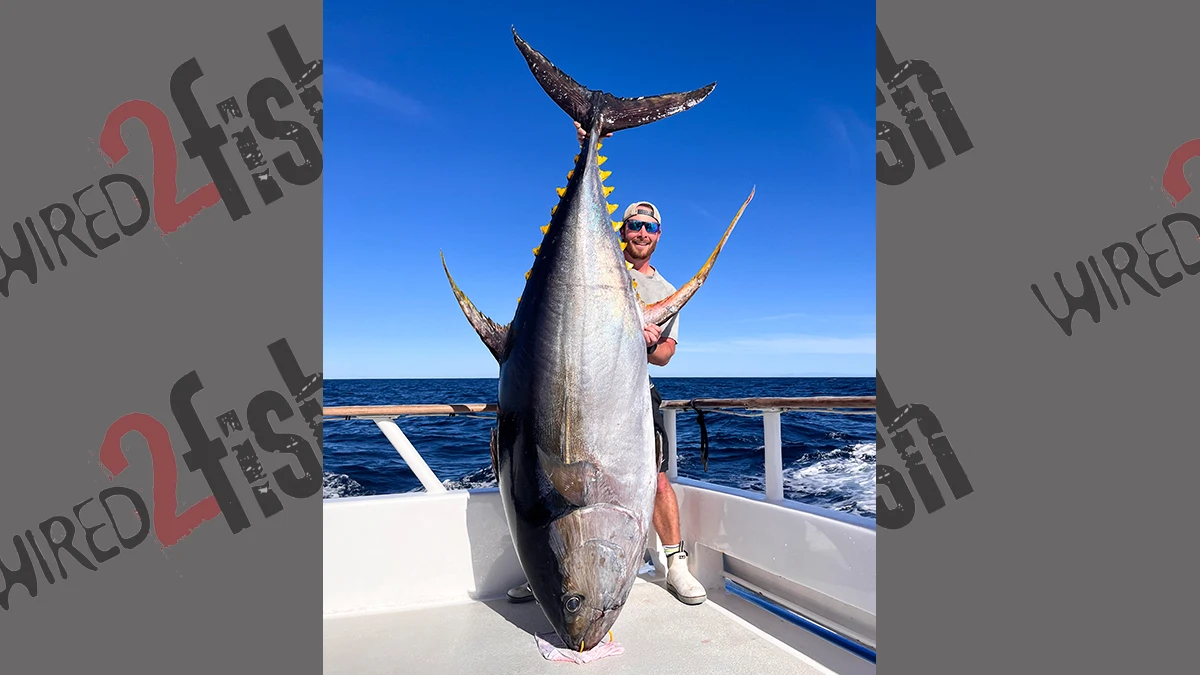
- 443 pounds
- Cabo San Lucas, Mexico
- November 2024
- Earl Gill IV
- Unspecified fishing bait on 100-pound mono
The ubiquitous and popular yellowfin roams all the world’s tropical and warm-temperate oceans. Identification of larger, mature yellowfin is easy: Their bright yellow second dorsal and anal fins extend elegantly far back nearly to the base of the tail. This is not the case for smaller yellowfin but the same fins are nevertheless yellow, as are the dorsal and ventral finlets ahead of the tail. Usually, a yellow band is visible along each side.
The IUCN has listed the yellowfin species of “least concern,” a status improvement thanks to tightened conservation measures. Stocks remain overfished in some areas, notably the Indian Ocean.
DOGTOOTH (Gymnosarda unicolor)
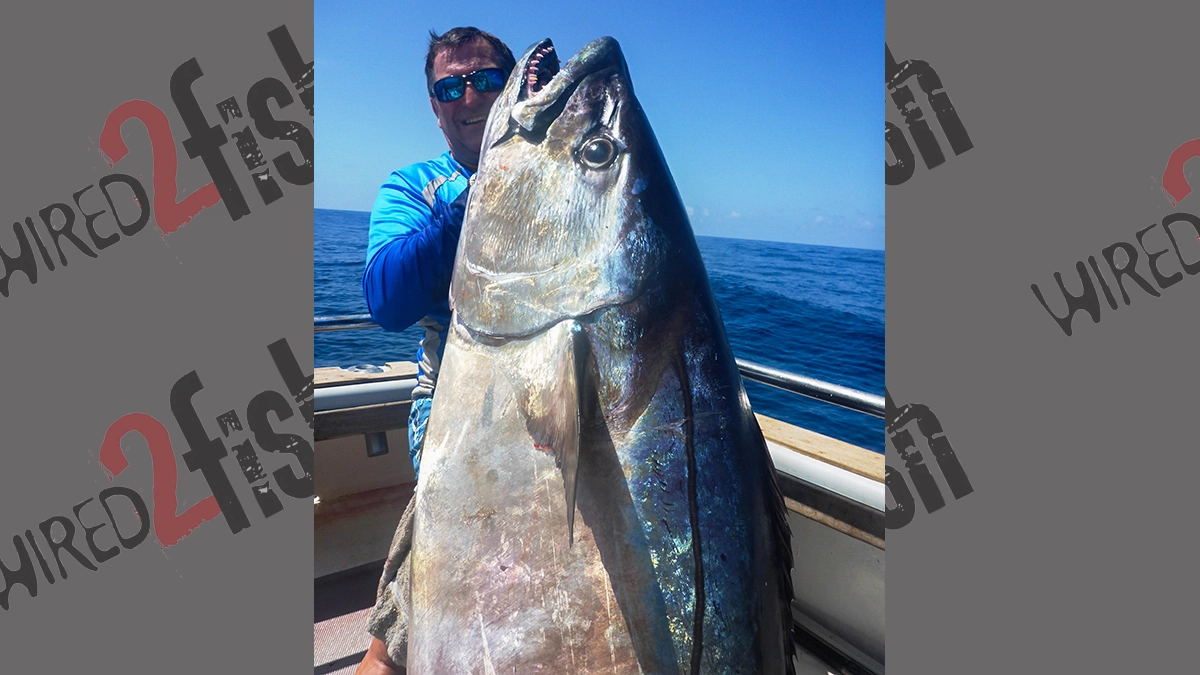
- 235 pounds, 15 ounces
- Tanzania
- November 2015
- Jon Patten
- Fishing live yellowfin tuna on 80-pound mono
The unique dogtooth is limited to the tropical Indo-Pacific waters, from Oceania including Japan and Australia to the east coast of Africa and the Red Sea. It belongs to a group unlike all the tuna listed above, notably longer and more slender, with an impressive set of teeth. (Its relative, the little Atlantic bonito—true bonito, not “false albacore”—has the same shape and teeth.)
Unlike the other tuna here, dogtooth eschew deep blue water for steep seamounts and reef walls and channels, and tend to be far more solitary. Anglers who’ve tangled with them generally insist that no tuna fights harder.