In the world of marine electronics, it seems like no one has heard or said a phrase more often than “forward-facing sonar” (FFS) these past five years. A term you rarely hear paired with it, however, is “budget friendly.”
But this is the exact combination you’ll find with the only sub-$1,000 forward-facing sonar unit on the market, the Lowrance Eagle Eye 9. While this unit only sneaks into that price point by a penny (priced at $999.99), it’s still the cheapest unit by a few hundred bucks offering forward-facing sonar, with the transducer and everything included.
Now, there are some drawbacks to this unit, too. And it’s not just a forward-facing unit. So let’s get into all of that.
First Impressions
When I put this on the front of my bass boat, the installation was fairly easy and straightforward. The transducer even has a slot where a pin rests, much like in the prop of a trolling motor. Since that pin and slot mean the transducer only fits one way, it removes the guesswork from orienting the transducer—an admittedly tricky part of the process. I really like that this unit doesn’t have an external box or anything additional to connect to, either. You simply hook the power to the graph and run the transducer to the trolling motor, and you’re ready to go fishing.
I was surprised at how easy to use and effective the Eagle Eye 9 was on the water. I’ve fished with a few forward-facing sonars, from the first Garmin Panoptix unit a decade ago to Garmin’s latest. While the Eagle Eye understandably wasn’t on par with the latter, it still functioned the same way. I could see cover and fish fairly well, plus track my bait up to about 50 or 60 feet out.
Experience On the Water
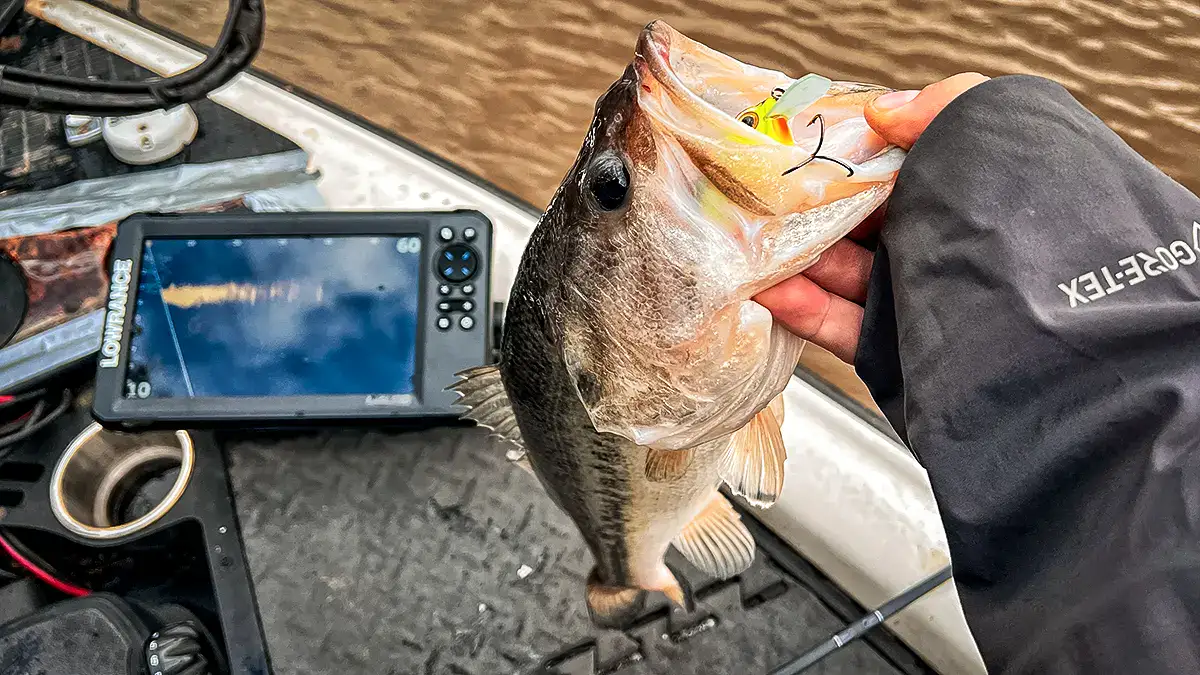
My first trip with the Eagle Eye 9 included one especially exciting encounter.
I was fishing stumps close to shore in about four feet of water—not your typical FFS scenario. But I wanted this tech on my boat to get the most from the way I already like to fish. I’m a bank-beating power fisherman at my core, so getting out in the middle and chasing a dot around doesn’t do a whole lot for me. But, up shallow, I can use FFS to find stumps, brush, and other cover I never knew existed. Such was the case on this trip. I used the graph to fish around stumps while watching for others along the bank that I could see.
On one cast, I felt my bait collide with a stump and looked down at my graph just in time to see my bait pass the cover. Then I saw a blob behind it. At this point my bait was maybe 10 feet from the boat, so I stopped reeling and started twitching it like a jerkbait. The blob inched closer and closer, and then ate the bait.
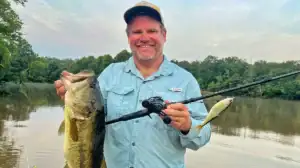
I set the hook and a three-pounder immediately broke the surface right by me. I fought the fish around and brought it aboard—a memorable catch and an instant assurance that the Eagle Eye 9 could definitely catch me fish that I would otherwise pass up. I’m confident that, given the fairly cold water I was fishing in, the bass would have boiled on the bait at the boat and been gone like so many before, if I hadn’t seen it and slowed the bait down.
Forward-Facing Woes
For a nine-inch graph with forward-facing capabilities at $1,000, you have to expect some limitations. While the Eagle Eye 9 does have the ability to see what’s both beneath the boat and ahead of the transducer, these two areas don’t show up at the same time. With most forward-facing sonar, you can still see below the trolling motor and even under the boat a little without switching to a designated down view. The Eagle Eye 9 blacks out the area close to the boat in Live Forward mode. But you can swap to Live Down and target fish this way if you’d like. It just makes things more challenging when trying to trick a trailing bass on those last few feet of the cast.
When panning the trolling motor back and forth, there’s an area right along the surface that also occasionally blacks out. Sometimes, the Live Forward setting will read all the way to the surface, but other times the upper 1 to 3 feet will disappear for a moment or two when turning the motor.
What It Does and Who It’s Good For

In addition to its live sonar capabilities, the Eagle Eye 9 also has traditional sonar and DownScan. It also has Lowrance’s proprietary C-MAP system, with 17,000+ charts for U.S. waterways. Your lake didn’t make the list? No problem, the Eagle Eye 9 has Genesis Live too, which lets anglers create their own topography maps. The nine-inch IPS (In-Plane Switching) screen makes the graph viewable from any angle, even when looking through polarized lenses and in the bright sun.
Ultimately, this is not going to be the tool a touring professional needs. But, for the everyday angler getting into forward-facing sonar, this is a phenomenal option. The price is unbeatable, the setup and installation are both super simple and straightforward, and—most importantly—the graph works.
You will spend some time learning it. And it can lead you on a wild goose chase just as good as any other FFS unit. But, if you want to try FFS, the Eagle Eye 9 is a great entry level unit. As it already has done for me, this will help you catch more fish.