You won’t see hatchery trucks roll up to Lake Texoma to stock striped bass. The fish are doing just fine on their own.
“At Texoma, the stripers are like the golden goose that keeps producing,” said Matt Mauck, a regional fisheries supervisor for the Oklahoma Department of Wildlife Conservation. “We have good year-classes of fish year after year.”
What started off as an experiment in the mid-1960s to stock stripers and see if they would take hold has become a giant success.
“By 1974, we saw signs of natural reproduction and we ceased stocking,” Mauck said. “The fish took it from there. Today, we have yearly natural recruitment that far exceeds what we would be able to get by stocking the lake. It’s a big success story.”
It’s little wonder that tourism officials have dubbed the reservoir on the Texas-Oklahoma border “The Striper Fishing Capital of the World.”
Favorable Fishing Factors
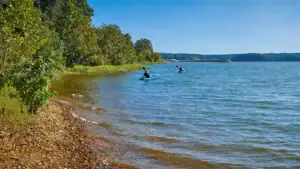
So what makes Texoma—an 89,000-acre reservoir sitting on the Texas-Oklahoma state line—so special?
- Texoma has two long, free-flowing rivers, the Red and the Washita, allowing the stripers to make long spawning runs.
- The rivers have a high salinity count, which benefits the stripers, a saltwater species.
- Texoma has a booming population of baitfish, both threadfin and gizzard shad.
- Because the population is so large, you can catch stripers moving from one of the giant reservoirs to the other.
About the only thing Texoma doesn’t have is trophy-size fish. Or not many of them, anyway. It’s definitely a quantity-over-quality fishery.
“For stripers to thrive and live long enough to grow to trophy sizes, they need cool, oxygenated water. And we don’t have a lot of that here in southern Oklahoma,” Mauck said. “The fish go right from a long, hot summer where they don’t eat much to winter, where they’re feeding up. It’s a numbers game at Texoma. On good days, you can catch a lot of 16- to 24-inch fish.”
A liberal daily limit of 10 (and only two measuring 20 inches and longer) ensures that anglers reel in plenty of fish practically year-round.
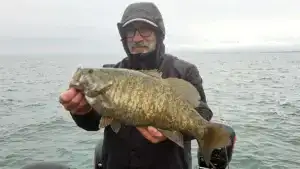
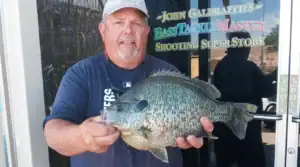
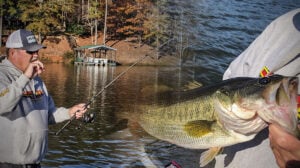
But stripers aren’t the only reason fishermen flock to Texoma. The huge reservoir that lies primarily in Oklahoma also has world-class fishing for blue catfish, trophy smallmouth bass, big crappies, largemouth bass, and white bass.
Lake Texoma Fact Sheet

- Location: On the Texas-Oklahoma border. About 80% of the reservoir lies in Oklahoma.
- Size: 89,000 acres; 580 miles of shoreline. One of the largest manmade reservoirs in the United States.
- Age: Completed in 1944, the project was formed by Dennison Dam on the Red River. As Texoma was built during World War II, German prisoners of war helped construct the dam.
- Main tributaries: The Red and Washita rivers.
- Management: The U.S. Army Corps of Engineers manage Texoma. Officials initially authorized it for flood control, hydropower, and water supply; recreation became a later priority.
- Claim to fame: Tourism officials dubbed Texoma “The Striper Capital of the World.” Because of the high salinity of the water in the Red River, stripers (predominantly a saltwater fish) thrive there and attract thousands of anglers every year.
- Boat ramps: The U.S. Army Corps of Engineers offers 20 public boat ramps. In addition, many resorts and marinas offer launch areas.
- Marinas: Texoma has more than 20 marinas.
- Lodging: Texoma offers lodging options to meet all needs—from primitive campsites to waterfront resorts to motels and hotels.
A Striper Awakening
In the 1970s, Bill Carey was a bass fisherman searching for something to do in the cold-weather months.
He read an article in the Dallas Morning News about the excitement around striper fishing at Texoma and decided to see for himself. So he hired a guide and the two fishermen went out on a blustery March morning. They caught 20 stripers, several of them in the 10- to 15-pound range, and Carey was excited.
“I called my bass buddies and told them, ‘These fish are bigger than bass, they’re meaner and you can eat them,’” said Carey, 73, who lives in Frisco, Texas. “I was hooked: I hired that guide 33 times in my first year.”
He added: “I never looked back.”
Carey went on to become a guide himself and eventually formed the Striper Express Guide Service out of Pottsboro, Texas. He distinguished his business by designating it as an “artificials-only” business, setting it apart from the many guides who used live bait to catch stripers.
His clients fished topwater lures such as the Cordell Pencil Popper for seven months of the year—from late April to the first week of November. They also used slab spoons over structure such as drop-offs and channel ledges once that narrow window of topwater activity closed.
Flukes and plastic swimbaits also became effective fish-catchers, and business grew.
Eventually, Carey retired to the front office and took on a partner—his son Chris, who is also the head guide for Striper Express. They now have 10 boats in their fleet and multiple guides.
“Texoma is a great place to guide,” Carey said. “It’s a place where you’re going to catch fish.”
How to Catch ‘em
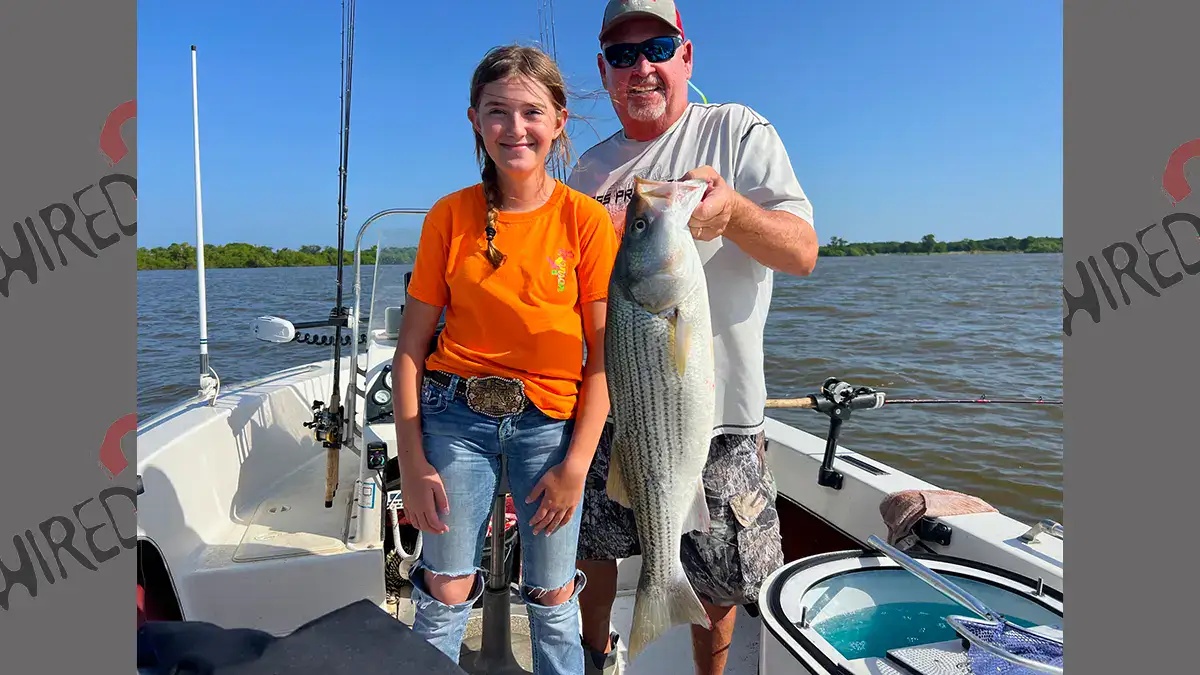
If you’re the type of angler who likes to throw out an anchor and sit in one place, you’re probably going to struggle at Texoma.
The stripers are constantly on the move, and fishermen have to move with them. That means using the electronics on your boat to follow the schools of baitfish and stripers. Or you can rely on nature’s clues. Flocks of gulls diving down to feed on shad often signal that stripers are below, pushing the baitfish to the surface.
“Gulls are better than $2,000 fish finders,” Carey joked.
Gary Scarberry, who runs Gary’s Striper Guide Service, points out that stripers can be caught year-round at Texoma. But the best times—provided the weather cooperates—are April through June and October through December.
“In the spring, the stripers will swim back to the lake from the rivers after spawning and they’re hungry,” Scarberry said. “We’ll find them on the flats where there are a lot of shad. We’ll fish with live bait and do a lot of drifting. Where there are schools of baitfish, the stripers usually aren’t far away.”
The fall can be another great time to catch stripers because their metabolism slows down and they tend to hold on structure. Scarberry likes to use either live bait or employ a method called dead sticking, where he uses a heavy jig head with a Fluke body and fishes it vertically for suspended stripers.
He tries to slowly drift through the schools of shad, without putting much action on his lures. He generally starts looking at the mouths of the rivers, channel edges and other structure.
Mauck advises fishing the upper end of the lake in winter. In summer, you can find the best combination of water temperature and oxygen from mid-lake all the way to the dam, he said.
Trophy Blue Catfish
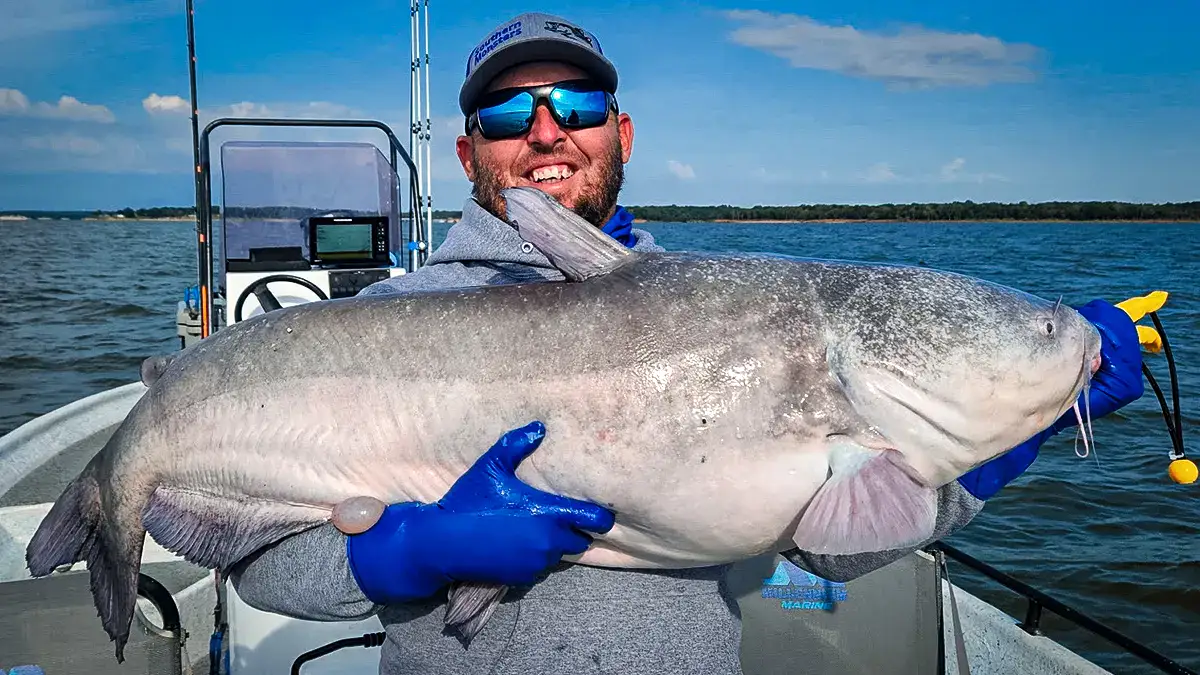
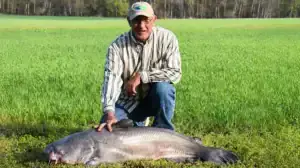
Texoma’s catfishermen still talk about Splash, the 121.5-pound blue cat catch that broke the current world record in 2004.
The fish lived in captivity at the Texas Parks and Wildlife Department’s Heart of the Hill Fisheries Science Center near Kerrville, Texas, for more than a year. Before Splash’s death in 2005, the giant cat had become a popular tourist attraction.
Was that fish unique or are there others like Splash roaming the depths of the huge reservoir? That mystery is why many dedicated cat anglers keep returning to Texoma.
Daniel Armstrong, who runs the Lake Texoma Catfish Guide business, knows there are still some monsters in the lake.
“Every year, our biggest fish of the year will be over 70 pounds,” he said.
That includes two blue cats in the 90-pound range caught by separate clients around Thanksgiving.
“When the water temperature gets below 50 degrees, we’ll start to anchor fish, and that’s when we’ll see our biggest fish,” Armstrong said. “Once the water gets cold, they’ll hunker down on structure, whether it be a river-channel edge, a ledge or what few stumps and brush piles we have.”
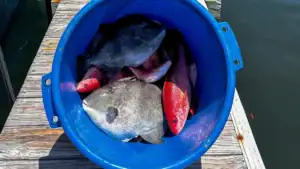
Armstrong likes to use cut bait from rough fish such as carp or buffalo that he catches on lighter tackle around fish-cleaning stations. Then, he anchors and waits.
He guides for catfish from October through April, then he switches to stripers.
Giant Smallmouth Bass
When Lake Texoma was built in the 1940s, most of the basin was clear-cut, removing trees, brush and other cover. But the smallmouth bass still had plenty of good, natural habitat.
Rocky points and banks, bluffs, ledges, and humps still provide the smallies with good structure, and some monstrous fish have been caught. Texas Parks and Wildlife lists a smallmouth weighing 7.06 pounds, caught Jan. 29, 2006, as the lake record. But anglers are convinced there are other line-stretchers still out there.
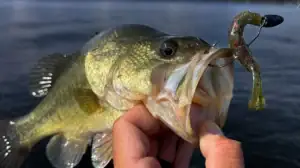
Small jig and pig combinations, plastic crawdad imitations and swimbaits account for a lot of the big smallmouths caught.
The bite is best from late September through November, and during the spring pre-spawn phase. But summer night fishing can be productive as well.
Bottom Line
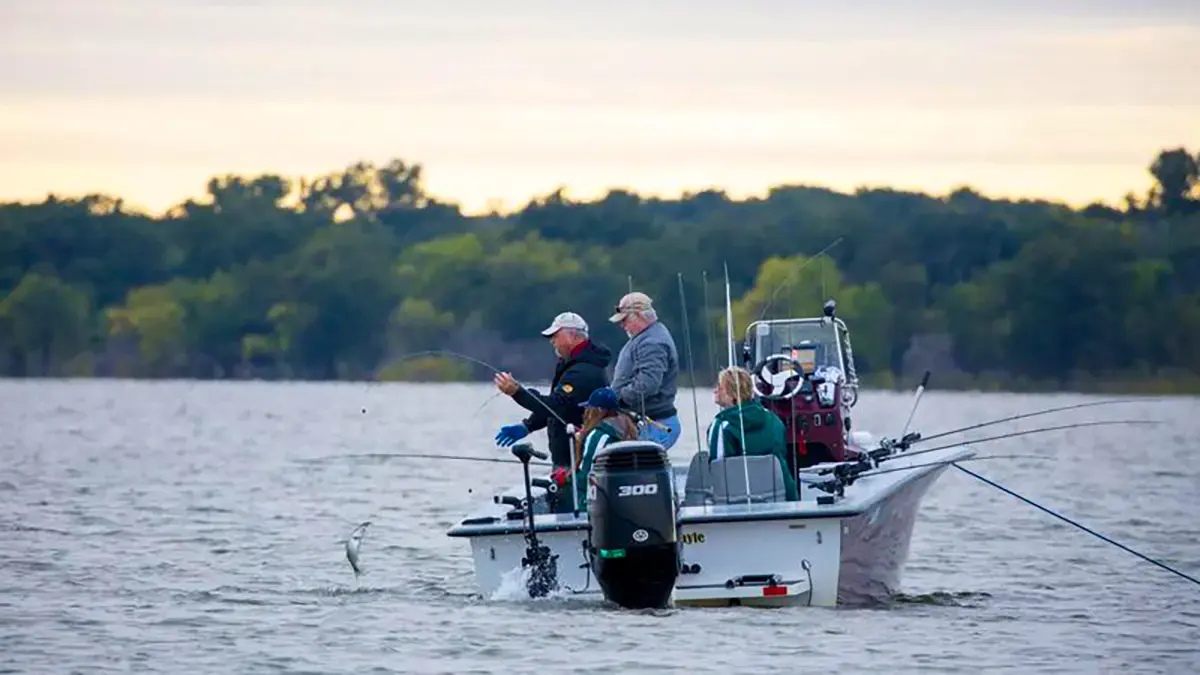
With huge expanses of open water, Texoma can be frustrating to fish. But modern technology can take some of the guesswork out of the equation.
Because of its big schools of roaming baitfish, it’s best to follow the food to the predators eating it.
“Just because you caught them in one place one day doesn’t mean they’ll be there the next,” Mauck said. “They move quite a bit on this lake.
“But generally, if you find the baitfish, the gamefish won’t be far away.”