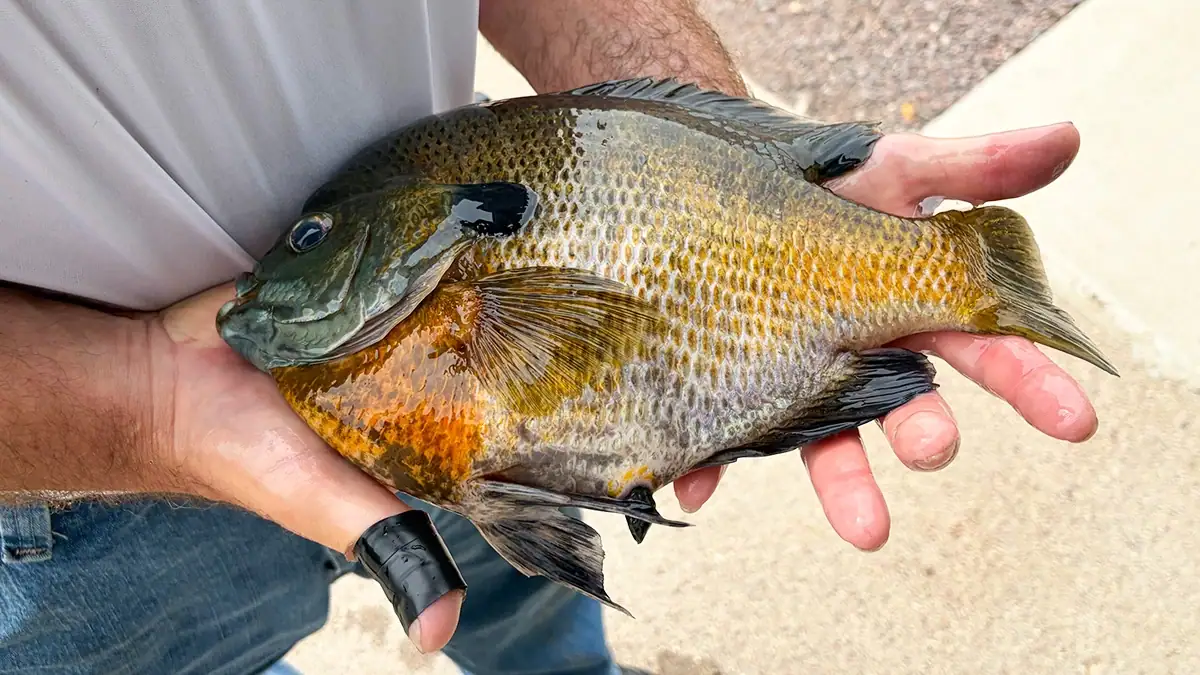
Dale Hoffman is finally enjoying the retired life he always dreamed about.
As a construction worker near his hometown of Ramsey, Minnesota, he was too busy in recent years to even get his boat on the water. But he vowed to change that once he retired.
He even bought a top-of-the line St. Croix spinning rod as a retirement gift. He set out to christen his new purchase on a trip in early July to Big Stone Lake on the Minnesota-South Dakota border.
A Slow Start to an Auspicious First Trip
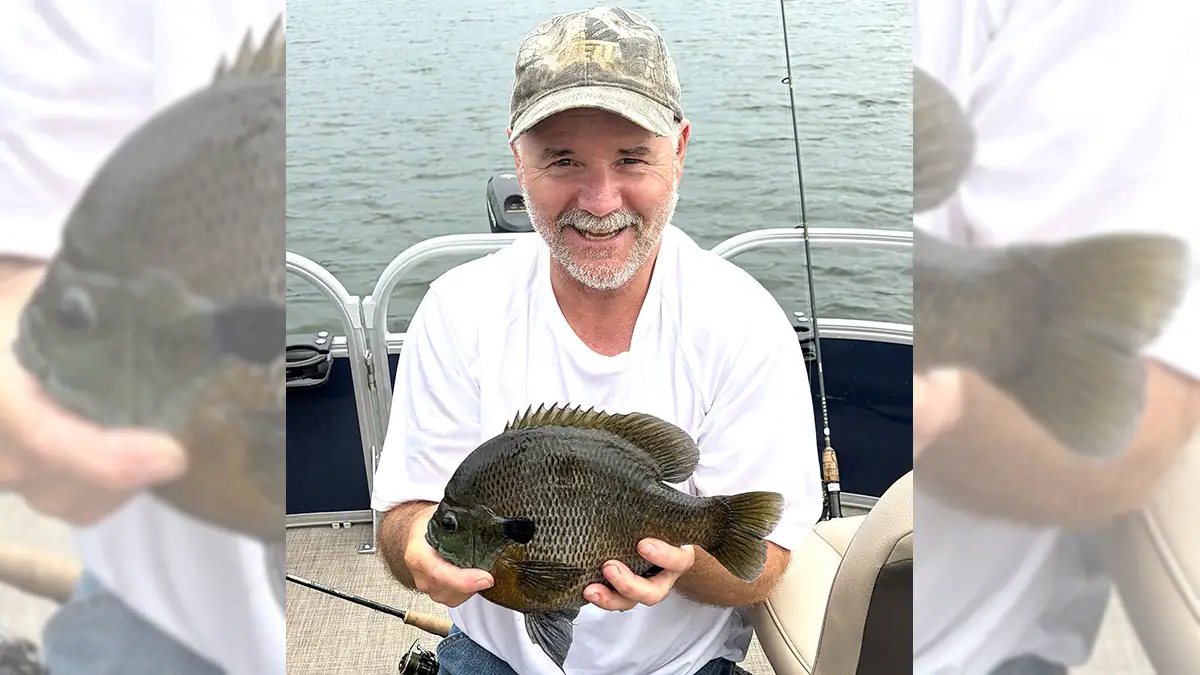
Hoffman joined his sister Annie Hess and Mike Rohling on their pontoon boat. But early results were a bit disappointing.
“Everyone else in the boat was catching nice-sized bluegills,” Hoffman told Wired2fish. “All I could catch were drum. They started calling me ‘The Sheepshead King.’“
But his luck changed dramatically on the trip’s second day. Fishing with a slip bobber, a gold jig, and redworms, he left his rod unattended as he talked to his sister. He heard some clanging and turned to see his prized rod fly out of the boat.
“I could see $300 just flying out of the boat,” said Hoffman, 59.
But he caught it mid-air and soon discovered he had something special. The fish at the end of his line tugged hard, almost like a drum. After he fought it for a few minutes, he was shocked to see a giant bluegill surface.
The anglers then searched for a place with certified scales. A grocery store weighed the 11.6-inch fish at 2.21 pounds. Hoffman then brought the fish to a Minnesota Department of Natural Resources (DNR) office, where it was certified as both a purebred bluegill and a state record.
How’s that for a way to break in a new fishing rod?
Boom Times for Bluegills
It marked the second time within a month and a half that the Minnesota state bluegill record was set at Big Stone. On May 29, Waterville’s Chris Mulcahey set a record when he caught a two-pound fish.
And a day after Hoffman caught his record fish, another two-pound bluegill was caught at Big Stone.
“We’re in a new era right now where big bluegills are pretty common here at Big Stone,” said Artie Arndt, who owns Artie’s Bait and Tackle and the Park Inn by Radisson Hotel on the lake. “It’s definitely quality over quantity at this point.
“We’ve become a national destination for panfish [anglers]. We get a lot of anglers who travel here to try and catch their personal-best bluegill or a fish for the wall.”
So What Makes Big Stone Special?
Twenty years ago, no one was talking about Big Stone Lake’s bluegill fishing. The 12,500-acre, 26-mile-long body of water had some panfish, but nothing special.
The water clarity was poor, with a green tint to it. Besides, it was better suited for species such as walleyes and yellow perch than bluegills.
But that changed in 2015. After an invasion of curly-leaf pondweed, a non-native form of vegetation, and better conservation practices in the watershed, the water cleared up dramatically. And the bluegills responded quickly.
“Big Stone is a very shallow lake,” said BJ Bauer, a fisheries specialist for the Minnesota DNR. “When curly-leaf pondweed showed up, it really became abundant. It created an ideal bluegill habitat.”
A large and diverse food base also helped the bluegills flourish. The result: Fast-growing fish that are developing to impressive sizes.
“Within the last five or six years, we started seeing larger bluegills,” Bauer told Wired2fish. “Right now, we have an abundant size group of nine- to 10-inch bluegills. That’s pretty impressive anywhere you’ll go.”
The Benefit of Big Bluegills
Arndt and other business owners in Ortonville, Minnesota, have benefitted from the revival. Anglers are flocking to Artie’s Bait and Tackle to buy live bait and tackle and to stay at his inn.
Big bluegills can be caught from one end of the lake to the other. Fishermen often concentrate on weed edges and rock piles.
Fish are caught on everything from the traditional worm under a bobber, to slip bobber, drop-shot rigs to small jigs, grubs, and even crankbaits.
Though the bluegills grow quickly, they have a limited lifespan. Minnesota DNR studies have shown that most of the bluegills only last until seven years of age. The good news is that, for the past five years, there have always been good year-classes of bluegills moving up to fill that niche.
Management practices keep the harvest of panfish from getting so high that it adversely affects the population. Minnesota and South Dakota maintain a daily creel of 10 bluegills per day at Big Stone.
Fisheries workers keep close tabs on the health of the bluegill population, conducting annual surveys to determine the species’ abundance, growth rate, and age. So far, biologists are pleased with what they see.
“I wouldn’t be surprised if there are state-record fish still out there,” Bauer said. “I don’t think it’s reached its peak. But really, how much better can it get?”