January is one of the coldest months of the year for us here in the States, and the fishing confirms it. Bass are coldblooded, meaning their activity level is dictated by their environment. In favorable water temps between 55 and 75, they are aggressive and need to feed to support their activity level and metabolism.
When it’s hotter than that, the bite can slow due to the warm water’s strain on the fish. And when it’s colder, the bite all but stops — especially when the water temps dip into the 40s. For many of us from New York all the way deep into Alabama where I’m from, that’s the case in January. You have to slow down to catch them when it gets cold. Here’s how to do it in my neck of the woods and here are a few tips from others across the country.
Ned Rig

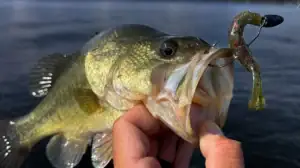
The Ned rig is the ultimate cheat code in January. As long as the water isn’t iced over and you can cast a Ned rig, they’ll bite it. This simple little setup of a short soft plastic bait and a flat topped jighead is perfect for dragging around on the bottom, and it’s surprisingly weedless even when using the standard version with an open hook. If you are fishing around grass or wood, there’s also a weedless version with a weed guard. Baits like Z-Man’s Finesse TRD excel here.
The key to this bait is moving it slow and keeping contact with the bottom. Use the lightest weight you can while still keeping it on the bottom. And try not to set the hook as soon as you feel it bump something. If you can keep your finger off the trigger, you’ll be able to distinguish between bumping into cover and getting a bite, which will prevent a lot of hangups from setting the hook on rock and wood. When you do get a bite, the fish are easy to hook with a pulling hookset.
Shad-Rap-Style Crankbait

There are lots of finesse-style crankbaits that work great in the winter, from flat-sided cranks to round Wiggle-Wart-style wobblers. But the Rapala Shad Rap works exceptionally well in the coldest water.
Countless wintertime bass have been caught on number 5 and number 7 Shad Raps. These baits dive anywhere from 7 and 15 feet, giving the angler a slow moving, tight wiggling presentation that triggers lethargic bass on the bottom. Crawling crankbaits like this across rocky points and even down plain clay banks is a great way to get bit in the winter. And there are some modern baits like this now with weight transfer systems that are much easier to cast, eliminating the main drawbacks of this style bait.
Double Colorado Spinnerbait

If I am going to pick up a power fishing bait in the dead of winter, it’s going to be a double Colorado spinnerbait, such as the BOOYAH Covert Series Double Colorado spinnerbait. Colorado blades not only generate an alluring vibration with their thump, but the resistance of these blades also slows the bait down as it passes through the water column. The result is a tantalizing treat crawling by a big bass’s face; something that’s hard to pass up even in sub-50-degree water. If the water is above 50 degrees, this bait is even more effective. Throw it around any shallow isolated cover you can find like docks, stumps, rocks, laydowns, and brush piles. You’re bound to get bit eventually and it’s liable to be a big one.
Finesse Jig

A finesse jig is the Ned rig’s older brother. It’s been around longer, but the younger sibling gets a lot more of the attention now. Still, a finesse jig, such as Bass Pro Shops XPS Tungsten finesse jig, is a better bait to me when fishing deeper, and especially when fishing in current. A Ned rig that’s heavy enough to stay on bottom in strong current is a Ned rig that’s going to stay hung. A finesse jig, however, can be fished right along the bottom in heavy current and kept out of the cracks and crevices a little better. The more traditional weed guard helps with this, since it’s much stiffer and has more strands than anything you’re likely to see on a Ned rig. Pair a Jewel Baits finesse jig with a craw or Beaver-style trailer and you’re good to go.
Jerkbait

Jerkbaits, such as Rapala PXR Mavrik or Strike King KVD Elite, are unbeatable in certain cold-water situations. If the bass are suspended but relating to bluff walls, bridge pilings, or rip-rap causeways, a jerkbait is about as effective as any other bait on the market. These lures can be twitched through the water column at the perfect depth, paused and restarted without sinking or losing their action, and they come fully loaded with 6 to 9 sticky sharp hook points. There are some general rules of thumb for color selection. If it’s sunny and clear, go with translucent colors. If it’s windy, metallic chromes and golds work well. And then for cloudy situations or stained water try solid colors like bone.
Trey McKinney’s Secrets For Success in Illinois

“This time of year I usually use a jighead with some kind of a rolling minnow; something I can kind of keep in place and work really slow. A rolling minnow is something like the Shindo from 6th Sense. A lot of people know about the 6- and 7-inch ones, but we actually have a 5-incher that we’re working on right now, which is the perfect one in my opinion. It rolls the best. I like to use a natural color because the water clears up a little bit in the winter, where I am anyway.
“Then the second bait I look to in January would be a Provoke 97 from 6th Sense, in a color like matte shad or something else real natural. I like the 97 just because it’s the smallest one. This time of year, when it’s really cold, the little threadfin shad will die off and that’s exactly what you’re representing — kind of a quivering dying shad, something that suspends perfectly.
“A lot of those shad will kind of kick and then just sit there for four or five seconds and then kick again and sit there for four or five seconds, which is the same cadence that I’ve been doing with my jerkbait a lot of times to get those strikes. Some will eat it on the pause, some want it quick, some want it really slow. You kind of have to play with the fish for sure on that side of it.
“My other winter bait would be a 1/4-ounce or 3/8-ounce jig, depending on how deep I’m fishing. I like a smaller jig this time of year, something that I can kind of float. I don’t drag these on the bottom; I’ll just kind of float it along real slow, like off a little rock edge or down some riprap. I’ll just kind of hold the line tight and catch a lot of big ones like that.” — Trey McKinney
Shane Lehew’s Guide to January in North Carolina

“Around the house we’ve been catching quite a few on the Shane’s Baits umbrella rigs. Water temperatures are obviously cooling off pretty quickly. The big key is definitely getting around some baitfish, so I always look for birds this time of year. Anywhere there are seagulls and loons and things like that driving around you’re probably around some baitfish. My umbrella rigs are good year-round but they really shine right now as a lot of bait starts dying off. It’s very versatile because it’s so lightweight so you can kind of get away with throwing it anywhere. I’ve been catching them around docks, ditches, brush piles, rock piles.
“One of my favorite things to throw in the winter is a crankbait. Right now, for me, two different styles have been working the best. The new Berkley Shallow Money Badger has been really good for me lately. It actually has a circuit board lip that’s a little thinner. There’s a pretty tight action on the bait, so perfect for those colder water scenarios. I throw these around boat ramps, chunk rock banks, natural rock banks. This time of year these fish are getting a little lethargic and tighter to cover, so anytime you can knock a Shallow Money Badger off of a piece of cover like that, you typically get some bites.
“If the fish are sitting out a little deeper off the bank, I’ve been using the Berkeley Dime 6. It’s a perfect bait if the water is super clear or you want to hit some rock a little bit deeper off the bank, you know that 8- to 10-foot deep stuff. And, this time of year, the Phantom red crawl is by far my favorite. That’s probably what I’m going to be throwing 99% of the time. Bass eat a lot of shad and a lot of crawdads this time of year, so both of these techniques are really good for the winter months.” — Shane Lehew