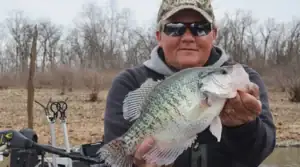
Frank Haidusek looks forward to the winter weather most people dread. Forget the cold temperatures, the snow and the bitter wind chills that hit the plains of Kansas. As long as there is open water, Haidusek is going crappie fishing.
“Winter is one of my favorite times of the year for crappie fishing,” said Haidusek, a guide, tournament fisherman and pro staff member for Bass Pro Shops. “Once the water temperature drops into the 40s, the fish are really grouped up. You can sit in one area and really catch ‘em.”
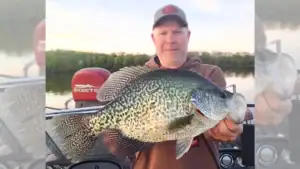
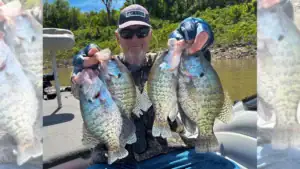
And some big ones, too. During a recent trip on El Dorado Lake, Haidusek hit the mother lode. Guiding his father and a guest who had never fished before, he led the party to seven fish weighing more than 2 pounds apiece.
Haidusek’s dad caught his all-time personal best, a crappie that weighed 2.76 pounds. And his friend from Nigeria, who had just gotten his U.S. citizenship, reeled in one that weighed 2.40 pounds.
For Haidusek, that was just further proof of what can happen in the Kansas chill down season.
“The fish are fat, because they’re actively feeding and starting to form eggs,” said Haidusek, 48, who lives in Newton, Kan., and operates the Cleared Hot Guide Service. “The last time I cleaned fish, I found some crappies that had as many as four shad in their bellies.
“Those fish were full, but they were still feeding.”
Winter In Kansas Is Crappie Time

At Kansas reservoirs such as El Dorado, Cheney, Milford, and Tuttle Creek, it gets cold… but not too cold.
In good years, there is open water for extended periods of time. Even if reservoirs do ice over during a harsh cold spell, they don’t stay that way for long.
While anglers in the North Country are ice fishing for crappies, Haidusek and other Kansans are moving from spot to spot in their boats.
Yes, it can get downright frigid. But if you dress for the weather, wearing everything from layers of clothing, insulated boots and snowmobile helmets for making long runs, the hot fishing can make it worth the discomfort.
That good winter fishing was once a well-kept secret. Veteran anglers recall days when they filled the boat with crappies while having the lake almost to themselves.
But that has changed. Today, dozens of boats dot the water, especially on weekends, at popular reservoirs.
“This type of fishing isn’t for everyone,” Haidusek said. “Your fair-weather fishermen aren’t going to be out on some of these real cold days. But people who are serious about catching crappies will put up with the weather.”
What To Look For
Once the water temperature drops below 50 degrees, it’s game-on for Haidusek. The crappies move out to deeper water and begin to group up as they feed on schools of gizzard shad.
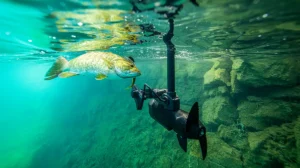
Haidusek uses the electronics on his boat to search for concentrations of fish relating to the flooded timber at El Dorado. He’ll use LiveScope, which shows the real-time movement of fish, to pick out the biggest fish and target them.
Locating the schools of shad is the key. Haidusek often begins his search in the timber not far from the creek or river channels. Others search for isolated brush piles along those channels or merely a dropoff in reservoirs that don’t have much natural cover.
Water depth can vary. Most Kansas fishermen think you have to fish deep, 20 feet-plus, to catch winter crappies. And that’s often the case. But not always. It usually depends on where the shad want to be.
Haidusek even found a large school of fish along the dam at Cheney recently.
“There is a dropoff, and I guess that’s what they were relating to,” Haidusek said. “The fish were stacked five feet deep along the bottom.”
How To Close The Deal

Haidusek likes fishing vertically for the crappies relating to timber. He uses his LiveScope to drop his jigs in front of the larger fish.
Because of the cooler water, the fish often are sluggish, so he avoids much movement.
He will hold his jig motionless in most cases, while his LiveScope shows a crappie just staring at the bait. When the fish doesn’t commit, he often will begin to slowly lift his bait to imitate a shad trying to escape.
But sometimes, it just takes a slight twitch or a jigging motion to get the crappie to bite.
“You don’t want to overdo it, because it won’t look natural in that cold water,” Haidusek said. “But sometimes, just the slightest twitch will do the trick.”
Lure Selection

Haidusek doesn’t use super ultralight equipment when he is trying to catch big winter crappies in Kansas. The water at most reservoirs has some color to it, and that allows him to get away with medium-action spinning gear and heavier line and bigger baits.
“I’ll use 2 to 3-inch baits because that’s how big the shad are by winter time,” Haidusek said.
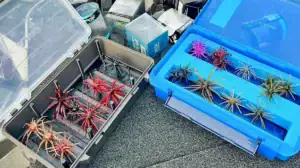
He will use Todd Huckabee and Crappie Nut crappie-specific rods and 12- to 14-pound fluorocarbon line or 25-pound braid made by K-9. He likes to use 1/8 to ¼-ounce hair jigs and plastic baits made by Pro Tuff Baits, a Kansas company, Bass Pro Shops, and Bobby Garland.
He tries to stick to natural colors, but if the fish aren’t interested, he will add some color to his presentation.
“A lot of times, I will go to a pink jig head with a bait that is a monkey milk type color with green flakes in it,” he said.
The Progression
Haidusek has been out on days when he had to drive his boat through a thin layer of ice to get where he was headed.
After the ice becomes too thick to launch a boat, some fishermen like to ice fish. Not Haidusek. He would just as soon wait for the reservoirs to thaw out.
Once there is open water, he is out there again. The good winter bite will last into February in some years.
I’ve been out on some nasty days,” he said. “But as long as the wind’s not blowing and there’s some sun, it’s not bad, especially when the crappies are biting.”