Ask Justin Nguyen for some South Florida advice and he’ll suggest Mama Cici. That might sound like a Latin eatery with mouthwatering ropa vieja and crispy pastelitos de guayaba, but it’s something very different.
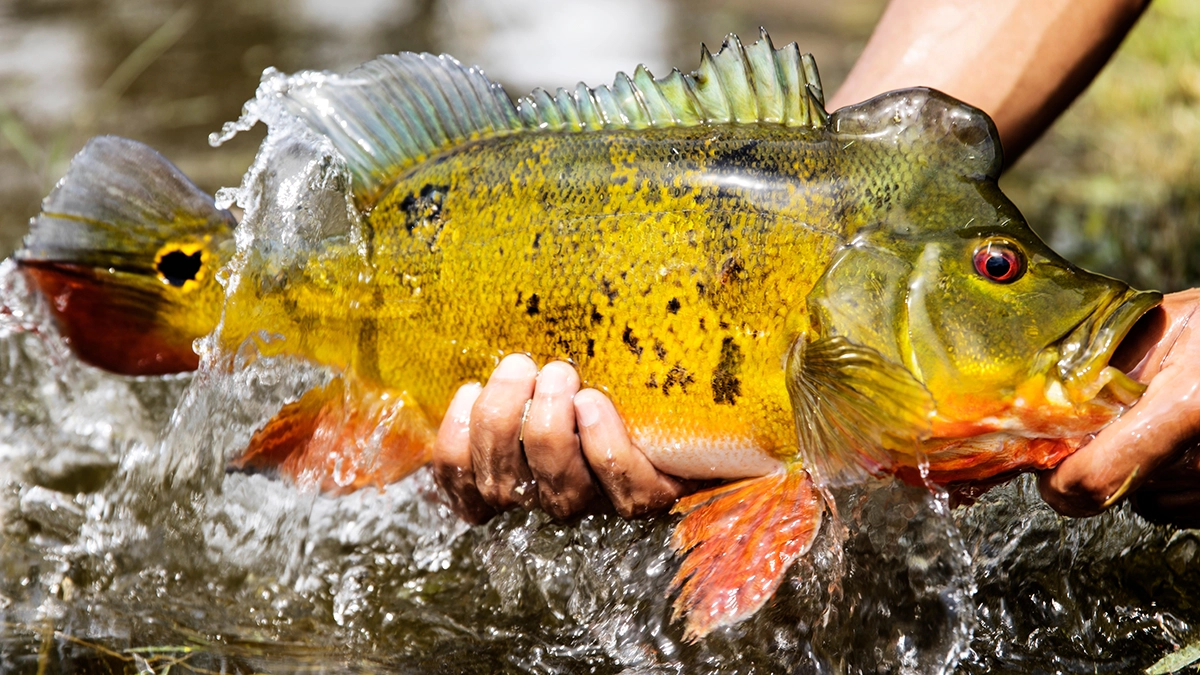
It’s a nod to history with modern relevance. Some find Mama Cici the connection to one of the state’s most pulse-pounding predators, the butterfly peacock bass. Mama Cici is Nguyen’s personal creation; a fly with orange, blue and red to resemble the juvenile Mayan Cichlids that rank high on the forage menu served daily in the labyrinth of natural and manmade waterways spread across the Sunshine State’s lower end.
“The peacocks like eating the juvenile Mayan cichlids and this fly resembles those fish,” Nguyen said.
Fly fishing is just one of the ways to tempt peacock bass, but let’s pause for a moment to tighten the relationship between the brilliantly colored fish that Nguyen calls “smallmouth bass on steroids,” (a reference to the brown beasts he used to chase during his Great Lakes guiding days), and a gang of invaders to which Mayan cichlids belong.
The Florida Peacock Bass Backstory

For several decades (as far back as the 1950s), non-native species of largely South and Central American origin have been thriving throughout South Florida waterways. Along with Mayans, you’ll find spotted tilapia, jeweled cichlids, Oscars, brown hoplo catfish, bullseye snakeheads, and clown knifefish.
Most entered the waterways via illegal dumping — typically exotic fish aquariums. The explosion of highly aggressive and prolific species has disrupted native fish populations through direct predation (eggs and juveniles), as well as competition for feeding and reproductive areas.
Native predators including largemouth bass and gar quickly developed a taste for the “exotics,” but they could not keep up with the numbers. To help combat the invasives, the state introduced peacocks to local waters in the early 1980s as a biological control agent. Already genetically programmed to prey on the species considered non-native to Florida, these aggressive predators have provided the expected assistance, while creating a vibrant sport-fishing opportunity.
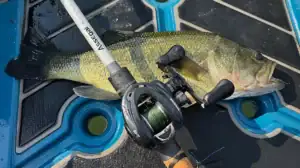
“These are beautiful fish that jump and fight hard,” Nguyen said. “Peacock bass are one of Florida’s top freshwater fishing species and you don’t have to go all the way to South America to catch them.”
Where to Find Peacock Bass in Florida

Calling late February through late May his busy season, Nguyen said it’s entirely possible to catch South Florida peacocks year-round. Most anglers can regularly find peacock bass south of Palm Beach County (Atlantic Coast) and Naples (Gulf Coast). Florida’s brief period of true winter conditions are tough on a species with tropical DNA, so the colder periods call for slower and deeper presentations. Plus, a hard freeze might kill off peacocks that have ventured too far upstate.
Peacocks like their cover and favor ambush spots, so Nguyen focuses on points, feeder creeks coming to a main canal, grass edges, and bridges. As he notes, a lot of the bridges along Alligator Alley (I-75) have rocks beneath that offer prime peacock positions.
“They like to hold along deep banks, near structure,” Nguyen said. “If a school of baitfish comes by, they’ll [rush] out and slam it. A largemouth will come out into the middle of a canal to chase a meal, but a peacock, not as much. So it’s better to stay closer to the bank.”
What Peacock Bass Like to Eat

Along with flies, Nguyen often throws Rapala jerkbaits for peacocks. A great baitfish imitator, this one’s highly adaptable to weather conditions and fish mood. Start with a twitch-twitch-pause cadence and adjust as needed.
If fish are following and not committing, you probably need to increase your retrieve speed. If the peacocks are just running out to look, but showing no serious interest, you might be moving too fast. The same logic goes for flies, Nguyen said.
“Most of the time, they like it fast,” Nguyen said. “When the water is clear, all you see is a yellow flash and boom! You’re on.”
Walking topwaters like the Heddon Spook Jr. often deliver unbelievably violent strikes, but on the opposite end of the spectrum, Nguyen puts many of his clients on stout peacocks with 1/16-ounce crappie hair jigs, or bare jig heads with small rubber tails.
“If someone has trouble working a jerkbait, jigs are a little easier,” Nguyen said. “Cast close to the grass edge, let it sink, reel down on your slack and jig the lure. Or you can work it like a fly with the rod tip down. With a jig, you’re more accurate. You can hit your target easier.”
The Real Thing
Live shiners also tempt peacock bass, but Nguyen offers key advice for what he believes to be the most effective presentation. First off, running a size 4 wide gap or circle hook though the bait’s lips keeps it frisky longer.
“Shiners don’t last too long in the summer, but they last longer in the fall and winter because the water’s cooler,” Nguyen said. “I free line my shiners on 10- to 15-pound braid with a 20-pound fluorocarbon leader.
“Cast it out, leave a little slack and let it swim around. A lot of anglers use bobbers, but I like freelining because it makes the bait look natural. I want the peacocks to come out and chase it. With a bobber sometimes your bait’s not swimming around too much.”
No Bullying Necessary

At the moment of truth, Nguyen advises a firm, but patient fighting technique. Keep a good bend in the rod, but don’t try to bully the fish.
“Once the rod bends, don’t yank on it,” Nguyen said. “The big mistake I see people make is once they get the rod bent, they start pulling back more. Just let the fish run, let him do his thing and let the rod do the work.”
“I want my anglers to enjoy the fights but don’t fight him too long. Some people eat peacock bass, but there are many other fish, like Mayan cichlids and tilapia, that are better.”
Bottom line, peacocks may not be able to claim original Floridian status, but they have unquestionably become one of the state’s top freshwater attractions. Fight the good fight, enjoy the photo moment and watch that beautiful fish swim off to fight another day.