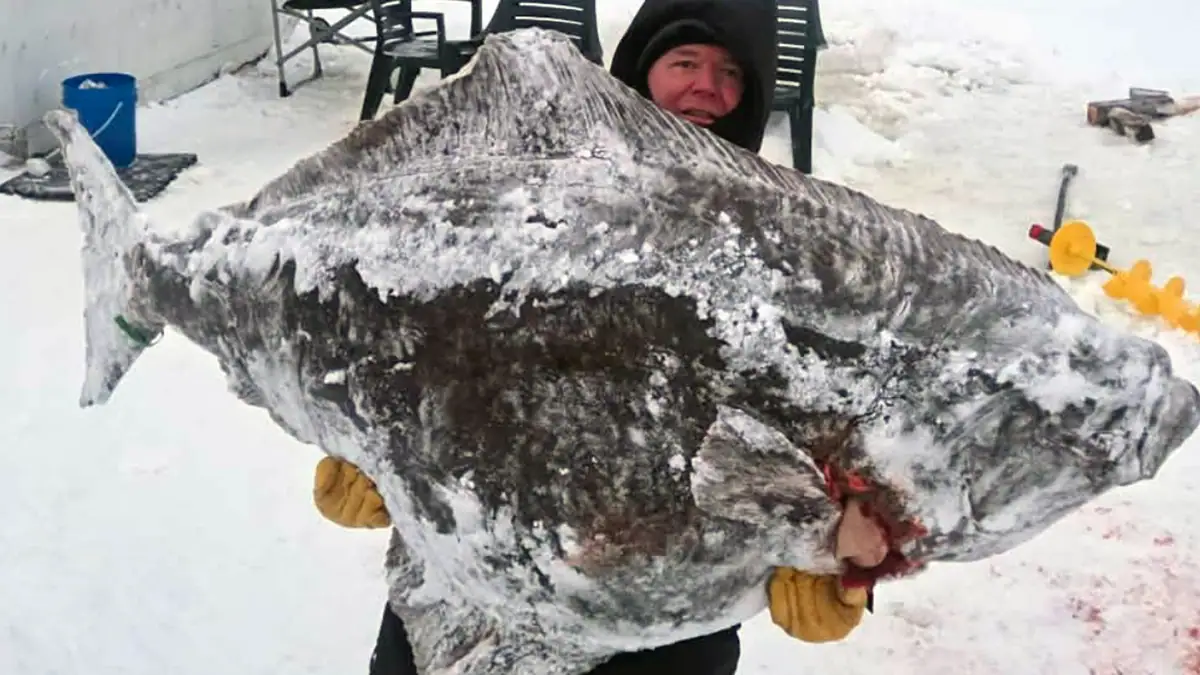
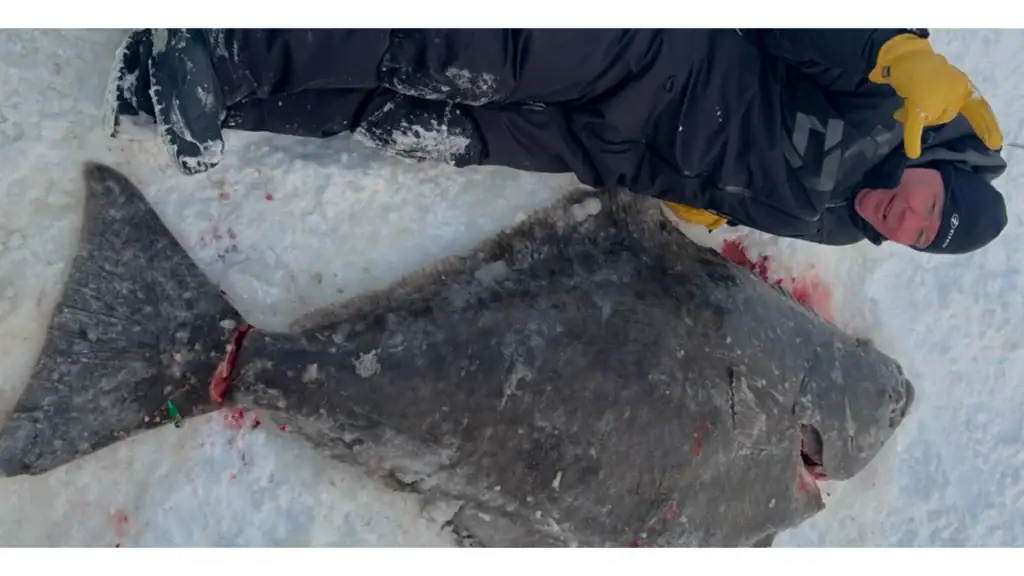
An angler in Canada landed a massive “barn door” — a 244-pound halibut — while ice fishing in early February, all in the name of scientific research. The catch was a regional record. Alain Hamel, who lives in the eastern province of Quebec, caught the big halibut in the Saguenay Fjord in 600 feet of water. The fjord drains into the Saint Lawrence Seaway.
Halibut fishing is prohibited in the fjord, but Hamel was taking part in a special permit project started by a local museum in 2022, according to Marc-Andre Galbrand, CEO of an environmental group called Contact Nature. The organization is one of two museum partners in the research study. Galbrand described Hamel’s catch as “amazing” and “really a cool thing.”
Pulling a huge flat halibut through the ice is no easy task, he said, describing another angler the day after the record catch who lost a halibut right near the surface after a six-hour fight.
Hamel’s battle lasted almost three hours before he pulled it through the ice with the help of some other anglers with whom he was targeting halibut. Since the fish was so big, once it was close to the ice hole, others had to use hooks to grab it and carefully extract it, being cautious about its sharp teeth. The fish was then given to biologists at the Fjord Museum.
What Happened to the Halibut?
Museum staffers cut off the head and emptied the stomach of the 6-foot, 9-inch halibut. Those parts will be used for research about the halibut species in the region. For example, the bones in a halibut’s head can indicate migration patterns as well as yield information about where the fish are born and their diet.
Hamel was able to hold the fish completely off the ground for a photo. “Here in Saguenay we are strong men and women,” Galbrand laughed.
An estimated 170 pounds of tasty halibut meat was left for the angler and other members of the museum’s fishing team. Hamel’s halibut surpassed a record of 194 pounds set by another member of the fishing team last year.
Halibut on the Rebound
Recreational fishing for halibut stopped in the fjord in 1998 because of declining populations, but increasing numbers inadvertently being caught on the fjord prompted the start of the research project in 2022. The goal is to get better data on the size and health of the local population.
“Our goal is to see if the population is of good enough health to eventually reopen recreational fishing in a sustainable dynamic,” Galbrand explained in a YouTube video posted by a Canadian television station.
One thousand anglers have halibut permits as part of the project. “I think it’s a nice way to make science more accessible for people,” said Galbrand.
Commercial fishermen in nearby areas like the Saint Lawrence Seaway sometimes catch halibut up to 400 pounds, but in the scientific study underway with recreational anglers like Hamel, the average is between 80 and 150 pounds, said Galbrand.
“So for us 244 pounds is quite impressive,” he said.
The IGFA record for the largest Atlantic halibut caught on rod and reel was just under 419 pounds by Thomas Nielsen in Norway in 2004.
About Halibut Research in Canada
The halibut research program at the Musée du Fjord (Fjord Museum) in Saguenay, Quebec, is officially known as the Atlantic Halibut Winter Fishing Project for Scientific Purposes. It is a unique collaborative effort between the museum, the Comité de bassin de la baie des Ha! Ha! (CBBH), and Fisheries and Oceans Canada (DFO). The project is currently in its fifth year (as of winter 2026) and has gained significant international attention recently due to record-breaking catches.
The Project is a unique collaboration between the museum, local organizers, and federal scientists to study an isolated halibut population in the Saguenay Fjord. Operating under a strict scientific permit, the program enlists experienced ice anglers to catch these deep-water giants while the museum’s biologists analyze vital biological data. Researchers focus on examining stomach contents and ear bones to track growth rates and migration patterns that were previously a mystery.
This research is only possible because the fjord’s dual-layer water system allows fishers to stand on solid ice while reaching the salty, cold depths where halibut thrive. By trading scientific samples for high-quality meat, this partnership ensures that both the local community and the scientific world gain a better understanding of the species.