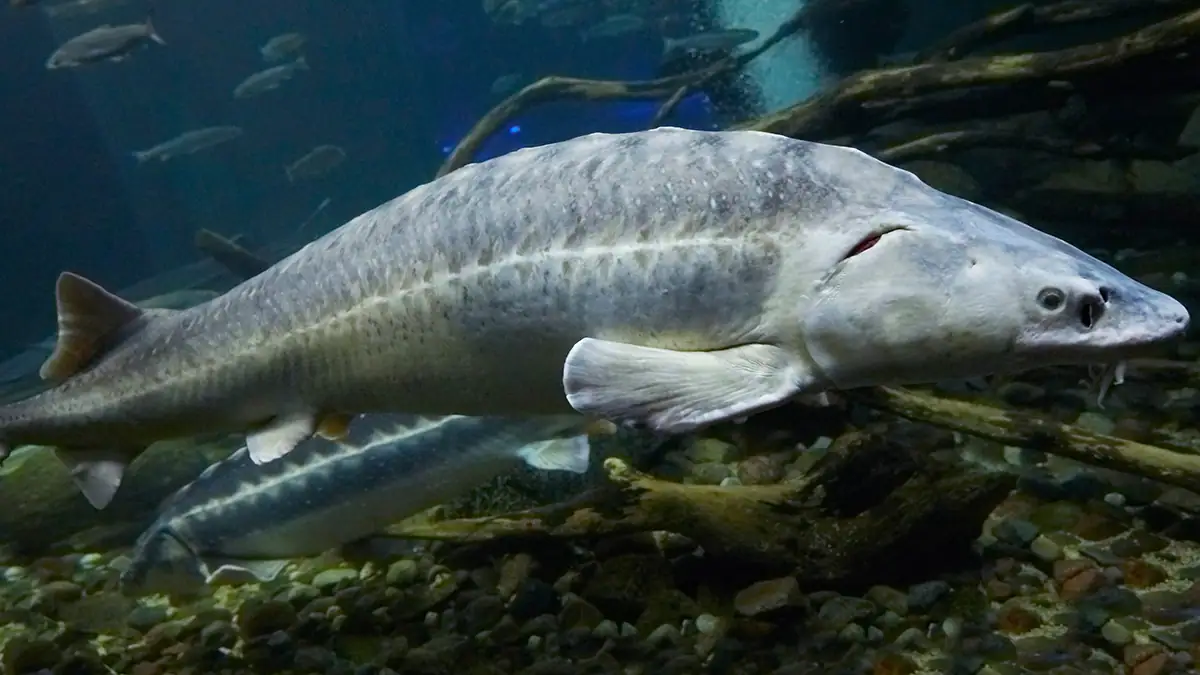
Sturgeon somehow look ancient, and well they should: Often deemed “living fossils,” theirs is an evolutionary lineage more than 200 million years old. The ancient family Acipenseridae has changed little since the Jurassic period per fossil records, with a mostly cartilaginous skeleton similar to sharks and rays, with a covering of bony armor.
Their unique appearance as well as valued flesh and roe (for caviar) has made them of interest to sport fishermen as long as people have been fishing. Some species seldom grow to more than a few pounds, while others such as the mighty beluga, grow to nearly 3,500 pounds or more. Of 27 species of sturgeon found worldwide, the five species listed here have been submitted to the IGFA for world-record status. Of these five, all but one are found in North America. These days they’re highly regulated in North America, with many species illegal to keep or even target thanks to threatened or endangered classification from widespread overfishing, slow growth and habitat destruction (dams obstructing migrations, water quality).
Still, it’s widely legal to catch and release sturgeon, but for most species, existing IGFA all-tackle world records are perpetual unless long-standing regulations change to allow keeping large specimens. So the trophy fish listed here — the biggest sturgeon caught for these species — appear to be etched in stone. That makes the anglers who caught them “safe” from being challenged by larger entries, but then, some of these record catches wouldn’t be easily defeated in any case.
Sturgeon battle hard, and many species leap clear of the water when hooked — or when not hooked — often free jumping as when a large sturgeon in Florida’s Suwannee River suddenly erupted near a small boat, falling back into it to land upon and kill a five-year-old girl.
Beluga Sturgeon (Huso huso)
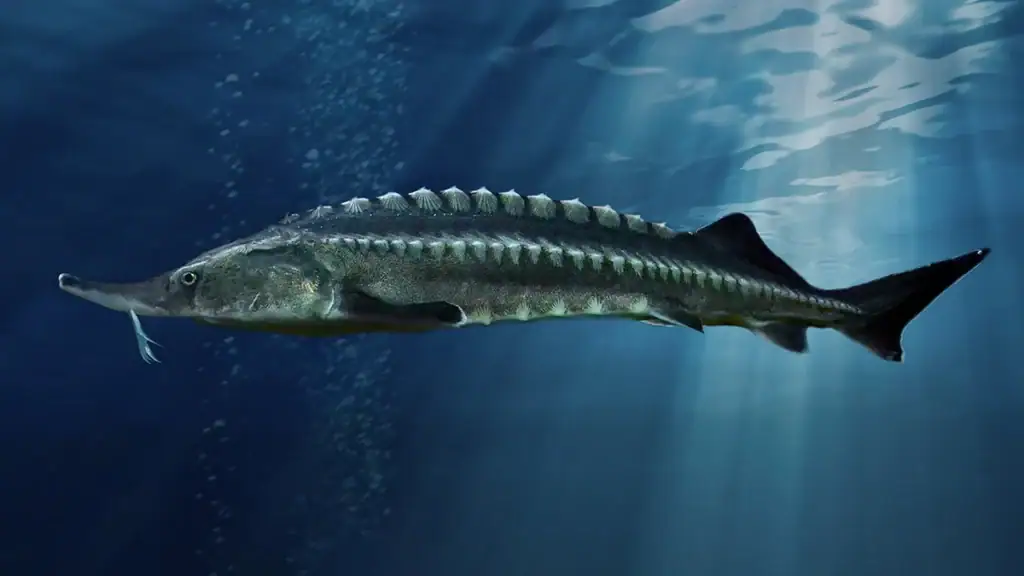
- All-Tackle world record: 224 pounds, 13 ounces; 96.5 inches
- Where: Guryev, Kazakhstan
- When: May 3, 1993
- Who: Ms. Merete Hehne
- How: 20-pound line, using an asp fillet
While 224 pounds is no small catch, it is in truth small for this species. The beluga is not only the biggest sturgeon species but the largest freshwater fish in the world, the biggest documented beluga weighing 3,463 pounds and taping out at 23 feet, 7 inches. That dates all the way back to 1827; such giants today are nonexistent. Most caught in recent years have been far smaller with many never reaching spawning size before their harvest (belugas don’t even begin to spawn until age 20 to 25). Such harvest is now almost universally illegal with the species considered threatened or even critically endangered. Yet widespread poaching reportedly continues to illegally remove half the mature belugas from the Caspian Sea (also found in the Black and Adriatic seas) and Volga River each year. Like all-tackle records for most species of sturgeon, clearly Ms. Hehne’s record of 30-plus years can’t be legally beaten (lifting a beluga from the water by any means to weigh it would be illegal), so it will stand.
Lake Sturgeon (Acipenser fulvescens)
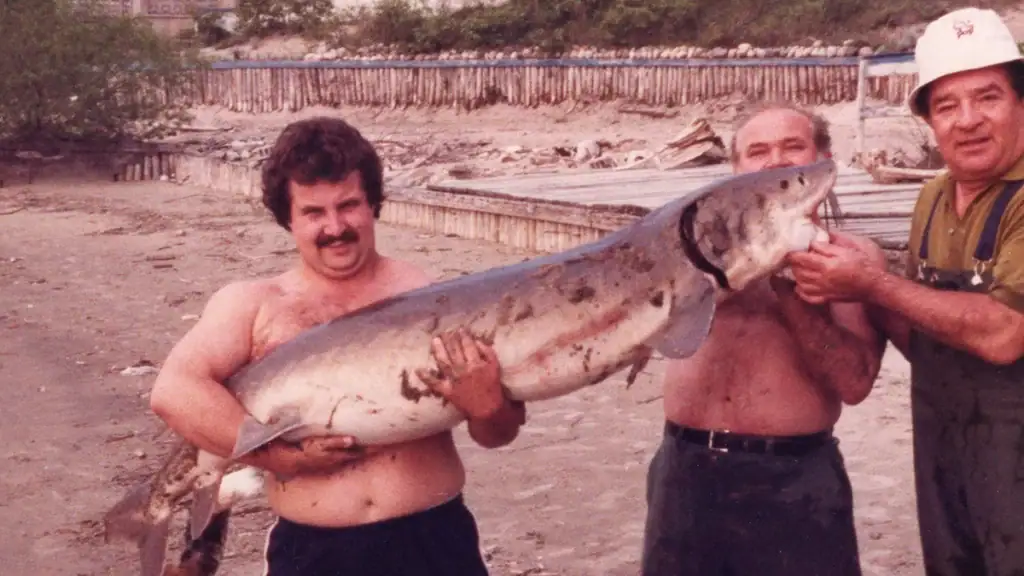
- All-Tackle world record: 168 pounds; 69 inches
- Where: Georgian Bay, Ontario, Canada
- When: May 29, 1982
- Who: Edward Paszkowski
- How: 12-pound line, casting a Mepps Algia #3 spinner
Were it legal to keep large lake sturgeon, this all-tackle record probably wouldn’t have lasted 43 years: The species is known to reach up to 300 pounds and 7 feet. Currently 19 of 20 states where lake sturgeon are found — primarily in large river drainages and lakes in eastern North America — list it as threatened or endangered, thanks to habitat degradation and overfishing. One historical report says of lake sturgeon, in 1860, “this species, taken as incidental catches, was killed and dumped back in the lake; piled up on shore to dry and be burned; fed to pigs; or [left to be] fertilizer.” They were at times stacked like cordwood and used to fuel steamboats. Over 5 million pounds were taken from Lake Erie in a single year. The fishery collapsed by 1900 and has never recovered, though protections and restocking have bolstered existing populations, and a very limited fishery exists in parts of Minnesota, Wisconsin and Minnesota.
Shortnose Sturgeon (Acipenser brevirostrum)
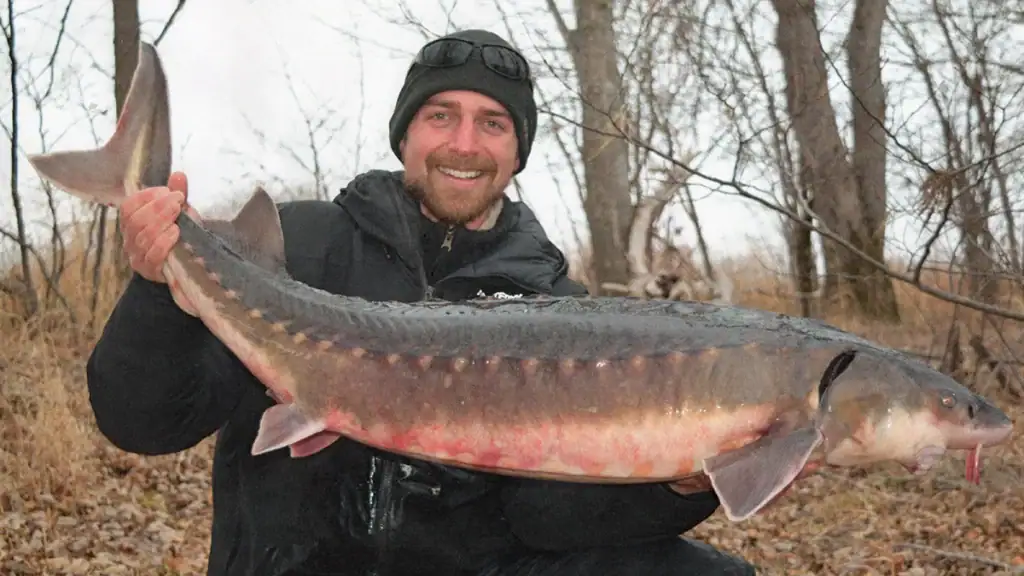
- All-Tackle world record: 33 pounds; 47.2 inches
- Where: St. John River, New Brunswick, Canada
- When: November 24, 2019
- Who: Samuel N. Andrews
- How: 30-pound line, fishing an earthworm
One of the smallest sturgeons in North America (only the shovelnose is smaller). Found from New Brunswick, Canada, south to the St. Johns River in Florida. Considered an anadromous species, shortnose hatch in the fresh water of rivers well upstream of the coast, but adults mainly inhabit estuarine waters of large Atlantic Seaboard rivers. The shortnose is another sturgeon federally designated in the U.S. as an endangered species, ending harvest in the U.S., but bycatch in some commercial gillnet fisheries remains an issue. The species continues to be threatened by dams on rivers preventing adult fish from reaching historic spawning areas. In both the U.S. and Canada, keeping shortnose sturgeon is not permitted.
Shovelnose Sturgeon (Scaphirhynchus platorynchus)
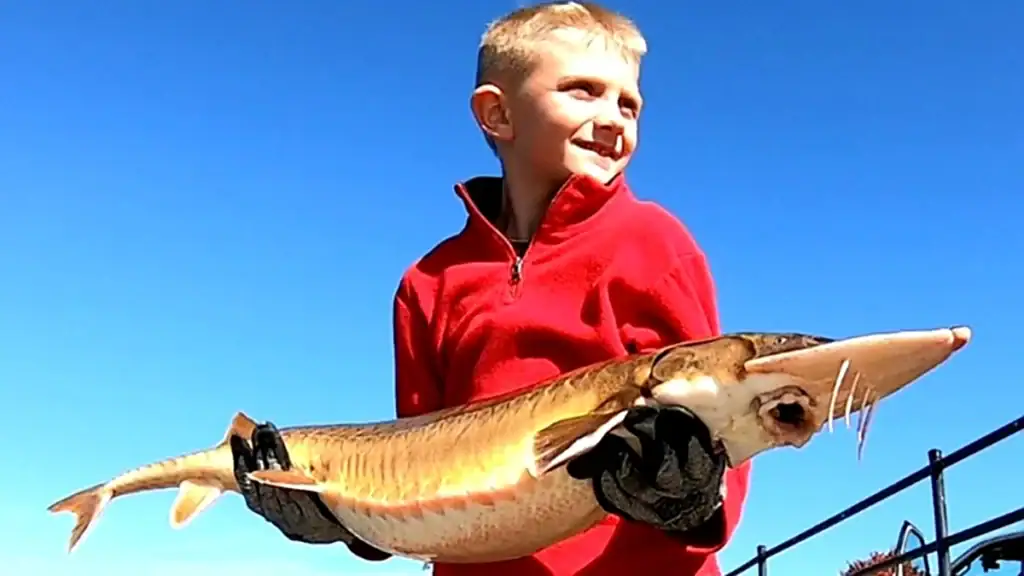
- All-Tackle world record: 11 pounds, 13 ounces; 36.25 inches
- Where: Rock River, Illinois
- When: Oct 21, 2022
- Who: Kashten Gustafson
- How: 30-pound line, on a nightcrawler
Named for its flattened, somewhat upturned shovel-shaped snout, the diminutive species is typically no more than five or six pounds. Found primarily in the Mississippi and Missouri River systems, where it’s widely called hackleback. (This author recalls fondly feasting often upon delicious hacklebacks as a youth in western Illinois, buying whole fish turned golden brown from smoking.) They prefer open, flowing channels of larger rivers with sandy or gravelly bottoms. At one time, as much as 25 tons of shovelnose were harvested annually. Their listing as threatened under the Endangered Species Act is mostly due to their similarity to the endangered pallid sturgeon. However, limited recreational-fishing seasons allow anglers some opportunities to target and retain shovelnose.
White Sturgeon (Acipenser transmontanus)
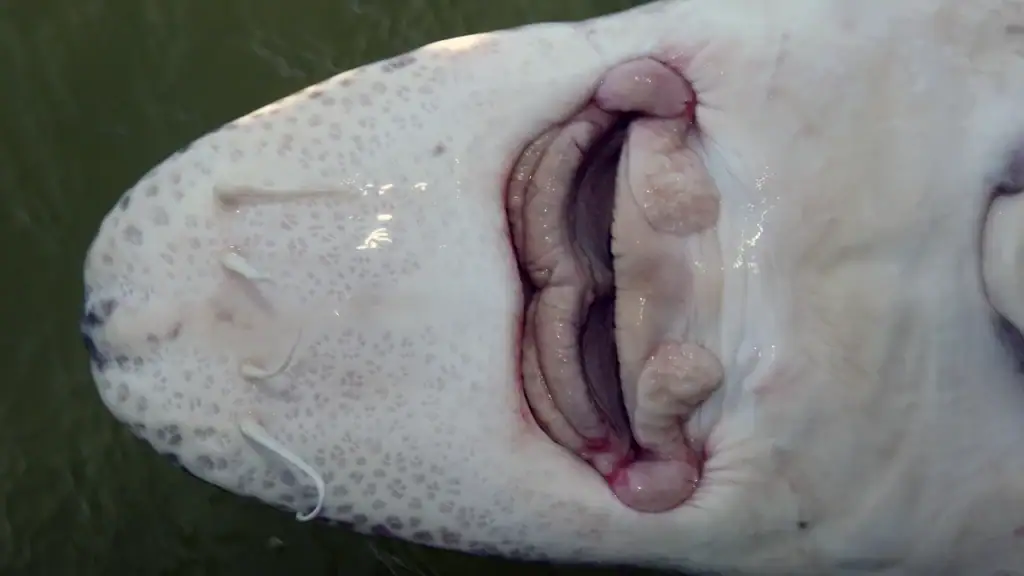
- All-Tackle world record: 468 pounds; 102 inches
- Where: Benicia, California
- When: July 9, 1983
- Who: Joey Pallotta III
- 60-pound line, caught on shrimp
The largest North American sturgeon, the white — found along the Eastern Pacific from Alaska to northern Mexico — has been documented at 1,390 pounds, with reports to 1,800 pounds. The anadromous species prefers deep estuaries of large rivers, but spawns farther up rivers (in cases where dams don’t limit access). Sport fishing is tightly regulated, widely with slot limits (assuring this world record will live on). Well up in some rivers (landlocked, again thanks to dams), white sturgeon populations thrive, such as the Columbia and Snake rivers in Washington and Oregon, where sport fishing is seasonally popular, and notably in southern British Columbia’s Fraser River. There, a well-known catch/release sport fishery brings in anglers from all over to catch massive whites, such as Kevin Estrada’s 2012 catch of an 11 ½-footer estimated at 900 pounds.