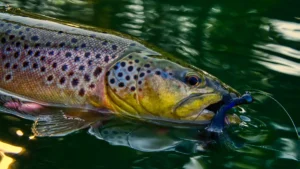
For 16 years, a female muskie known to scientists as “Fish 691” lived as a ghost in the non-tidal Potomac River. Despite residing in one of the most heavily fished stretches of the river and being tracked by biologists for over a decade, she had never once been fooled by an angler’s lure—until now.
In January, Clear Spring, Maryland, resident Garrett Davis ended the fish’s 16-year winning streak. Davis landed the trophy muskie, recorded her tag information, and snapped a few photos before releasing her back into the river, providing the Maryland Department of Natural Resources (DNR) with the final chapter of a decade-long biography.
“I was very fortunate to catch her,” Davis said. “And, it was awesome to hear the story behind her.”
The Magic of Muskellunge
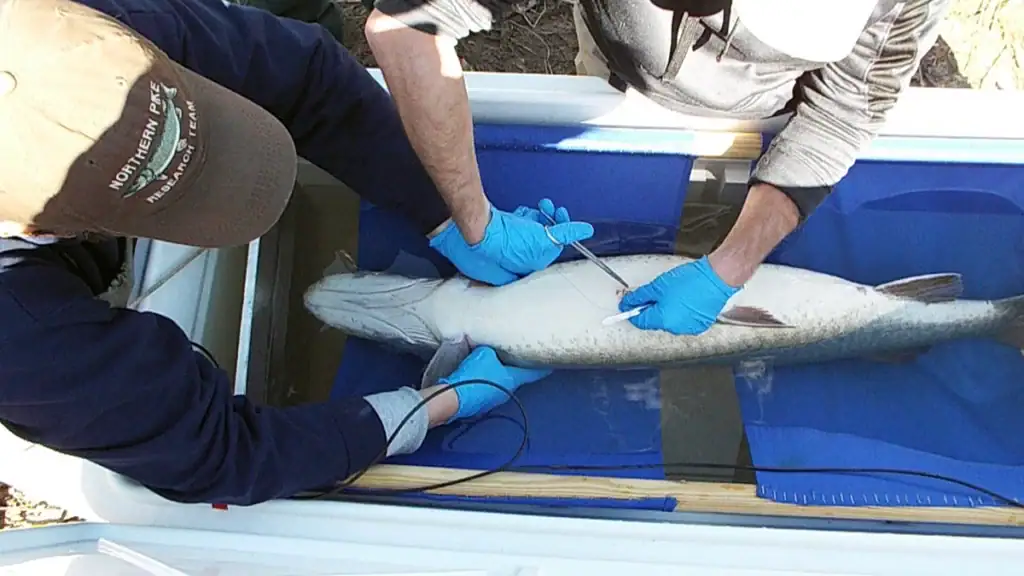
Even though Fish 691 was a stranger to anglers, she was a frequent subject for Maryland DNR biologists. Her recorded history began in March 2013 when she was first captured as a 30-inch juvenile and fitted with an identification tag. Over the subsequent years, she was recaptured by scientists during routine surveys in 2015, 2017 and 2021.
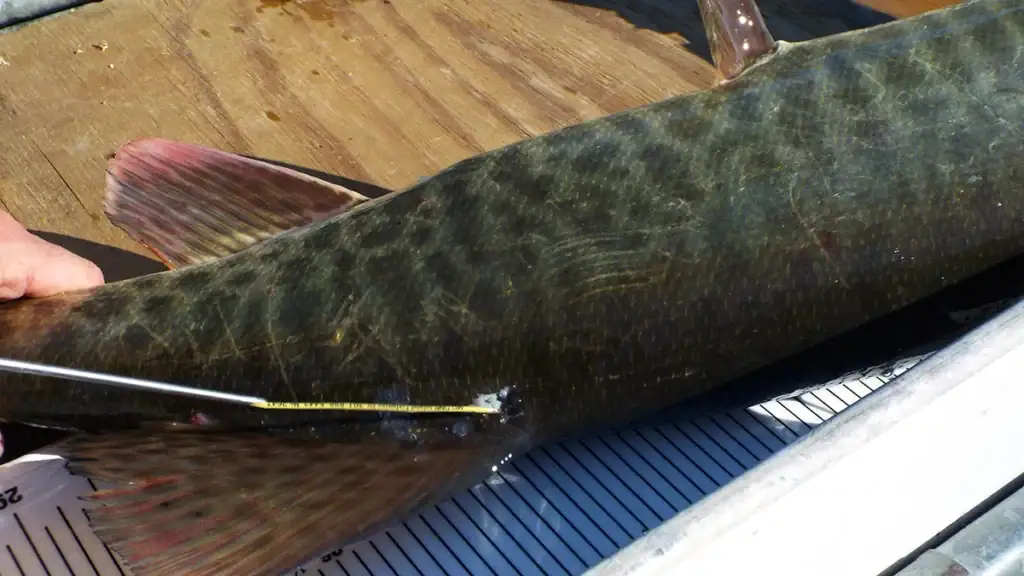
During these encounters, biologists aged her using fin ray cross-sections and surgically implanted radio transmitters to monitor her movements. By her last scientific check-in, she had grown to nearly 44 inches and weighed over 20 pounds, establishing herself as a dominant force in her local waters.
The radio-telemetry research, supported by grants from Muskies Inc., provided a rare window into the secret life of this apex predator. By tracking Fish 691’s unique radio frequency weekly throughout 2021, biologists confirmed that she was remarkably sedentary, maintaining a very small home range within a single river pool.
This data helped researchers understand how muskies navigate the Potomac’s unique challenges, such as summer water temperatures that can push the limits of their survival. Her consistent presence in one specific area for over a decade makes her ability to avoid every lure and bait thrown by local anglers all the more impressive.
An Important Fish
Beyond her hefty size, Fish 691 became a vital data point in understanding the resilience of riverine muskies in the southern part of their range. Her life story is proof of the species’ ability to endure a harsh environment defined by ice jams, severe droughts, and high-pressure fishing. The fact that she was never reported by an angler until she was 16 years old underscores the “fish of 10,000 casts” reputation, proving that even in a river with an estimated 7 to 11 adult muskies per mile, a single fish can remain a ghost for a lifetime.
This catch also highlights the critical partnership between Maryland’s angling community and state biologists. Since the late 1990s, the DNR has relied on a voluntary creel diary and the reporting of external dart tags to monitor the health of the fishery. While nearly half of the 1,011 tagged muskies in the Potomac have been caught at least once, Fish 691’s story is a statistical rarity. Reaching a fourth recapture—and doing so at the ripe age of 16—is a feat shared by fewer than a handful of fish in the program’s history.
Maryland manages the non-tidal Potomac as its only “true” muskie population—a self-sustaining fishery that relies on careful conservation. The DNR credits the survival of mature fish to the ethics of local anglers and continues to urge the public to avoid targeting the species when water temperatures exceed 80 degrees. This simple precaution ensures that sensitive populations can continue to reproduce naturally, allowing legends like Fish 691 to thrive in the heart of the Potomac.