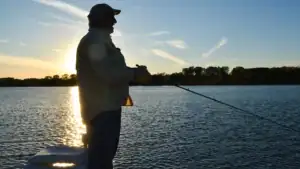
Running at 40 MPH into a 10-knot wind on a cloudy 44-degree December morning is not what this former Florida boy is used to. Our guide Joseph Clark asked me and my buddy Bruce whether we wanted him to slow down to throw on another jacket.
“I’m good,” I lied. “Except I wish I had a ski mask!” The flimsy Buff wasn’t doing much.
“I’m already wearing everything I brought,” laughed Bruce.
“We’re not running much farther, I see a few seagulls up ahead,” Clark said. He peered through binoculars as we entered a dock-lined finger of the lake. “We hooked up near here yesterday,” he added. “And the stripers were mixed in with spotted bass under the threadfins (shad).”
Fishing With Joseph Clark
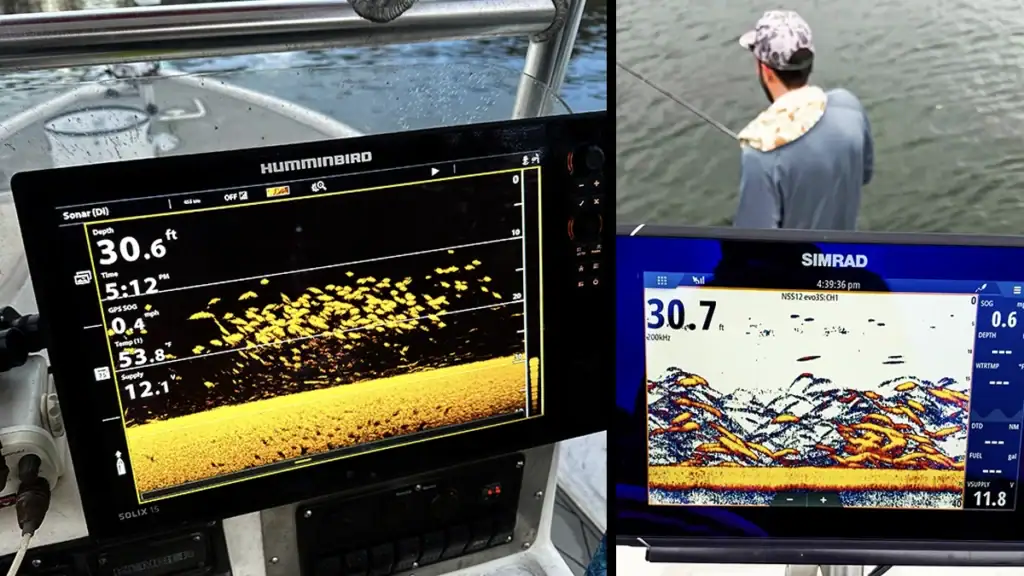
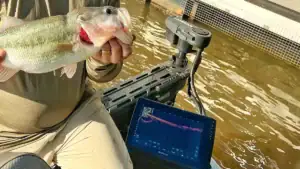
Coming off the plane, Clark pointed out bait schools on his Humminbird sonar. He also noted the signature blips that were a mix of stripers and spotted bass. Up ahead, about a dozen ring-billed gulls hovered and dipped, with the occasional tail slap of a feeding fish. I’ve fished a number of times for stripers on the Northeast U.S. coast where gulls and terns showed us the fish. But here? Pretty unique, and exciting.
We armed ourselves with 8-weight flyrods, spooled with intermediate sinking lines. Clark gave a terrific Lake Lanier striper presentation at my local Trout Unlimited chapter in Blairesville, Georgia, earlier in the year. He showed us a Clouser Minnow pattern that mentor and fly guide Henry Cowen (author of Fly Fishing for Freshwater Striped Bass) tweaked and coined the “Somethin’ Else” that imitates the threadfin shad that stripers forage on in Lanier. Its fluorescent pink throat makes it stand out in baitfish schools.
Our group came rigged with them. Upon boarding Clark’s bayboat, however, he quickly snipped them off our leaders. He then swapped them for a juvenile threadfin pattern barely an inch-and-a-half long.
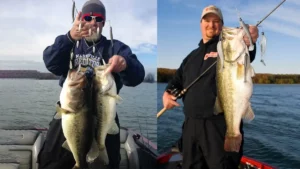
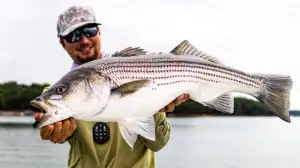
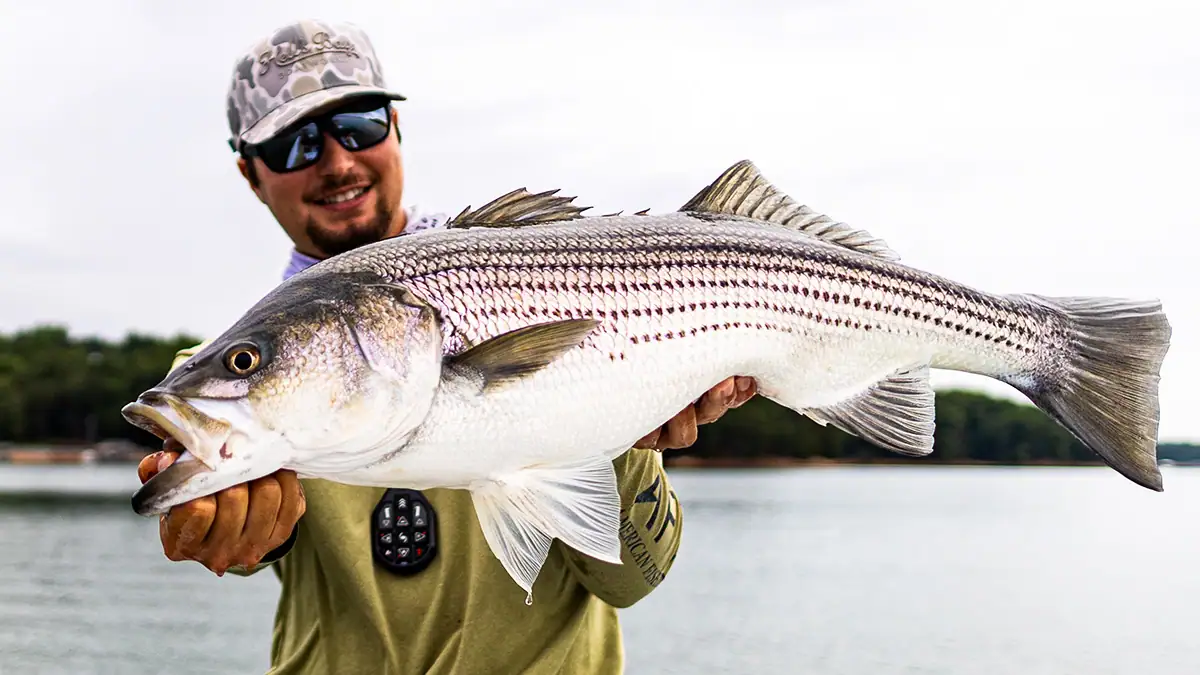
“They have been on some really little shad this week,” Clark explained. And sure enough, when I landed a 10-pounder that morning (which I was lucky to wrestle out of a dead tree on the bottom of a dock), we briefly laid the fish on the deck. There, it coughed up tiny shad the same size as the fly. Yep — always match the hatch. The fishing improved in the late afternoon: That same fly landed four stripers and a few spotted bass.
Henry Cowen’s Striper Insights
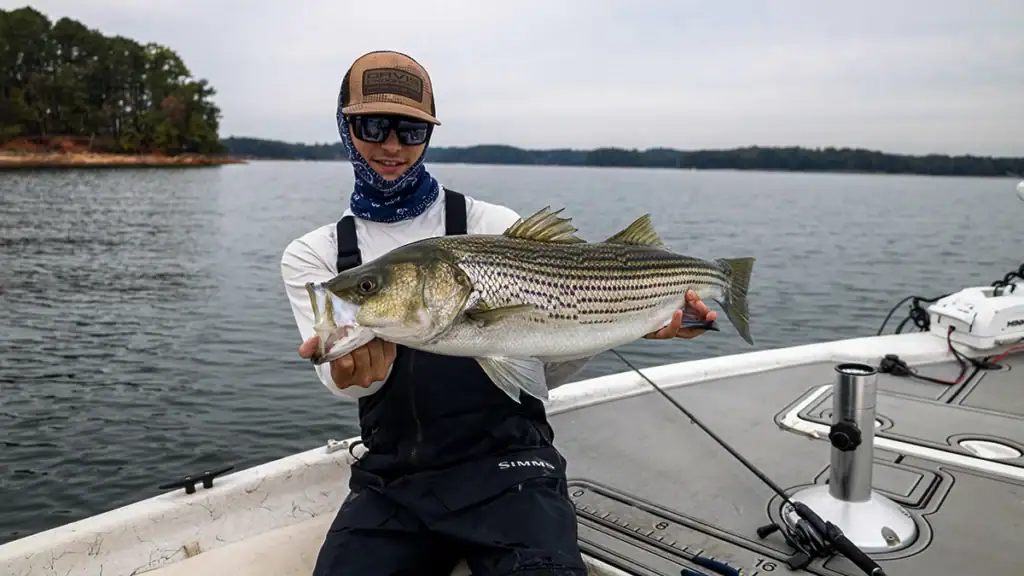
Cowen moved to Georgia in1997 and started guiding on Lake Lanier in 2000. “I consider September to be the very start of striper season, though I do not take clients out until mid-October,” he said. “You could run the lake in September and see a hundred fish on the surface in an hour and find nothing the rest of the day. It’s all about water temperature when fishing lakes — any lake, Lanier included.”
He explained that water temperature drives the bus in freshwater (he calls those fish “sodium-free” stripers). Water temperature dictates where baitfish — threadfin shad primarily for stripers and spotted bass — will be. The gamefish find them quickly.
“The best line I’ve ever heard about freshwater stripers came from my friend O’Neil Williams, who hosts the O’Neil Outside radio and television shows. He said freshwater striped bass don’t know where they live,” Cowen said. ”In other words, a striper in Lake Lanier will do just what a striper does in Smith Mountain Lake in Virginia, an impoundment in Oklahoma, or Lake Mead, a stone’s throw from Vegas. They all do the same things, just at different times of year depending on water temperature.”
Cowen added that 47- to 80-degree water is best though in the dog days of summer. The fish suspend deeper to a cooler thermocline for comfort.
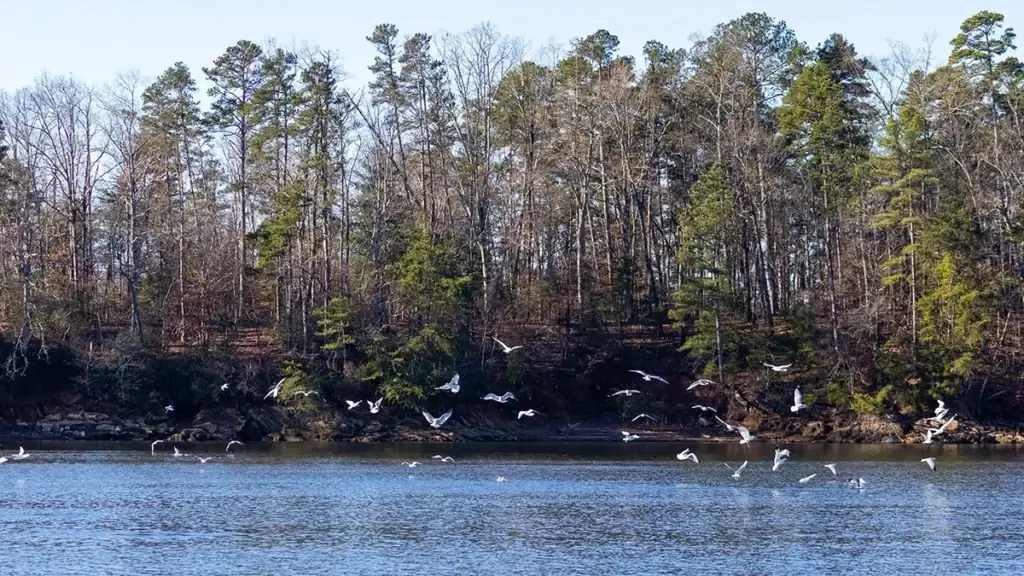
Regarding the bird-striper dynamic, Cowen said the feeding frenzy shared by primarily ringbilled gulls and stripers and spotted bass makes Lake Lanier look like a classic saltwater striper fishery.
“Our birds arrive from the coast by November and they fly back to the coast by April,” said Cowen. “The fish can still be caught, but you lose the fish-finders that make it easy and exciting.”
Cowen says that despite the presence of three species of gulls — the big herring gulls; medium-size ring-billed gulls; and the smaller Bonaparte’s gulls, named after Charles Lucien Bonaparte, an ornithologist and nephew of the famed French Emperor — it pays to find flocks of the smaller gulls.
“I call Bonaparte’s ‘striper gulls’ for good reason,” Cowen began, citing a topic that his book explores in great detail. “They are the magic bird on Lanier. When they are not around, you have to pattern these fish. With your sonar, you’ll find bait and the fish in the backs or mouths over lake coves, in the river channels, on humps, shallow blow-throughs. They are somewhere, to be sure.”
Quick Lanier Facts and Stats
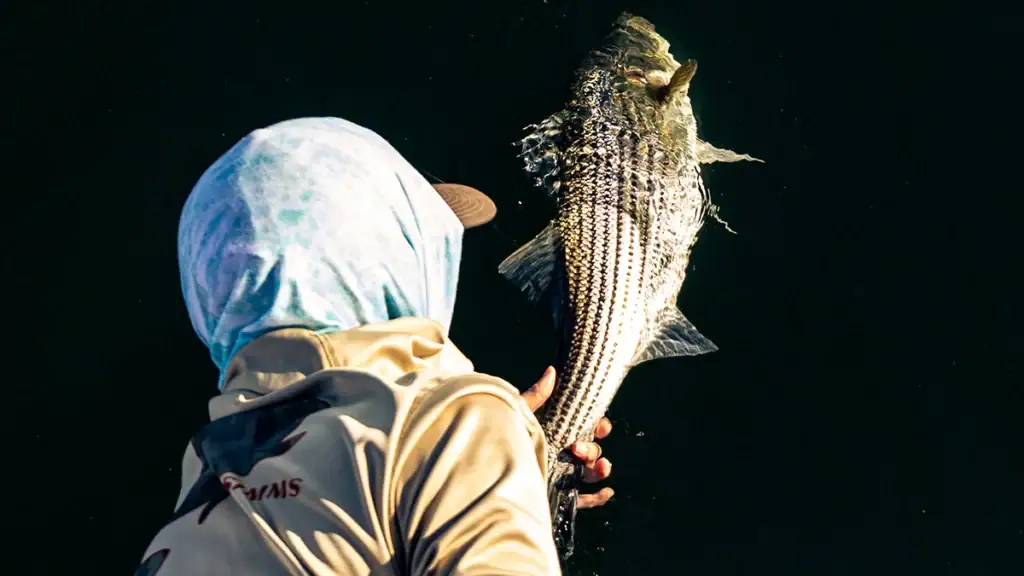
Lake Lanier is not a natural lake; it’s a manmade reservoir. In fact, there are no large natural lakes in Georgia.
Created in the 1950s by the U.S. Army Corps of Engineers through the construction of the Buford Dam, the project flooded a large area of the Chattahoochee River valley and parts of the Chestatee River. The goal was to provide water supply, flood control, hydroelectric power, and recreation.
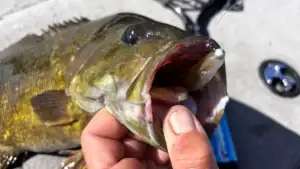
The Lake’s spotted bass population is totally wild. That means the Georgia Department of Natural Resources (Wildlife Resources Division) manages the species by regulating catch and size limits, rather than through stocking. Stripers do migrate up the Chattahoochee and Chestatee rivers each spring in a so-called “false spawn” run. But they are basically going through the motions: Lake currents are too weak to keep a striper’s semi-buoyant eggs suspended. Those eggs sink to the bottom, suffocate, and die.
Tackle and Top Offerings
Though Cowen and Clark are not only avid fly fishers but also guide other fly fishers, they are quick to use spinning gear when it’s called for. And there is always spinning gear aboard their boats.
Clark — who also works at Unicoi Outfitters in Sautee, Georgia — fishes with and outfits his non-fly fishing clients with medium-light spinning tackle. It’s ideal for the occasion when fast-swimming blueback herring are the primary baits on a particular spot.
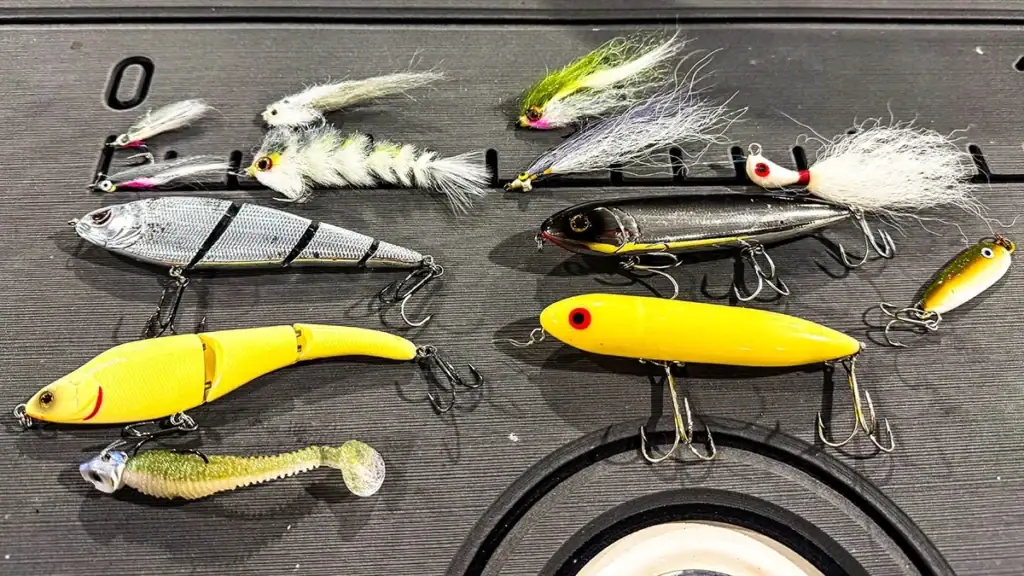
“They surface but move along at a faster clip than shad, so most fly fishers can’t get a cast off as quickly or far enough at times. That’s when long casts with plugs gets the job done,” Clark advised. “I do recommend the walk-the-dog lures, including the MirrOlure Top Dog, Sebile’s Magic Swimmer, Heddon Super Spook, and Ima Skimmer.” For deep work for suspended fish, Clark breaks out standard bucktail jigs or paddle-tail jigs.
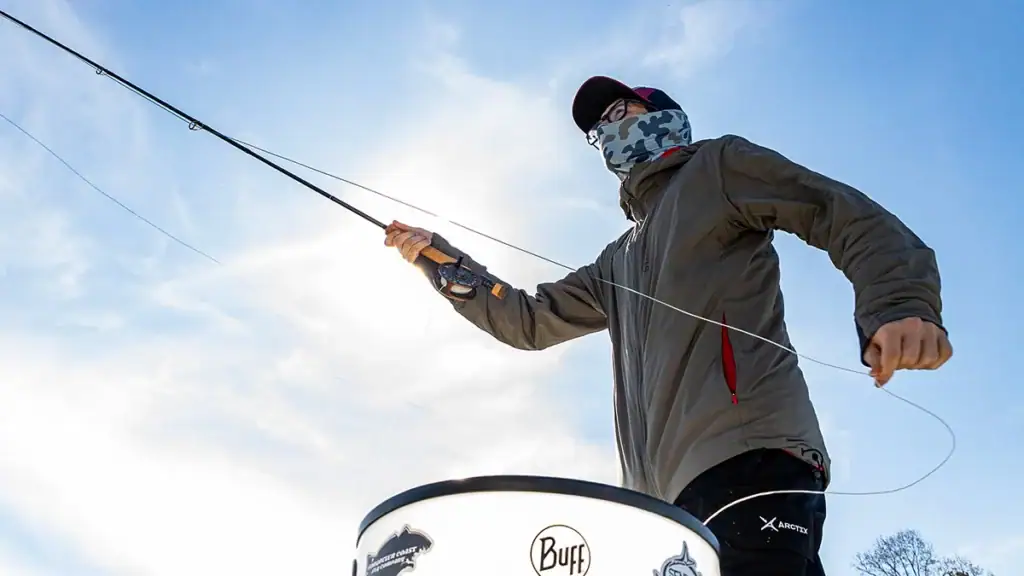
Clark’s go-to fly rod is an 8-weight, though a 9-weight helps with casting in brisk wind. Top line is an intermediate sinking line or a sink-tip line. His favorite flies include Cowen’s Somethin’ Else (tied with small lead dumbbell or bead chain eyes depending on how close to the surface the fish are), and Umpqua contact tyer Daniel Roberts’ Pop Shad and Good Friday Shad (which is tied hook up). Clark also ties and fishes a number of his own creations.
Cowen favors a medium-light spinning rod with a quality reel and drag spooled with 12- to 15-pound-test monofilament or gelspun anywhere from 20- to 30-pound-test. To that he rod ties on a 6- to 8-foot fluorocarbon leader testing 12- to 20-pounds.
“I very much enjoy topwater fishing, and thankfully our stripers enjoy topwater feeding,” said Cowen. “Walk-the-dog style plugs are terrific, especially on a flat or light-chop surface. You can’t go wrong with a Sammy, MirrOlure Top Dog, or Ima Skimmer. If there are lots of spotted bass in the feed, try a Whopper Stopper.”
Cowen’s go-to fly outfit is an 8-weight rod. He uses a 9 at times, depending on the client, but breaks out a 7-weight for spotted bass. He uses an intermediate sinking line 65 percent of the time, a fast-sinker 25 and a floating line 10. His standard leader is a 7-footer tapering to 15-pound tippet, but swaps to 12-pound when fish are picky. His top four flies include a No. 1 Clouser Minnow, his 1/0 Coyote fly (which as a small spinner blade at the nose), Game Changer in two sizes and the Somethin’ Else (Cowen’s Clouser version that imitates threadfin shad.)