A pair of anglers from Northeast Minnesota hired Luzaich to better learn Vermillion Lake and catch its heavyweight muskies. With 1,200-miles of shoreline, 75-foot clear-water depths and over 360 islands, the lake’s enormity can be overwhelming. Chartering a muskie guide seemed a good way to learn the ropes for “the fish of 10,000 casts.”
“Tom Larson and Matt Roderick are co-workers living in the area, and it was their first guide trip with me,” Luzaich tells Wired2fish. “Tom had fished Vermillion for years but had never hooked a muskie before that night.”
Luzaich says they fished for about three hours trying to stay out of the wind-swept lake. Finally, with the sun set and the moon going down, too, Luzaich headed to a prime muskie spot.
“We started fishing the edge of a main-basin reef that came up to a depth of about five feet,” said the 34-year-old guide from Embarrass, Minn. “We were fishing big 10-inch white ‘Magnum Swimmin’ Dawg’ plastic swim baits when the fish hit Tom’s lure.”
The soft jerk bait rigged with a pair of treble hooks was crushed by a huge muskie.
“When the fish hit, Tom just went silent,” explained Luzaich, who owns and runs Erect Dorsal Guide Service. “I said ‘you got him?’ And he let out a short, quiet ‘yep’!”
The muskie stayed deep at first, while Larson battled it with a 10-foot rod and a Daiwa “Prorex” bait-casing reel spooled with 80-pound test braided line and 130-pound test fluorocarbon leader.
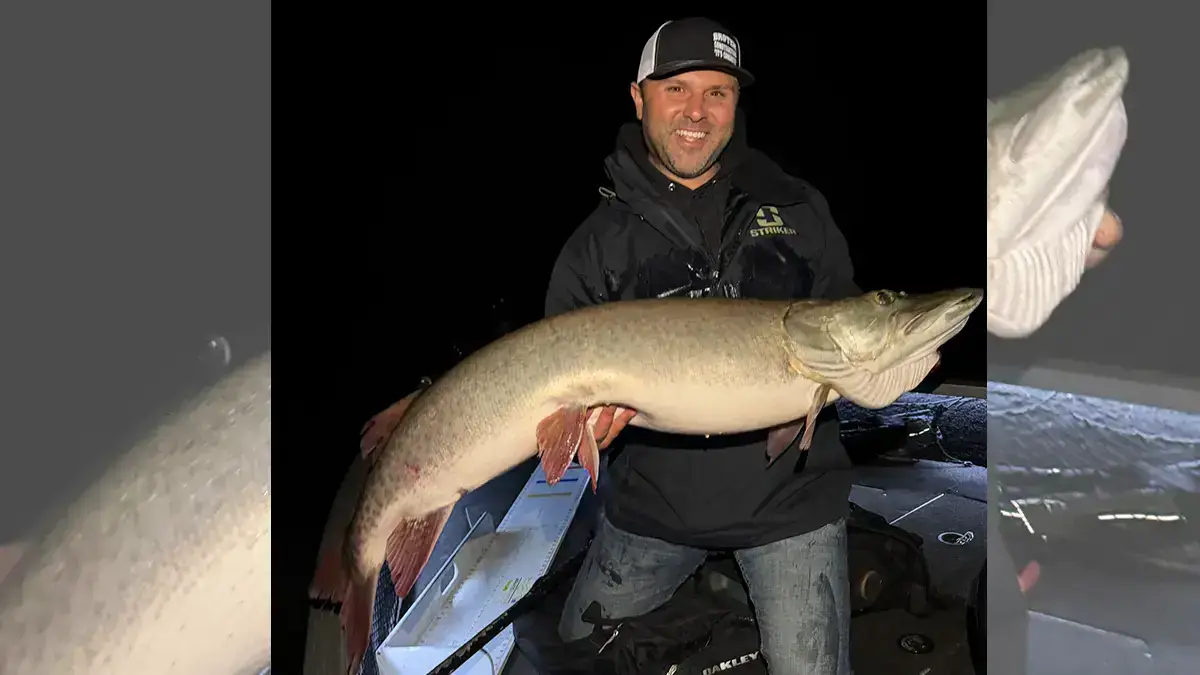
“Then it jumped twice, bulldog fought for awhile at the boat, and before we knew it the muskie was thrashing in the net, and we all started giving each other high fives,” Luzaich stated. “We looked at its head and knew it was huge, and pretty fat, too. I measured right at 50-inches in length.”
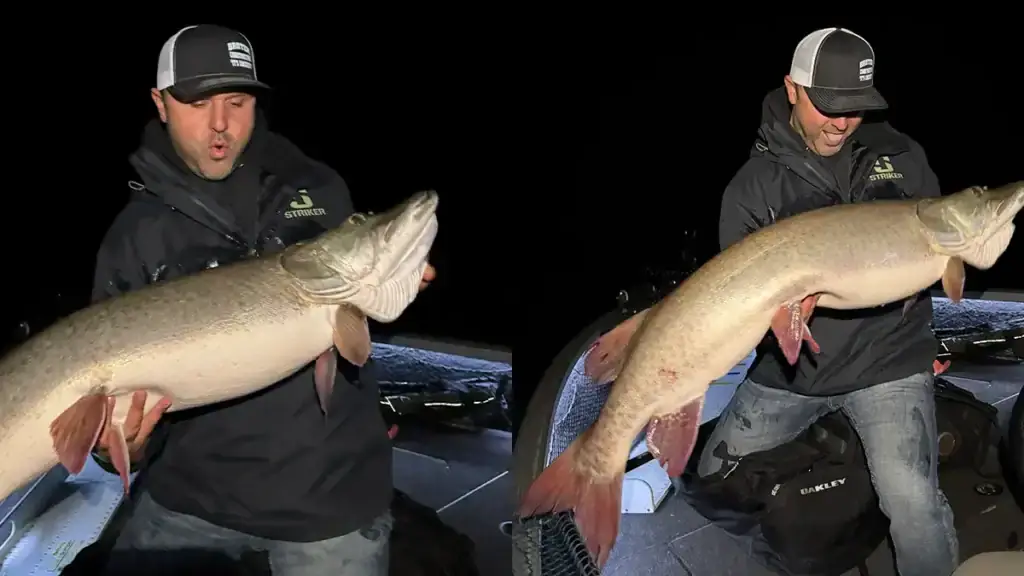
They didn’t weigh the muskie, as they didn’t want to keep it out of the water for long. Several weight-to-length charts show a fat 50-inch muskie is in the 35-to-40-pound range.
The fish had one hook in its mouth that Luzaich said came out clean and fast. They took a few photos of Larson with his first ever muskie and released it within a couple minutes of boating the fish.
“The first thing Tom said to me after finally catching his first-ever muskie was, ‘Well, I’m hooked’,” Luzaich said with a chuckle.
Luzaich has guided on the lake for about five years, chiefly for muskies, walleyes and bass. He’s a staunch proponent of forward-facing sonar (FFS) and says what he’s learned using it is invaluable.
“Tom’s fish is the third 50-inch muskie I’ve guided anglers to this year, and that success has a lot to do with FFS,” he explained. “I’ve fished the lake my whole life, beginning with my grandparents years ago. But using FFS has shown me how muskies move around in the water column, hold near a rock pike or the edge of a reef – waiting and watching like the deadly predators they are.
“But they’re still muskies. Sometimes you see fish on FFS and they just won’t hit – fish after fish, after fish refuse to strike. They’re really fickle, like every angler who fishes for them knows so well.”
“It makes me wonder sometimes how we ever caught even one muskie before FFS.”