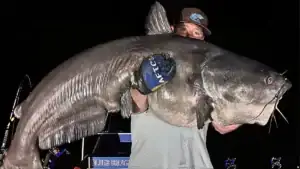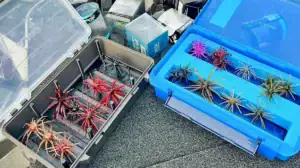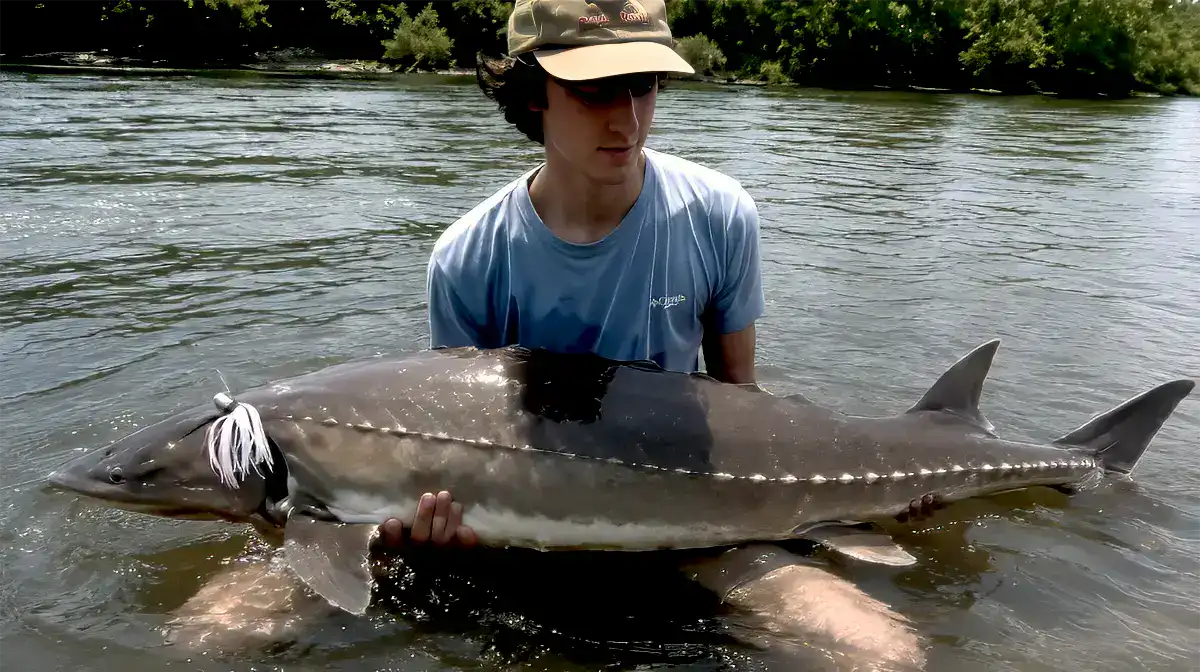
When Micah Degier tied on a 3-ounce flare hawk jig and began working the bottom of the Savannah River on July 31, he was hoping to catch a striped bass.
Instead, something entirely different thumped his jig.
Degier and his longtime friend Jack Herrington were fishing below the New Savannah Bluff Lock and Dam near Augusta, Georgia, when the unexpected catch happened around 11 a.m. The two had known each other since middle school but had recently reconnected online, making this their first time fishing together.
Degier was slowly working a jig he had tied himself a few nights earlier when the lure suddenly stopped.
“For a second, I thought I just got snagged on the bottom, like on a rock or something,” Degier told Wired2fish.
Then the “rock” started moving.
“It starts pulling, and then about three seconds later, I see a sturgeon launch out of the water and I’m tight,” he said.
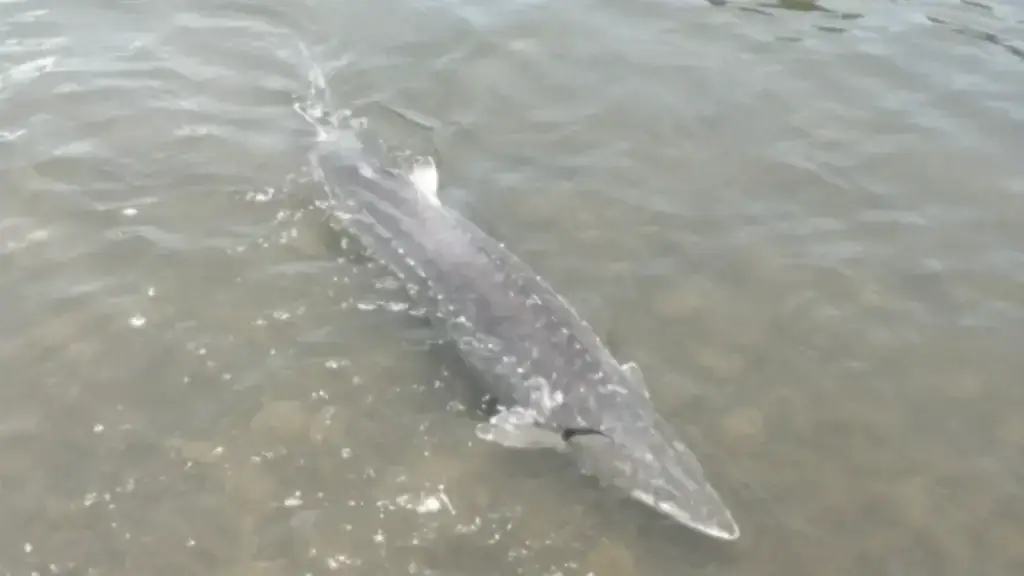
What Degier had hooked was an Atlantic sturgeon, a prehistoric-looking fish that can grow more than 10 feet long and weigh hundreds of pounds. More importantly, Atlantic sturgeon are federally protected, and the South Atlantic population is listed as endangered under the Endangered Species Act.
Atlantic sturgeon spend much of their lives in coastal and ocean waters but return to freshwater rivers to spawn. The Savannah River is one of the river systems where the species still reproduces. But seeing one this far upriver noteworthy, especially on the end of a fishing line.
Degier hadn’t been targeting sturgeon. He and Herrington were fishing for striped bass, and after the fish ate the jig, Degier suddenly found himself trying to land a federally protected species he hadn’t expected to encounter.
The fight lasted longer than it seemed to Degier.
“I thought it was way shorter,” he said. “I thought it was only fighting for like 10 minutes, but my buddy said it was a little bit longer than that.”
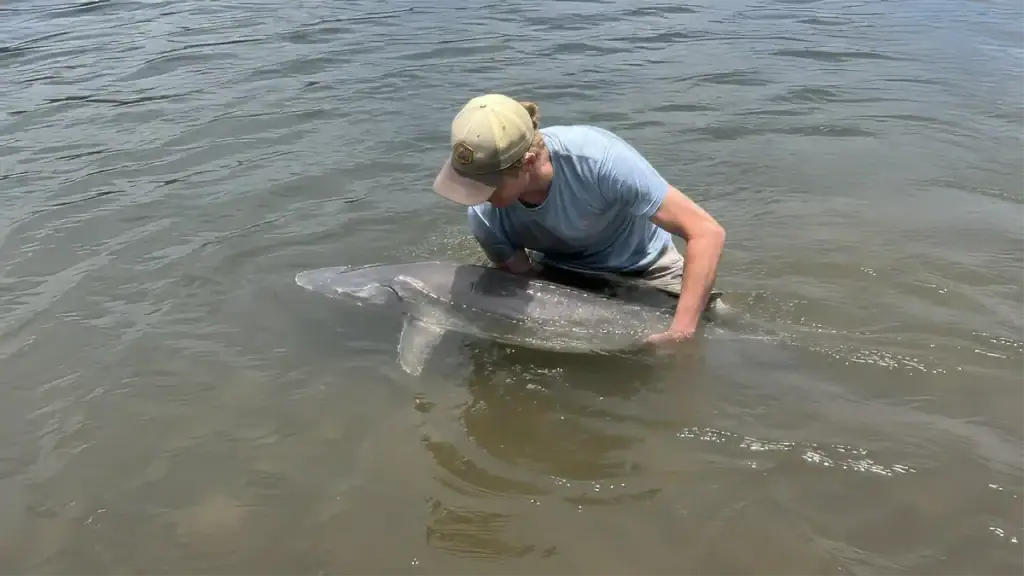
Eventually, the anglers worked the fish toward a sandbar, where they could get out of the boat and remove the hook.
For Degier, landing the fish wasn’t the end of the encounter. Making sure it swam away safely became the priority.
“I pointed its head up current, saw its gills flapping, and I was shaking its tail until it gave me enough hard kicks with its tail to let me know that it was ready to go,” Degier said.
The fish eventually regained its strength and disappeared back into the Savannah River.
Atlantic Sturgeon in the Savannah River
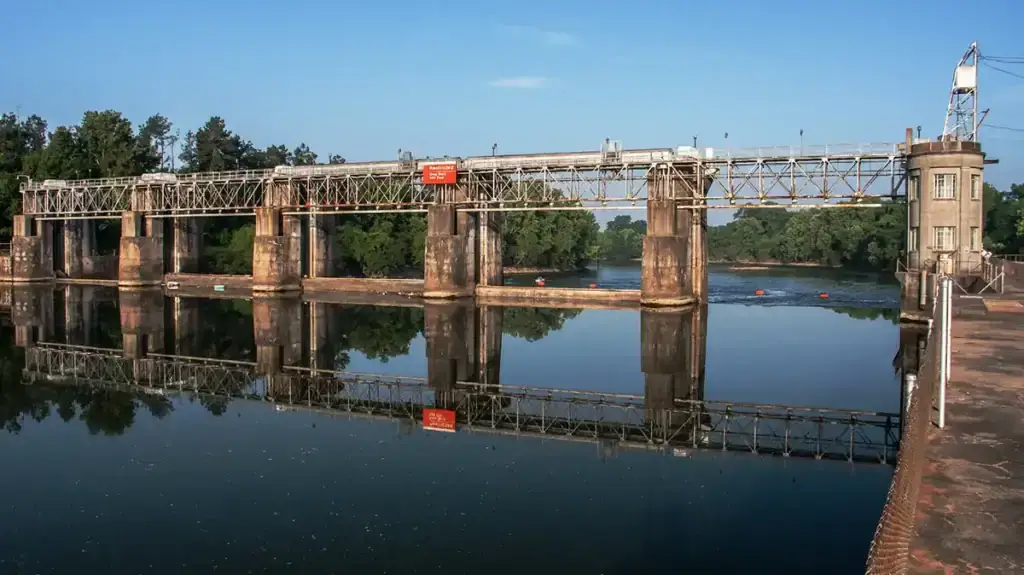
Degier knew he had hooked something unusual when the sturgeon exploded out of the water, but the fish’s history in the Savannah River makes the encounter even more remarkable.
Atlantic sturgeon were once far more common along the East Coast, including in rivers such as the Savannah. Their numbers declined dramatically after centuries of exploitation, particularly during the late 1800s, when the fish were heavily harvested for their eggs, which were sold as caviar. Habitat changes, dams, dredging, declining water quality and accidental mortality added to the pressure on the species.
Those declines eventually led to commercial harvest restrictions, and Atlantic sturgeon received federal protection under the Endangered Species Act in 2012.
That history is part of what made Degier’s accidental catch below the New Savannah Bluff Lock and Dam so unusual. He wasn’t searching for the rare fish or using specialized gear to catch one. He was slowly dragging a jig along the bottom in search of striped bass when a fish that had disappeared from much of its former range picked it up instead.
“This is actually a federally protected species that is very endangered,” Degier said.
Once he realized what he had hooked, his focus shifted from landing the fish to making sure it returned safely to the Savannah River.
What to Do if You Catch an Atlantic Sturgeon
Because Atlantic sturgeon are federally protected, anglers should release any accidentally hooked fish as quickly and carefully as possible.
NOAA Fisheries recommends keeping the fish in the water whenever possible and minimizing handling. If the hook can’t be removed easily, anglers should cut the line as close to the hook as possible rather than risk causing additional injury.
If the fish appears exhausted after the fight, give it time to recover in the water. Once it becomes active and can swim away under its own power, release it.