Working with five Indigenous tribes, the Michigan Department of Natural Resources (DNR) places a strict limit on the number of lake sturgeon caught each year by recreational anglers, either by rod-and-reel or spearing.
Within about five minutes of the sixth catch on Feb. 7, all 679 pre-registered anglers were advised via text that the DNR quota had been reached — even though it had been only a matter of minutes.
One Part of a Greater Effort
Black Lake is about 10 miles southeast of Cheboygan, Michigan, near the top of the state’s lower peninsula. It currently has a small but growing population of roughly 1,200 adult sturgeon. Once their population reaches about 1,600-2,000, harvest limits can increase, according to Tim Cwalinski, a Fisheries Unit Supervisor for Michigan’s DNR.
Between local tribes’ allotment and what recreational fishermen can take, the total sturgeon harvest is 1.2% of the total population, or 14 in all, he said. The tribal harvest is independent of the recreational angler one, with the five tribal governments working together to both establish their harvest season and share their total allocation.
“The annual sturgeon harvest is just one part of a comprehensive effort underway to study, rehabilitate, and increase the (sturgeon) population in the roughly 10,000-acre lake,” Cwalinski explained. He additionally described it as “probably the most well-studied population in the world.”
The Black Lake sturgeon fishery is deeply rooted in the local fishing culture. A limited number of the fish are harvested because the public wants to fish for sturgeon, even if in a restricted fashion, Cwalinski explained.
“There are not a lot of sturgeon that are allowed to be fished in the U.S.,” he added.
A United Approach
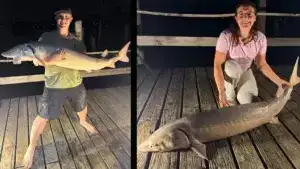
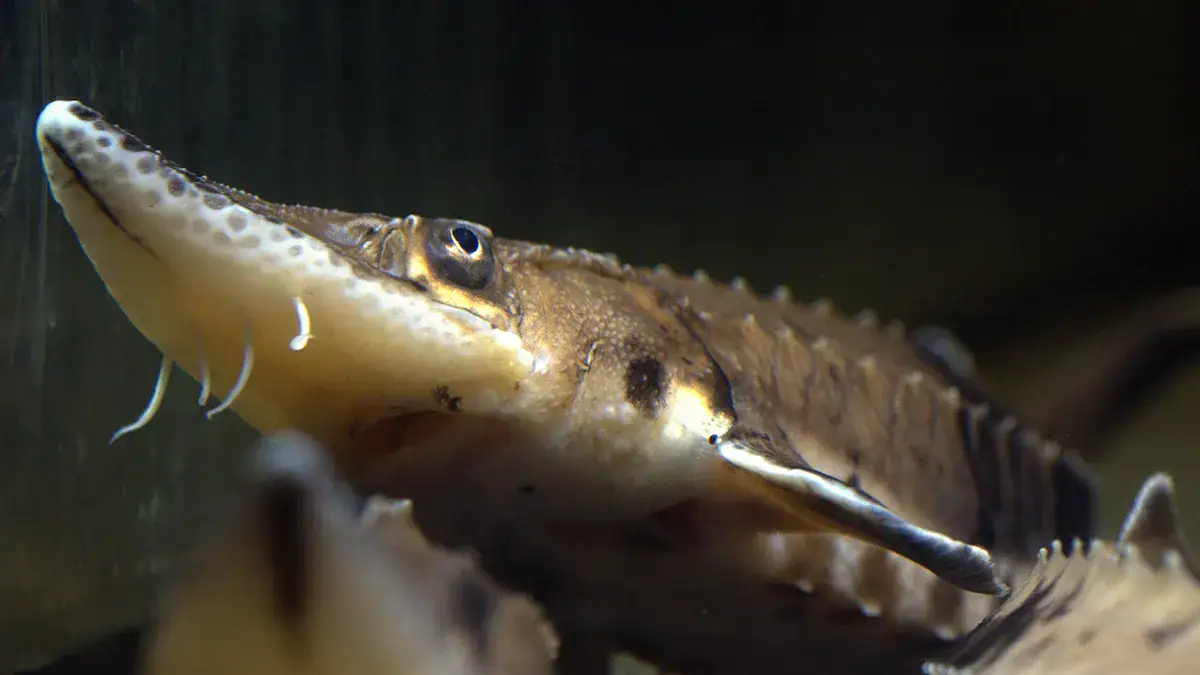
Sturgeon have five rows of bony plates instead of typical fish scales. These “living fossils” — the species is hundreds of millions of years old — are bottom feeders that can live for over 100 years. They can also reach more than eight feet in length and weigh more than 300 pounds, though most in the Great Lakes region are smaller.
In 1997, the lake sturgeon population in Black Lake was determined to be well below historical levels, yet still at a level that could withstand a limited annual harvest.
Rehabilitation of lake sturgeon in the Cheboygan River watershed, where Black Lake is located, is a cooperative effort. It involves the DNR, the Black Lake Chapter of Sturgeon For Tomorrow, Michigan State University (MSU), Tower-Kleber Limited Partnership, the Bay Mills Indian Community, the Grand Traverse Band of Ottawa and Chippewa Indians, the Little River Band of Ottawa Indians, the Little Traverse Bay Band of Odawa Indians, and the Sault Ste. Marie Tribe of Chippewa Indians.
Experience Pays Off
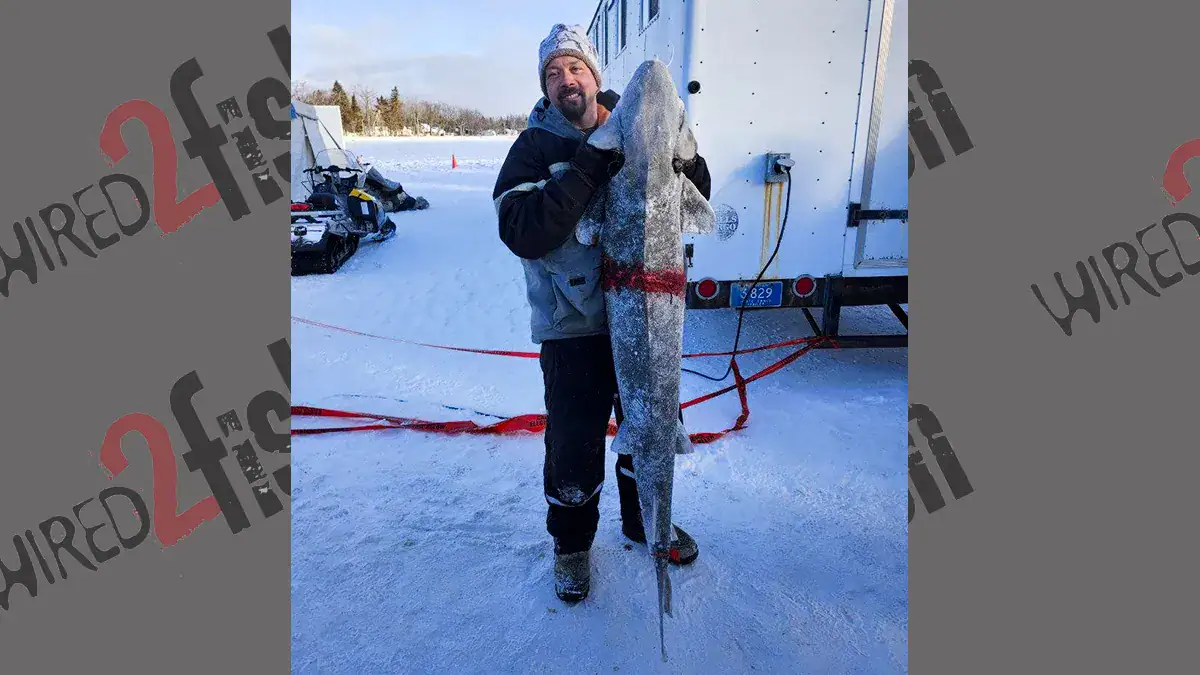
Brett Trapanier of Onaway, Michigan, speared the day’s biggest sturgeon — a 64-inch female weighing a tad over 79 pounds. He and his wife Janelle set up an ice shanty above a flat sandy bottom in 15- to 18-feet of water, near what he called a sturgeon “travel corridor.” Knowing where to place the shanty comes from more than 35 years of experience targeting sturgeon, said the 44-year-old Trapanier, who owns a local car-collision repair shop.
The couple started preparing about an hour before the 8 a.m. start. Like in past years, they knew they’d likely have only minutes of fishing before DNR announced that anglers reached the day’s sturgeon quota. They readied their seven-pronged, 22-pound spears and then placed in the icy water a couple red-and-white shiny objects to attract the fish’s curiosity — what they call “decoys.”
Around 7:50 a.m., Trepanier stepped out of the morning sunshine and into the shanty to acclimate his eyes to the darker conditions inside. “It’s not flawless visibility,” he said, “but it’s pretty darned good.”
Then, right at the start, Trepanier was sitting on the edge of his chair, hyper-focused and gazing into the water.
“You’re just looking down that hole, you’re not deviating,” he said. “I don’t take my eye off the hole. I’m scanning the perimeter the whole time. Just waiting for that approach.”
By 8:09 a.m., Trepanier landed his lunker sturgeon. He immediately whistled to a nearby DNR staffer who recorded the catch, the second sturgeon of the morning.
A Speedy End to the Season
Numerous DNR staffers were on the ice with the anglers, closely monitoring activity and communicating with one another exactly when the six sturgeon were speared. A central communication staffer then texted all anglers at 8:48 a.m. when fishing was over.
The six sturgeon ranged in length from 52 inches to 67 inches, and in weight from 40 to 79 pounds. Only one of the six fish had been caught previously by MSU or the DNR — during spring spawning runs in the Black River or via a lake survey.
There is often a party-like atmosphere on the lake during the sturgeon catch, with many onlookers also tracking the action. For Trepanier, he’s stocked his freezer with sturgeon filets, and he and Janelle will likely host a cookout for friends in the early summer.