If an angler tried to put all of the latest fishing technology into a bass boat, it would undoubtedly sink the ship. There are so many options out there—from different brands to different tech within the same brand—that it’s hard to know where to begin, and completely impractical for the vast majority of us all.
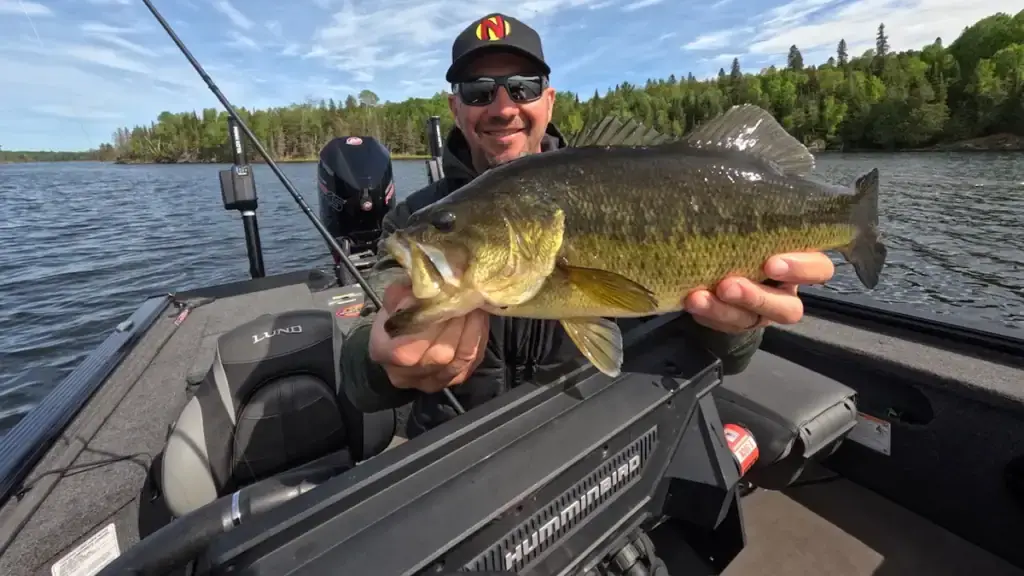
So, we linked up with a Bassmaster Elite Series pro who has tested out and dialed in the latest and greatest gear for years. We were particularly interested in how 360 Imaging and forward-facing sonar (FFS) stacked up against each other in his mind. Here’s what Jeff “Gussy” Gustafson — a Shimano, Johnson Outdoors and Z-Man Fishing pro — had to say on the subject.
What is 360 and FFS?
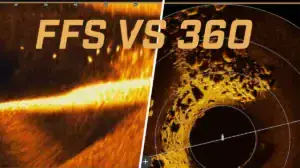
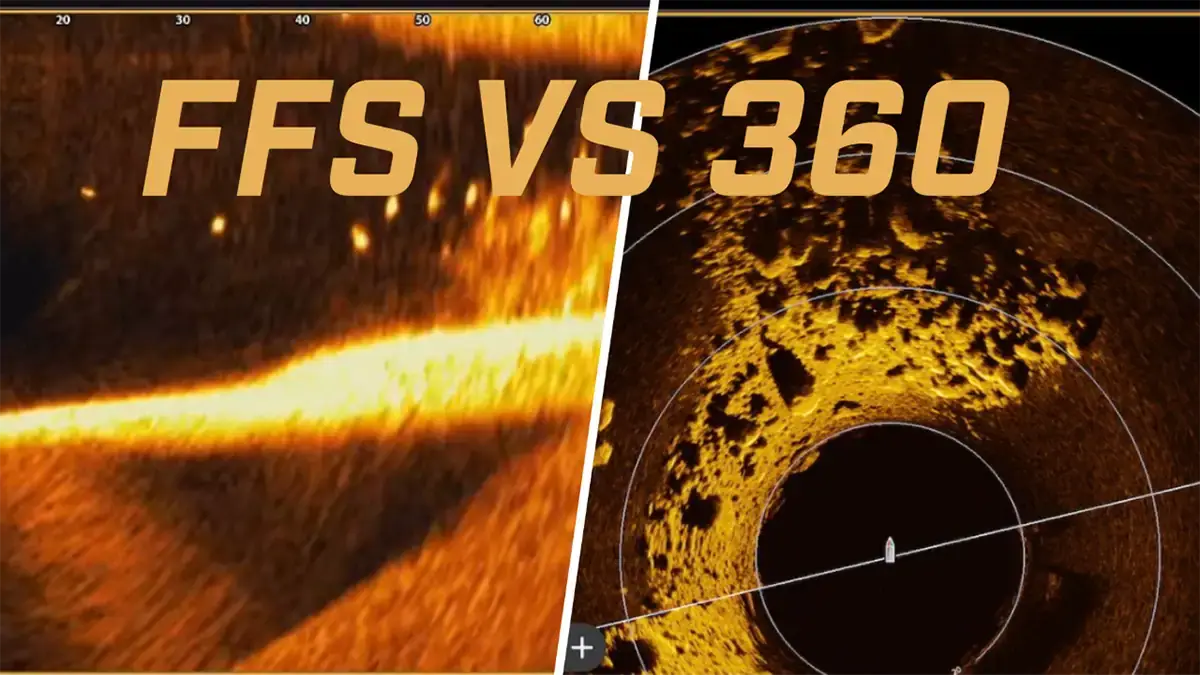
To get us all on level footing, let’s first establish what we’re talking about when we say “360” and “FFS”. For 360, we’re talking about sonar technology that is able to relay an image of the lake bottom covering a full 360-degree circle around the boat. Humminbird’s Mega 360 is the pinnacle of this sonar type, with the company also serving as the pioneer of this tech. Depending on the settings, the image an angler sees is refreshed every 15 to 80 seconds as the sonar’s beam makes its rounds, similar to what you’d see from a weather radar.
Forward-facing sonar (FFS) is a completely different animal. In its simplest form, FFS offers a vertical live snapshot that covers a narrow cone out in front of the transducer. The readout that’s returned to the graph is far more concentrated, and it’s constantly updated, making this tech an all-new type of live sonar. All other sonar types relay what the transducer has already passed over or passed by—differently, FFS is a real-time readout updated 50 to 60 times per second.
Why FFS is the GOAT
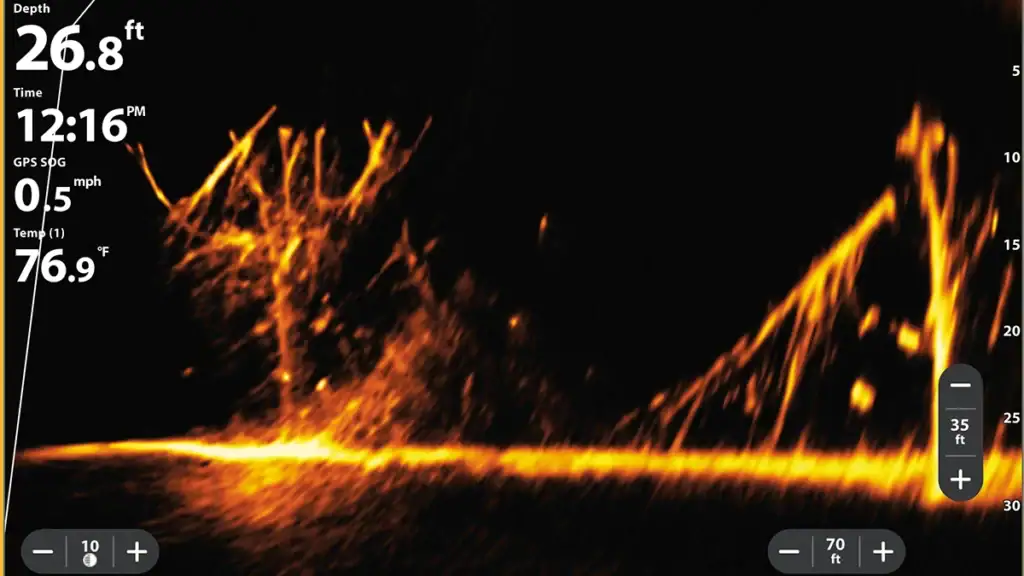
While 360 imaging has its place on Gussy’s boat, and has certainly contributed to hundreds of fish catches for the Bassmaster Classic Champion, FFS is undoubtedly the predominant tech he uses. It’s the one he’d recommend for the vast majority of anglers, as long as you’re allowed to use it.
“Obviously, forward-facing sonar is more powerful,” said Gussy. “In the events where we can’t use it, then the 360 becomes really powerful.”
For the 2026 Bassmaster Elite schedule, there were five events in which FFS could be used, and then four events where live sonar was prohibited.
“If I don’t have the forward sonar on, I have 360 on 100% of the time,” he said. “I really was a fan of the 50/50 schedule this year. In the events where we couldn’t use forward sonar, 360 was huge for me.”
The Case for 360
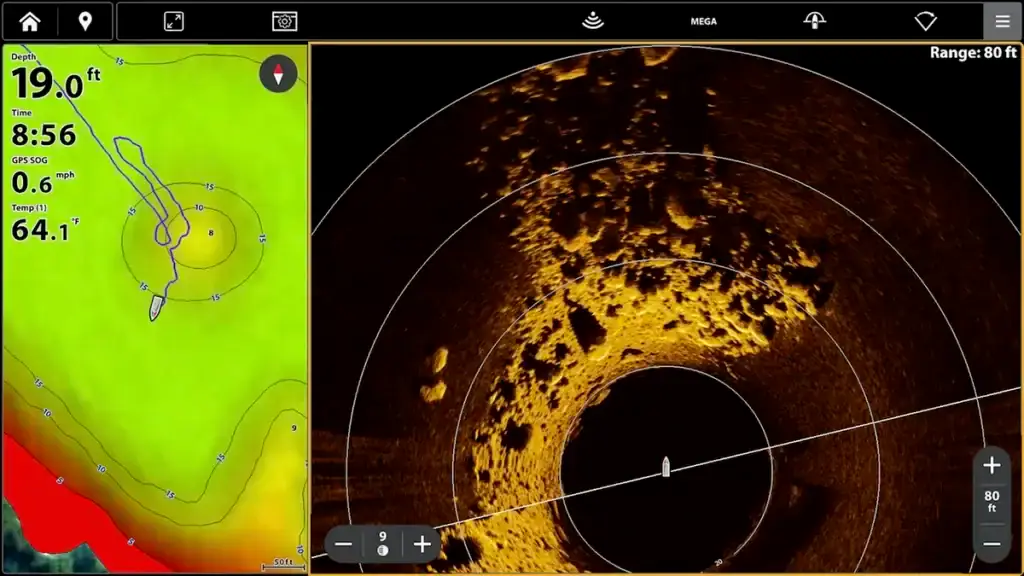
Gussy pointed out how he relied heavily on his Humminbird Mega 360 Imaging this season in the non-FFS events to find and fish cover and structure. With 360, Gussy could confidently cast to bream beds, rocks, stumps, brush piles, grass edges, and more. While he typically doesn’t expect to see actual fish on this tech, there are times when he can do that.
“If you’re spot-locked, you can actually see fish on it too,” he pointed out, “but you can’t really be moving; you’ve got to be kind of stationary.”
With spot-lock enabled on his Minn Kota trolling motor, Gussy is able to keep his transducer relatively still, allowing the beam to make full rotations without the boat moving. This creates a sharper image and helps him see fish in certain situations, like when one is swimming around a boulder, for instance. With the boat on the move, the image is stretched and blurred. Sitting still, 360 allows you to track anything that moves.
“If you’re fishing tournaments without scope, 360 is a powerful tool to be able to see a stump, a brush pile, or a boulder and cast in the right direction,” said Gussy. “It’s going to help you catch a few more fish every day. It points you in the right direction, more than anything else will.”
A Case for Both
If you do have the funds to run both forward-facing sonar and 360-degree imaging at the same time, the two technologies pair really well together.
“Using 360 in conjunction with forward sonar, you get a feel for the range on the screen,” he explained. “I usually keep my 360 at 80 feet, and it just allows me to cast in the right direction to stuff that is likely going to hold fish.”
If Gussy is really covering water and moving along quickly, he’ll swap over to his map and use that with FFS. But the rest of the time, when he’s either picking a place clean or pre-fishing and trying to dial in an area, he’ll have 360 and FFS going at the same time. Reason being: There are some things he can see with 360 that he can’t see on FFS straight away, or at least not as clearly.
“A big boulder’s going to show up on forward sonar well. But sometimes, like a rough patch of rock, a hole in the grass, or different bottom compositions, you’ll see stuff like that you might not see with forward sonar. So many times, you’ll just be going along and looking, and there’s a rough patch of some kind of hard bottom or shell bed. And then you scan over in that direction and pay a little more attention to it, and that often pays off.”
If funds are a limiting factor (as they are for the majority of us) and it’s legal to use forward-facing sonar, the reality is that you’re going to have a hard time consistently competing without it. And, in that case, FFS definitely beats out 360. But, if FFS is banned from your event—or possibly even on the waterway or in the state you’re fishing—then 360 is an invaluable tool worth considering. Ultimately, running the two together is the real secret sauce, by using 360 to get a lay of the land and FFS to take a closer look.

![[VIDEO] How Brandon Palaniuk Uses the One-Boat Network App](https://www.wired2fish.com/wp-content/uploads/2025/06/one-boat-network-300x169.webp)
![[VIDEO] How to Install the Garmin Force Pro Trolling Motor](https://www.wired2fish.com/wp-content/uploads/2025/06/trolling-motor-install-300x169.webp)