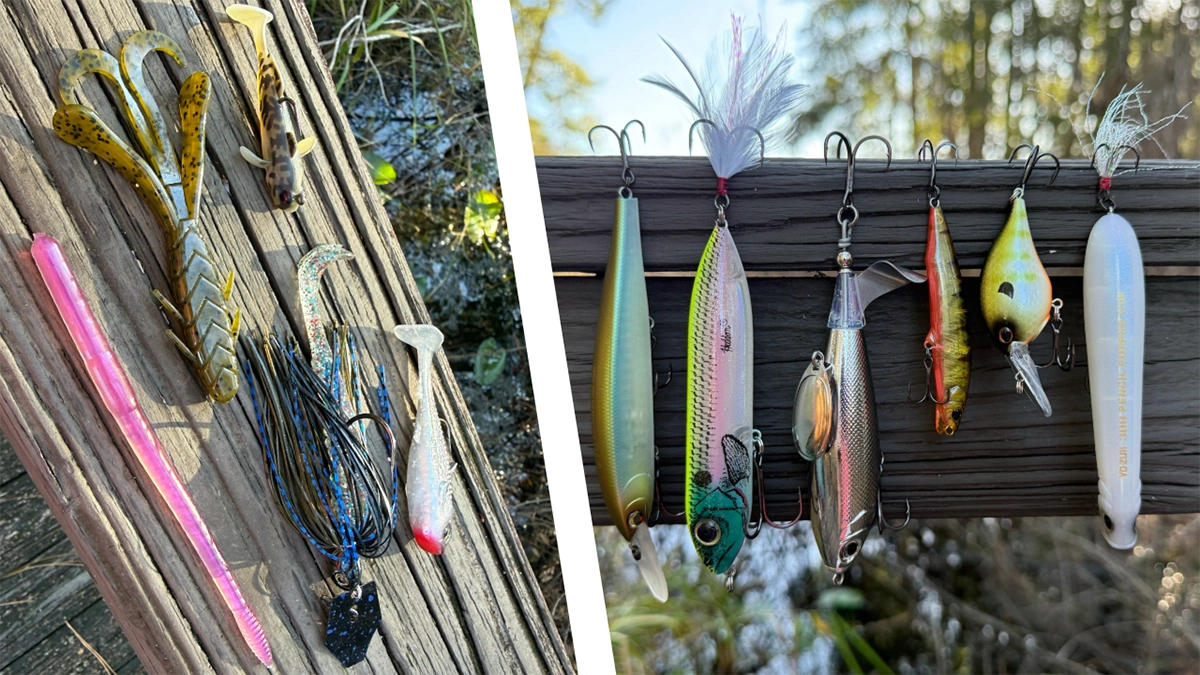
While the market is loaded with thousands of bass lures today, every category started with a single, ground-breaking design. These original icons didn’t just catch fish — they defined the gear I use today. Some remain staples in our tackle bag, while others have been refined by modern tech. As an angler, understanding these different categories and top-performing baits is key to success.
At Wired2Fish, we’ve spent thousands of hours on the water testing products. We like old baits, we like new baits, and of course everything in between. For the purpose of this guide I wanted to highlight some of the best bass baits within different categories of bass fishing lures. You might have a few in your tackle trays already while others might be completely new to you. Let’s get started.
Favorite Bass Lures and Common Designs
This guide covers different styles of bass lures, but also specific baits on the leading edge. Plus, I’ll share links where to find and purchase these baits. Some of these lures we’ve even covered in depth with dedicated reviews too. Our ultimate goal is to share a huge variety of some of the best bass lures around to help you catch more fish. Forewarning: This guide is updated consistently to include new options that might just become the next great fish-catchers. Baits are listed in alphabetical order by their design and purpose.
- Bladed Jig: Z-Man Chatterbait Elite Evo — Buy from Bass Pro Shops
- Crankbait: Berkley Dime 4 — Buy from Tackle Warehouse
- Creature Bait: Lake Fork Lures Pro Hog — Buy from Lake Fork
- Drop Shot Worm: Lake Fork Lures Pro Drop Shot Worm — Buy from Lake Fork
- Forward Facing Sonar Minnow: Jenko The Don — Buy from Tackle Warehouse
- Glide Bait: Strike King Hog Father Jr. — Buy from Bass Pro Shops
- Hollow Frog: Berkley Swamp Lord — Buy from Amazon
- Inline Spinner: Panther Martin Classic Holographic — Buy from Tackle Warehouse
- Jerkbait: Yo-Zuri Pro Jerkbait 110 — Buy from Tackle Warehouse
- Lipless Jerkbait: Lunkerhunt Black BLB FFS Minnow — Buy from Tackle Warehouse
- Minnow: Great Lakes Finesse Dropkick Shad — Buy from Bass Pro Shops
- Ned Rig: Z-Man Fuzzy TRD — Buy from Bass Pro Shops
- Popper: Yo-Zuri Pencil Popper — Buy from Bass Pro Shops
- Prop Bait: Rapala Claptail 110 — Buy from Bass Pro Shops
- Soft Stick Bait: Yamamoto Senko — Buy from Amazon
- Spinnerbait: Spro Blade — Buy from Tackle Warehouse
- Straight Tail Worm: Roboworm Straight Tail Worm — Buy from Bass Pro Shops
- Swimbait: Storm Surge Minnow — Buy from FishUSA
- Trick Worm: Zoom Thick Trick Worm — Buy from Zoom
- Walking Topwater: Heddon Super Zara Spook — Buy from Amazon
Bladed Jig: Z-Man Chatterbait Elite Evo

The ChatterBait revolutionized the fishing industry in the early 2000s when Ron Davis Sr. and his son Ronny developed a unique “bladed jig” in their South Carolina garage. By attaching a hexagonal metal plate directly to the eye of a jig, they created a lure that combined the erratic flash of a spinnerbait with the violent vibration of a crankbait. Though it remained a Carolina secret for years, the bass lure became a global sensation in 2006 after pro angler Bryan Thrift used it to dominate a major tournament on Florida’s Lake Okeechobee.
I’m a huge fan of the chatterbait, the bladed jig, however you want to call it. In my view, it’s the best bait to replace casting a spinnerbait in many scenarios. Not all, but definitely some. The compact size of a chatterbait, even with a trailer makes it an easier bait to scarf down. And while some anglers will throw a bladed jig just about anywhere, I prefer to cast them over vegetation like eelgrass where I can do a bit of prospecting with the bait.
Today, other lure companies make vibrating jigs too. But Z-Man Fishing is still the most well-known, especially since they own different patents and trademarks directly related to the Chatterbait. Z-Man recently released its high-performance ChatterBait Elite EVO, which I’ve had success with. This affordable bladed jig features pro upgrades, including a custom-honed hook, a wire-tied silicone skirt, and a specially sculpted head.
Crankbait: Berkley Dime 4

The first commercially successful lipped crankbait was the Creek Chub Wiggler, created in 1906 by Henry S. Dills of Indiana. While earlier wooden lures were primarily surface baits, Dills revolutionized the industry by adding a metal diving lip that allowed the bass lure to dive and wobble underwater. This design became so effective that it earned a 1920 patent and paved the way for legendary baits like the Pikie Minnow, which was used to catch a long-standing world-record largemouth bass in 1932.
Today, nearly all the best crankbaits utilize a plastic lip. There are deep-diving cranks, shallow cranks, and lipless cranks, as well as other variations such as square bills. Cotton Cordell Big-O, Rapala Shap Rap, and Storm Wiggle Wart are classics that will never disappear, but I’ve thrown the Berkley Dime 4 a bunch recently. I’ve been bouncing it off dock pilings, tree stumps and logs in waters no deeper than 4 feet. There’s just not a ton of deepwater lakes in Florida and not much rock around either. But I feel confident knocking the lure against hard structure without getting it snagged or breaking it. Constructed from durable plastic rather than timber, the lure features an internal weight transfer system that allows me to cast this thing a ways out there.
Creature Bait: Lake Fork Lure Pro Hog

In the world of bass fishing, a creature bait is a category of soft plastic lure that doesn’t necessarily look like any specific prey in nature. Instead, it’s a hybrid lure that blends the best features from various animal parts — like the legs of a centipede, the feel of a worm, the claws of a crawfish, and the long tail of a lizard — into one freaky design.
There is plenty of debate about the first true creature bait. But as early as the 1970s, brands were experimenting with designs that paved the way to modern baits. Soft baits gained bulk and multiple appendages that moved in water differently than a slender worm. Baits like the Brush Hog and Sweet Beaver were born.
Today, the Lake Fork Lure Pro Hog is the latest iteration of a deadly creature bait. I’ve used it when punching mats in the heat or cold, working it really slow. And then of course, it might be at its best if bass are on beds, starting as early as February or March. The Pro Hog features a unique claw design that snaps into a defensive posture the moment it hits the bottom. Put up your dukes! This bass lure is a stinky-garlic attention-getter if it doesn’t scare off a bass first — yes, I’ve beamed a couple bass in my day.
Drop Shot Worm: Lake Fork Lure Pro Drop Shot Worm

This do-nothing worm was not a new shape or creation, but the massive impact it had on the drop-shotting technique and bringing the technique to the mainstream can’t be ignored. The specific type of soft plastic bait is designed and best used for finesse fishing. It is characterized by its thin profile, soft plastic, and ability to quiver with very little movement from the angler. Unlike a traditional worm rig where the weight is at the tip of the worm, a drop shot worm is rigged above its weight.
You can use a bait like the Straight Tail or Flat worm, but some brands are now tweaking designs for drop-shotting. The Lake Fork Lure Pro Drop Shot Worm is a perfect example. I like its flat-bottom design and horizontal hover in the water. If your bait isn’t horizontal on the drop-shot, I think it’s got no shot. And I only need to twitch my rod a smudge to get it to wiggle. Plus the durability is there to survive multiple strikes.
Forward Facing Sonar (FFS) Minnow: Jenko The Don

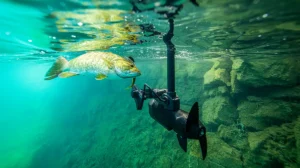
When fishing with Forward Facing Sonar (FFS), minnows are one of the best bass lures used for strolling, moping, or shaking. Unlike traditional swimbaits that have a paddle tail, these lures usually have a straight or forked pin tail that requires the angler to provide the up-and-down action. The goal is to present a vertical finesse look to suspended fish you can see in real-time on your screen.
There may be no better bait for his technique than Jenko’s The Don. The Don was specifically designed for forward-facing sonar (FFS) and mid-strolling. With this presentation, I’m always trying to get that bait right in front of suspended fish. It doesn’t look like much out of the water, but I often use this bait when fish aren’t reacting or feeding with gusto. And that’s when it gets bit. Jenko uses a plastic with zero salt to make the bait buoyant, and I rig it with a Jenko Revolution jig head that has a 90-degree line tie. The goal is to get that bait to rest like a minnow on its deathbed.
Glide Bait: Strike King Hog Father Jr.

While the glide bait has roots in Japanese engineering, the California big bait frenzy is what turned it into a global phenomenon. In California, the all or nothing mentality—targeting only 10-pound bass—found its perfect match in these oversized, single-jointed lures. Does your bass lake or river have rainbow trout? Then a glide bait should probably be in your box. Don’t discount a glide bait as a tool to draw out large bass, revealing their position, even if they don’t strike the bait.
I’ll use this bass lure when bluegills or shad are around in good numbers – honestly, when they’re the main seasonal forage for bass. There’s no rainbow trout in Florida, but there are plenty of panfish. And a glide bait like the Strike King Hog Father Jr. at 7 inches long isn’t too expensive to purchase for a guy like me who isn’t a single-minded trophy hunter. Strike King collaborated with Matt McBee to make the slow-sinker that still produces that irresistible S-turn.
Hollow Frog: Berkley Swamp Lord

Wanting to mimic frogs and fish them around dense cover was a problem. Hard topwater baits could be made to resemble a frog but the exposed hooks meant the angler was constantly fighting with snags. Enter hollow body frogs to the market like the Bronzeye Frog and Sexy Frog. These bass baits collapse on the strike and hook fish in heavy cover.
I want a frog that jumps and dances on top, maybe even a bit of side to side action. That’s the best action in my opinion. The Berkley Swamp Lord hollow-body frog has been working for me. I especially like the natural color options, although not sure if it truly matters. If it’s anything dark in color, it seems to get bit. The bait has angled Fusion19 hooks right out of the package, and it really doesn’t seem to collect as much water inside as some other frogs. Plus, if you have the skill to skip a bait under overhangs, this frog is definitely one of the easier ones to get back into the shadows.

Sponsored
Panther Martin Deluxe Holographic
The inline spinner has its roots in 1930s France and trout fishing. Introduced to the U.S. in 1958, Panther Martin’s design featured a blade that mounted directly on the shaft rather than on a clevis. This allowed it to spin at much slower speeds. The inline spinner remains a numbers bait today, particularly favored by river and pond anglers.
I cast a Panther Martin Deluxe Holographic Single Hook inline spinner as a prospecting bait when fishing the edges of ponds. I don’t have trout or pike where I fish, so this is a bass lure I use for searching. What sticks out to me about the spinner is its vibration, plus its ability to handle current in creeks and ditches. This is one of the best baits to just cast and slowly retrieve, and a surprising number of species will bite it.
Jerkbait: Yo-Zuri Pro Series Jerkbait SF 110mm

In bass fishing, a jerkbait is a slender, minnow-shaped lure made of hard plastic designed to imitate a wounded or fleeing baitfish. Anglers found out that by adding weight to their lure that they could make a floating bait sit in a bass’s face and tempt them to bite. Each year, lethargic bass in cold water fall to jerkbaits. It’s the best time of the year to use them. And there’s plenty of well-known options like the Vision 110, Rattlin’ Rogue and Shadow Rap.
I’ve thrown the Yo-Zuri Pro Series Jerkbait SF 110mm (a ½-ounce size) in open water during the colder months. The slow-floating bass lure truly mimics a dying baitfish. Unlike a crankbait which I retrieve steadily, this jerkbait requires me to provide the action through sharp, downward snaps of the rod tip. When you jerk the rod, the lure darts erratically side-to-side. When you stop, the lure pauses allowing for a bass to strike.
Lipless Jerkbait: Lunkerhunt Black BLB FFS Minnow

When you think of the best lipless baits, I immediately think of Rat-L-Trap style bass lures. But some jerkbaits are lipless too, and it took a bit to get used to the look. The bait style excels at sniping suspended fish by allowing you to stop the lure at a precise depth and trigger reaction strikes with subtle movements. It’s a tool for depth-hunting and targeting deep-water bass.
The Lunkerhunt Black B.L.B. FFS Minnow is a sinking lure specifically engineered for use with Forward-Facing Sonar (FFS) technology. You’ve probably fished soft baits on jigs with FFS. But what about hard baits? Its high-density construction ensures it produces a strong return on electronics. I think the most distinctive feature is its unique fall, which gives off vibration and flash.
Minnow: Great Lakes Finesse Dropkick Shad

Minnow baits are popular these days. Yes, because of forward facing sonar, but also because they flat out catch fish. Even before FFS, jigheads and soft plastics worked, but anglers used (and continue to use) depth control and targeted high-probability structures where bass congregate.
Designed for high-pressure scenarios and gin-clear water, Wired2Fish contributor Nick Petrou has used the Great Lakes Finesse Dropkick Shad a bunch in pressured waters. Its best feature is a neutrally buoyant composition that allows the bait to maintain a horizontal profile on a jig head. Using a basic countdown method, he lets the bass lure sink for a specific number of seconds to target different layers of the water column. His success also comes from basic fan-casting in likely areas.
Ned Rig: Z-Man Fuzzy TRD

The Midwest finesse fishing pioneer Ned Kehde spent years cutting up and modifying ElaZtech baits to create a small softbait that would entice strikes from heavily-pressured bass in public reservoirs in Kansas. After introducing his friend Drew Reese, a fishing industry veteran and competitor in the first Bassmaster Classic to ElaZtech, Reese convinced Z-Man Fishing Products to manufacture Kehde’s creation, which brought the Ned Rig to the mainstream.
Years later, the Z-Man Finesse TRD is one of the best-selling soft plastic bass lures nationwide and a bait that both recreational and tournament anglers rely on. I use the Z-Man Fuzzy TRD on just about every trip because it’s so versatile. Fuzzy baits took over in 2025, and this bait is no different. Built from 10X Tough ElaZtech, the Fuzzy TRD is nearly indestructible and naturally buoyant, ensuring it always stands tail-up. And so far the silicone legs have held up well; I don’t think I’ve lost a single one yet when hopping it on a jighead.
Popper: Yo-Zuri Pencil Popper

Aglers probably have a few of these in their tackle boxes. And likely not an old-style Hula Popper or Rebel Pop-R. The Hula Popper was the first widely marketed topwater popper hitting shelves sometime in the 1930s. Today’s poppers are streamlined, finely detailed, and beautifully painted forage imitators.
I tie on a Yo-Zuri 3DB Pencil Popper when fish are hitting on top. With its side-to-side “walk-the-dog” action and surface-spitting commotion, I treat it like a sight-casting lure. A popper is one of the best topwater lures around precise targets, when fish are shallow, or during spawn and post spawn periods. Surface strikes are the best thing in bass fishing and this popper mimics the frantic look of a fleeing shad to trigger aggressive strikes.
Prop Bait: Rapala ClapTail 110

Prop baits used to feature a metal propeller at the tail end. Today, lures that fall into the category look a bit different. Instead of small metal blades that require a twitch-and-pause retrieve, modern lures incorporate a large, rotating tail. This creates a deep, plopping sound that can be retrieved at a steady pace to cover water. Not surprisingly, the term for these baits is “ploppers,” with the Whopper Plopper likely the best known bait in the category.
The Rapala ClapTail 110 is a bit unique. It has a metal prop and back blade that hit each other when retrieved. I use this bass lure when I really want to bring the noise and bubble trail. This bait churns water even at lower speeds, making it effective for both steady cranking and erratic stop-and-go cadences. It casts far and tends to entice bigger fish, but I wouldn’t call it a numbers bait.
Soft Stick Bait: Yamamoto Baits Yamasenko (Senko)

Around these parts, we call the Yamamoto Senko the “stupid bait” because you could be the worst fisherman in the world and throw the Senko near a bass and catch it. The action and do-nothing appeal make this a top bass catcher from spring to fall all over the country. It might be one of the best bass baits ever designed.
Widely regarded as one of the most influential lures in bass fishing history, the Yamamoto Baits Yamasenko (commonly known as the Senko) is the gold standard for stick-style worms. Even new anglers fall in love with it because of its high catch rate. Rig it as a wacky rig, Texas rig or Neko rig. The option I tend to use, and likely the easiest, is to slide on an O-ring to the Senko’s middle and slip your hook under the ring. It’s a simple option to extend the life of each worm.
Spinnerbait: Spro Blade

The history of the spinnerbait began in the late 19th century with John Hildebrandt, who famously fashioned the first primitive spinner from a flattened dime in 1893. By 1915, the Shannon Twin Spinner hit the market as the first recognizable precursor to modern designs, featuring a lead head and twin blades. The evolution continued into the 1960s with the introduction of the “safety-pin” style wire frame, which allowed the lure to become famously weedless and versatile. This bass lure dominated the professional tournament scene throughout the 1970s and 80s, propelled by legendary anglers like Jimmy Houston and Bill Dance.
So, as you can imagine, there are many spinnerbait options today. I’ve thrown the Spro Blade spinnerbait most recently because of its high-quality components, but also because the blade sizes are stamped directly on its gold and nickel willow blades. That feature allows for quick adjustments on the fly.
Straight Tail Worm: Roboworm Straight Tail Worm

The straight tail worm represents the very foundation of soft plastic bass fishing, tracing its lineage back to 1949 when Nick Creme developed the first vinyl nightcrawler imitation in an Ohio basement. The Texas Rig revolution sure helped too, allowing anglers to probe heavy cover with a weedless profile for the first time. As the industry moved toward high-action curly tails in the 1970s, pioneers like Charlie Brewer maintained the importance of the straight tail.
Today, the straight tail worm is still a bait I use all the time. Its ability to catch bass truly rivals the Senko. I prefer the Roboworm Straight Tail Worm best for finesse fishing. The tail shivers with the slightest touch or water movement, making it deadly for me on a drop shot or shaky head.
Swimbait: Storm Surge Minnow

Let’s take a look back to the 1970s when anglers were experimenting with small, minnow-shaped bass lures featuring a paddle-style tail. Saltwater anglers also played a key role in the development of this style of soft plastic swimbait. By the 1990s, the movement shifted toward larger, internally weighted designs in California, where anglers sought heavy, oversized imitations to target trophy bass.
Today, the swimbait category has evolved into a diverse national staple, ranging from small, scent-infused models used for finesse techniques to large, hollow-bodied versions capable of mimicking baitfish in almost any water condition. Anything from a Huddleston Deluxe 8-inch Trout, to the Megabass Magdraft, to much smaller baits like the Keitech Fat Swing.
I’ve been casting a Storm Surge Minnow, measuring 3 inches, pretty often lately. The bait comes out of the box when I see small baitfish schooled up. Its “fish-ready” design is easy to work and easy to cast. The minnow is internally weighted, featuring a dorsal fin that doubles as a weed guard, for fishing through light cover. I’ve caught all sizes of bass on the 3- and 4-inch models in the past year.
Trick Worm: Zoom Thick Trick Worm

The trick worm was pioneered by Ed Chambers, the founder of the Zoom Bait Company, who began mixing plastic in a 55-gallon drum in 1977. Officially introduced in 1981, this straight-tail design was revolutionary for its high salt content and super-soft texture. It gained legendary status as the original floating worm, a best bet by anglers to catch shallow-water bass with a weightless, twitching retrieve.
The Zoom Thick Trick Worm takes the original design and scales it up into a beefier, high-profile silhouette. I’ve been using the beefier version because of its casting ability and inclination to attract larger fish. I’ve also found it a bit more durable for skipping under docks or pitching into thick cover. That’s when I’ll cast it with spinning gear. But I’ve also had success targeting bass in heavy vegetation with conventional tackle.
Walking Topwater: Heddon Super Zara Spook

The Heddon Spook originated from a chance discovery in the late 1890s when James Heddon observed a bass strike a hand-whittled piece of wood, leading to the creation of the cigar-shaped Zaragossa in 1922. (Notice where the Zara Spook name came from?) In 1939, the design transitioned from wood to a transparent plastic, earning the Spook name because of its ghostly appearance in the water.
Today, the Spook remains possibly the best topwater lure ever imagined, having expanded into various sizes and rattle configurations that continue to produce. I fish the Heddon Super Zara Spook in saltwater for snook, but the Zara Spook is also a bait I used as a kid to catch my first big bass in a Fort Myers, Florida pond. Today’s Super Zara Spook design features a fixed lead tail and a feathered rear treble hook.
Why Trust Us?
Our featured lures aren’t based on a single, lucky day on the water, but on countless days on the water, sometimes grinding through baits to see what they finally want. I’ve personally fished in Florida and Wisconsin for decades, tackling any fresh or salt water I can launch a boat in. Our staff includes tournament anglers, BASS Hall of Fame nominees, and longtime fishing editors that have seen endless lures and baits over the years. We’re located all across the U.S. too, from Florida to Arkansas, farther north to New York and the Midwest.
It’s impossible to predict what a bass will eat every time, but there will be signs. And I’m pretty good at picking up those signs and knowing what lures to cast. The exact lures highlighted here might not be the best for you — just about every angler has their favorite baits. But the baits here will catch bass, and that’s all I can offer to you, learning about some of today’s best bass lures for a host of different fishing conditions.