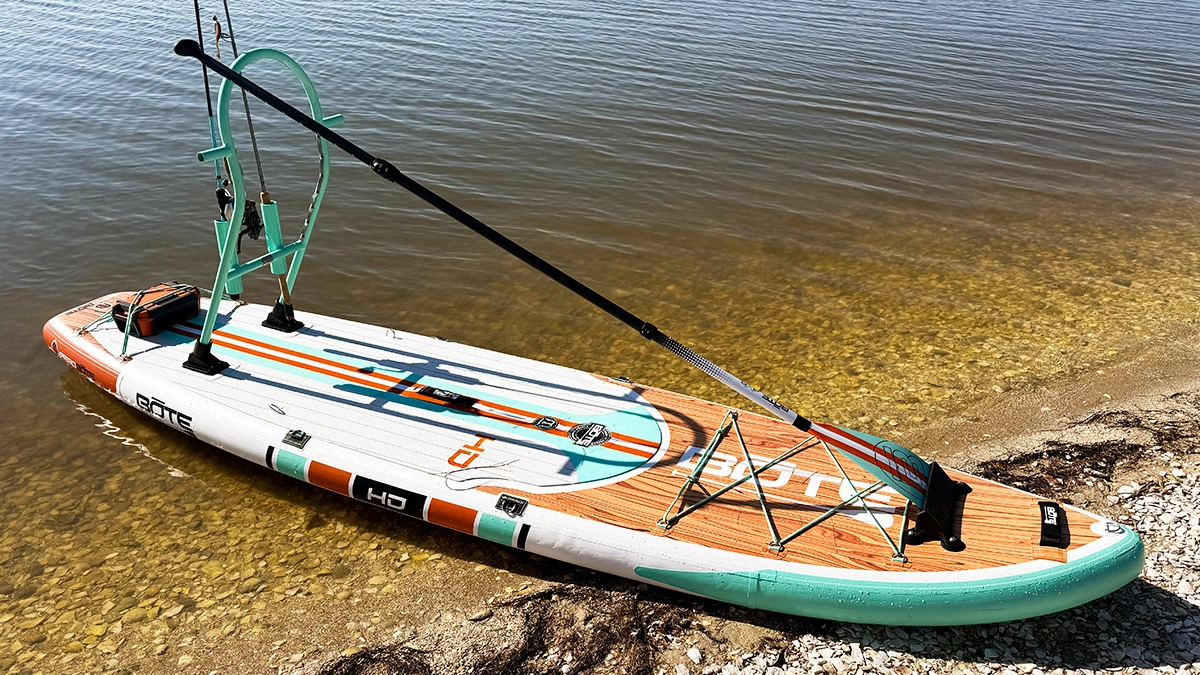
My friends all wanted to borrow the BOTE HD Aero stand up paddle board (SUP) after a river trip of paddling, exploring and fishing. I’m new to SUPs, but they all had their own setups that I think were purchased from Amazon. Maybe it was Temu, I don’t know.
What they immediately said to me was how firm the BOTE board was, how perfectly rigid the paddle was for propulsion, and how methodical the tracking was with help from three rear fins. I found plenty of features I liked while fishing and paddling, but it was fascinating to hear them gush about my SUP when they had their own rigs. Let’s dive into the review.
Before Hitting the Water
I was testing out the HD Aero Package from BOTE that included all the accessories necessary to get on the water immediately. The 11-foot, 6-inch inflatable paddle board (when deflated and rolled up) fits inside a travel backpack. Just about all the accompanying gear fits inside that pack too, which is great for anglers who don’t have a pickup truck. It’s a truly compact design that your shoulders can handle.
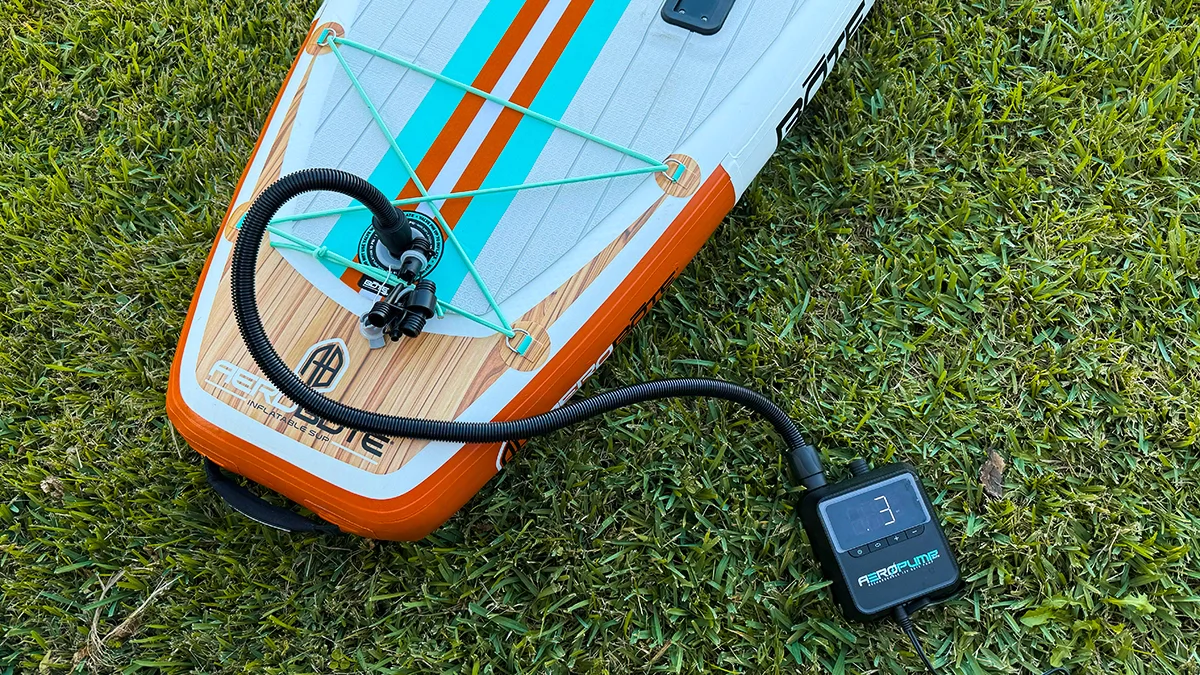
My pack included a hand pump and AeroPump Mini 12 Volt Pump to both blow up and deflate the paddleboard. Yes, deflating your SUP at the end of the day is part of packing up and heading home. The electric pump, which can be charged at home or just work off the cigarette lighter in the dash, really shortened prep time when inflating the board to 14 PSI. When deflating, I actually liked the hand pump better, as it quickly sucked out air from the paddleboard with minimal setup.
For fishing, I had a three-piece adjustable paddle from BOTE, an inflatable belt PFD (which is great for most anglers, but I personally prefer a traditional PFD), a Tackle Rac that incorporates two rod holders and leaning bar, coiled leash, and removable paddle sheath that holds the paddle when fishing.
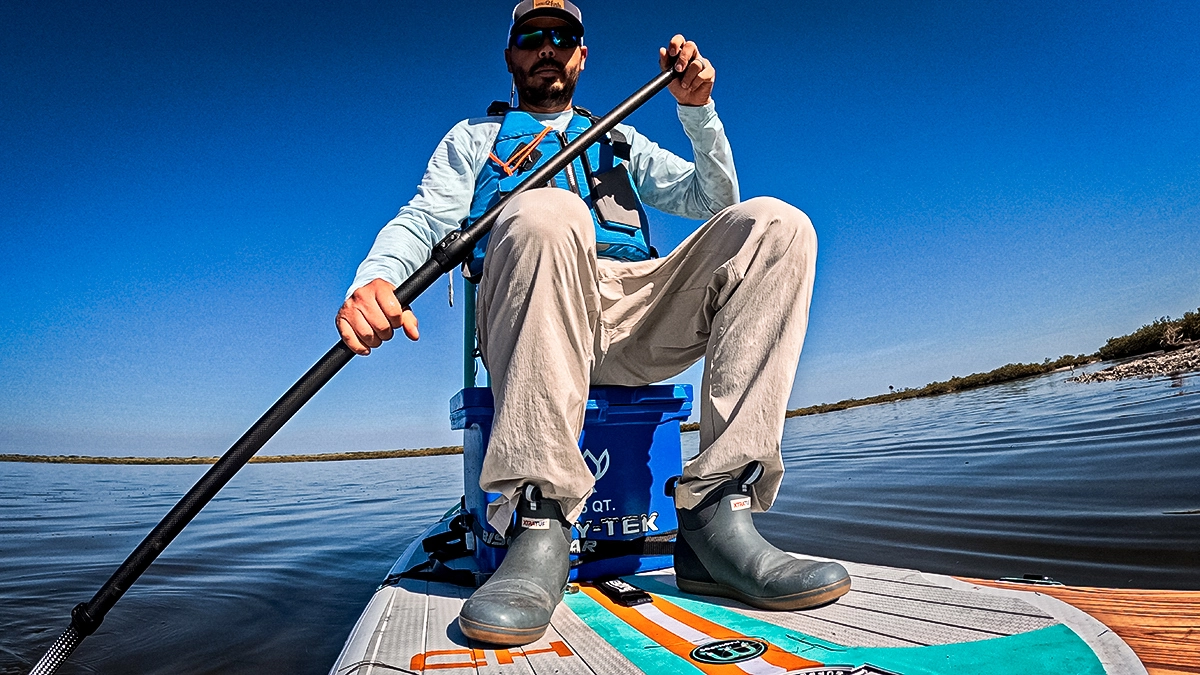
Two other key accessories that must be mentioned: a cooler and a 10-inch removable center fin. BOTE recommends a premium option like the KULA Cooler that’s easy to strap down and can be used as a cooler, seat, bait well, rod holder, cast net holder, or equipment storage. I used an older cooler from my garage because it’s all I had available, and it was where I stored my tackle and dry bag. I would make sure whatever cooler or seat you use has good mounting points, as the HD Aero has mounting spots built-in for straps.
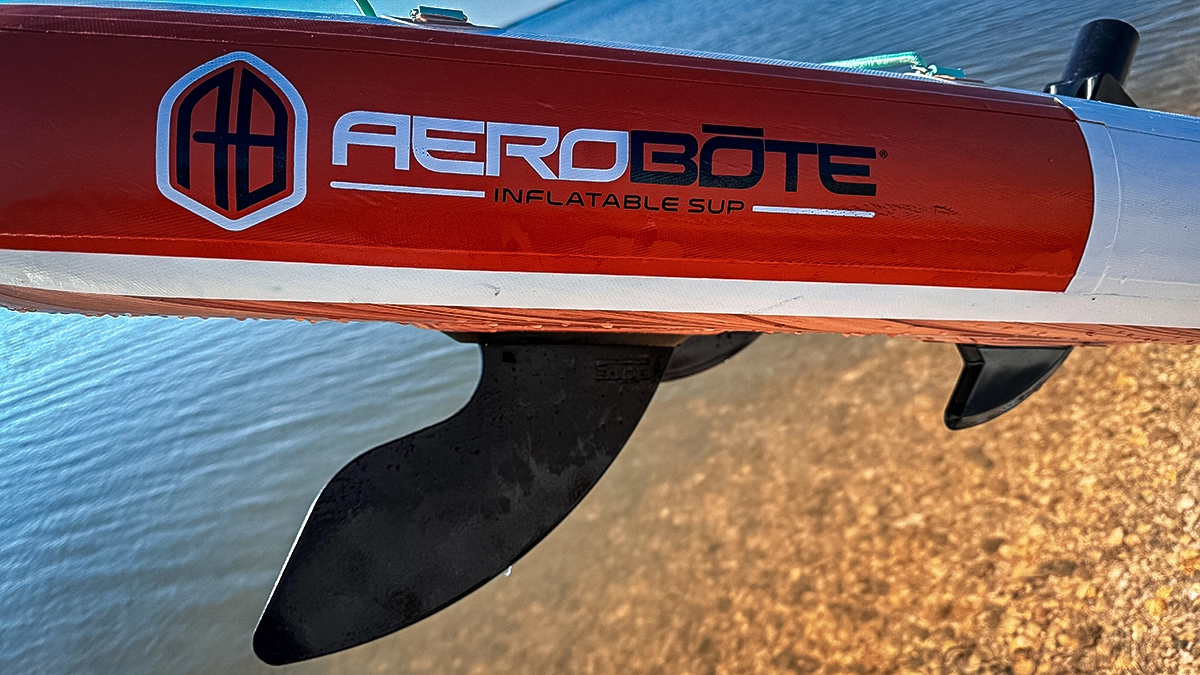
Now the 10-inch fin isn’t mandatory to use, but I was playing with a bit of chop and wanted to cross over to calmer sections. The fin easily slides into place, although anglers have to be mindful of paddling in at least 10 inches of water. I was pretty careful not to get too shallow and risk hitting bottom. But that fin was a godsend that allowed me to maneuver the paddleboard well, overcoming a common complaint I hear about SUPs.
A Fishing Mission
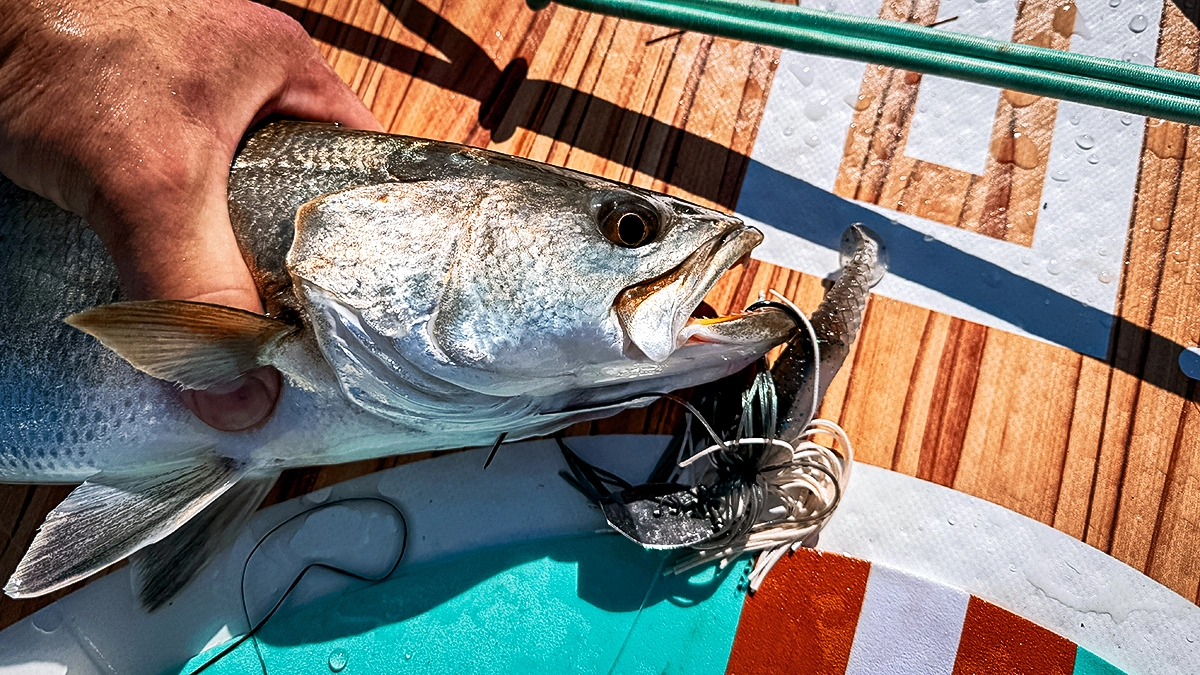
Now just cruising and paddling along the beach is plenty of fun with a paddleboard. And down here in Florida, SUPs are perfect rigs to explore freshwater springs and drift along. But I can’t even sniff water without having to fish it, so off I headed to the shallows in search of anything that’d bite a hook.
Although I thought I’d be sitting on my cooler most of the time, that was the exact opposite of what played out. I felt entirely comfortable standup paddling using the long paddle with a healthy symmetrical blade. In fact, I did almost all my fishing standing up — casting, reeling, fighting a fish, and paddling were no problem. And when I landed a fish, I knelt down and leaned over to unhook and release them. You get the idea: The paddleboard was plenty stable to anyone familiar with standing in a kayak.
The only time I sat down was to paddle against the wind. Heading back to the launch, I wanted to fight the wind and make good time, so I plopped onto the cooler and put some mustard into my paddle strokes. I got a bit wet, but isn’t that the whole point of a paddleboard?
Specifications
- Dimensions: 11′6″ Length × 34″ Width × 6″ Depth
- Capacity: 315 lbs
- Average Weight: 30 lbs
- Construction: Inflatable AeroBOTE Technology
- Optimal Inflation: 10 to 15 PSI
- Travel Bag Dimensions: 36″ Length × 17″ Width × 13″ Depth
- Loaded Bag Weight: 48 lbs
Features
- 11′6″ Inflatable Paddle Board
- Tackle Rac Seafoam
- AeroPump Mini 12 Volt Pump
- Travelink Carry Sling
- Coiled Leash
- BOTE Inflatable Belt PFD
- Three-Piece Adjustable SUP Paddle
- 10-inch Removable Aero Center Fin
- Pair of Slide-In Aero Rac Receivers
- Removable Aero Paddle Sheath
- Aero Repair Kit
- Hand Pump
- Travel Bag
When to Go
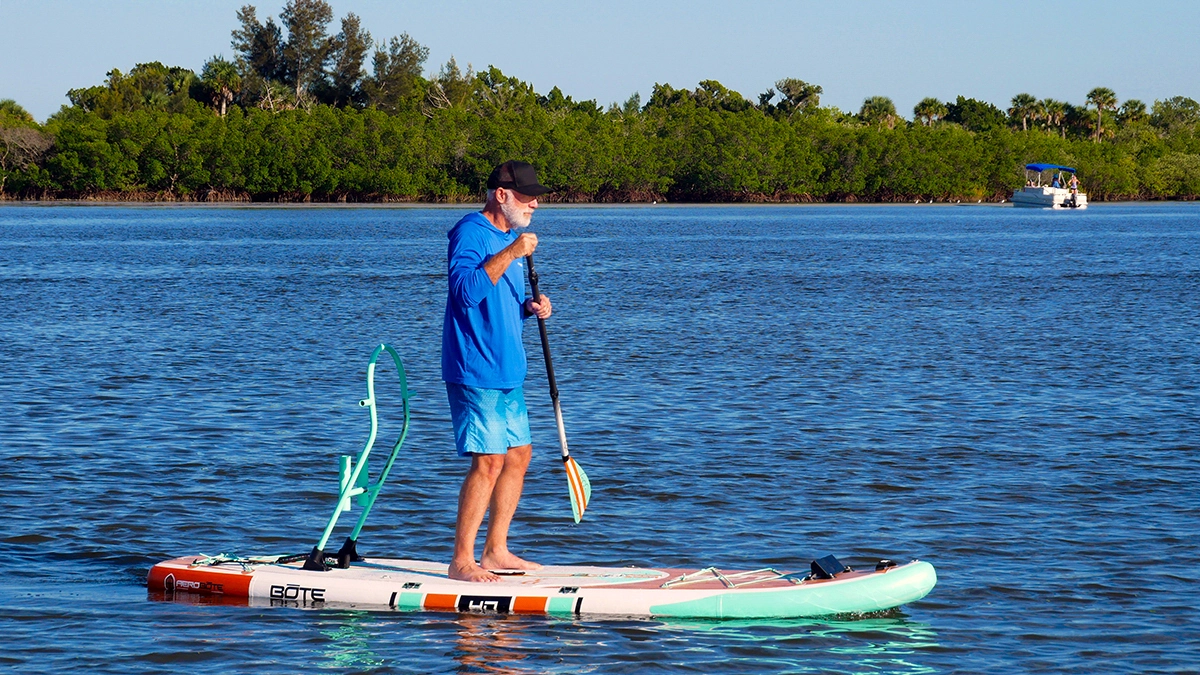
I don’t think an SUP will ever replace a bass boat or walleye wagon: A bay boat, pontoon boat or plain-old fishing boat will always have more space and horsepower. But there are times when a paddleboard will absolutely shine. I think most instances won’t require the use of electronics, although I’m sure some anglers out there are running fishfinders on their paddleboards.
BOTE’s HD Aero worked well for me launching off a dilapidated launch ramp that boats simply couldn’t access. Imagine walking into a backcountry lake, or hiking along a trail put in at a little piece of remote shoreline — the idea is the same. I have a truck, but if I were on vacation with a rental car, I could still successfully transport and launch the BOTE HD Aero. Getting close to the spot you want to fish before launching is key; don’t expect to make long journeys on SUPs in a short window.
For short distances in calm weather, the BOTE HD Aero was a great exploratory machine. I paddled and drifted all day without using up any battery power — because there were no batteries. And I didn’t need to get the paddleboard registered at the county office, either. I packed light with minimal gear; since the BOTE HD Aero is lightweight, I didn’t need a trailer or cart to move it around.
Simplicity is the name of the game here. I could imagine an SUP being the perfect fishing rig at a summer lake house: Launch right after dinner, scoot over to the lilypads, and catch some bass and pike as the sun sets.
What to Look Out For
For all the great things about the BOTE HD Aero, there are a few things to watch out for. Nearly all of them have nothing to do with the specific BOTE model, but rather paddleboards in general.
Difficult in Wind: If the water’s white-capping, maybe reconsider fishing an SUP that day. Wind can blow around an SUP because of its light weight and your body acting as a sail, plus water will definitely spray you and anything attached to the boat. Add in cold weather or water, and you better be prepared for those sloppy conditions.
Not Too Fast: Kayaks are way slower than boats, and SUPs are slower than kayaks — you won’t be breaking any speed records on a paddleboard. Plan accordingly, understand your range isn’t too far, and don’t be surprised by it.
A Little Tippy: While they’re great for exercise and strength building, SUPs might not be the top option for someone without balance. I never felt like I was going to tip over in the BOTE HD Aero, but others might. And I’m not some strength trainer or anything; when I first tried an SUP years ago, it was so tippy for me that I had to sit and paddle the entire time. If you have adequate leg strength and decent balance, you’ll be just fine.
Minimal Storage: The BOTE HD Aero has no built-in storage, so bring a cooler. A second great spot is to hang net storage from the leaning bar. Up front, bungees also allow you to strap down gear to the paddleboard.
Even with those considerations, paddleboards are definitely worth exploring. After all, the BOTE founders started experimenting with SUPs in 2008 when they were completely unimpressed with what was available on the market — and the BOTE HD Aero is undoubtedly a premier option. I wash it down after a day of fun and let it dry (inflated) on my back porch. The sun takes care of the rest. Now if you’ll excuse me, I’ve gotta make a phone call to get my board back from the buddy who borrowed it.