Have you ever caught a black carp? Well, you should have kept and killed it — and it likely cost you free money. More on that later. Black carp (Mylopharyngodon piceus) are one of four non-native fish species that belong to a group commonly referred to as invasive carp. And all the invasive carp species (bighead, black, grass, and silver carp) are wreaking havoc on the Mississippi watershed.
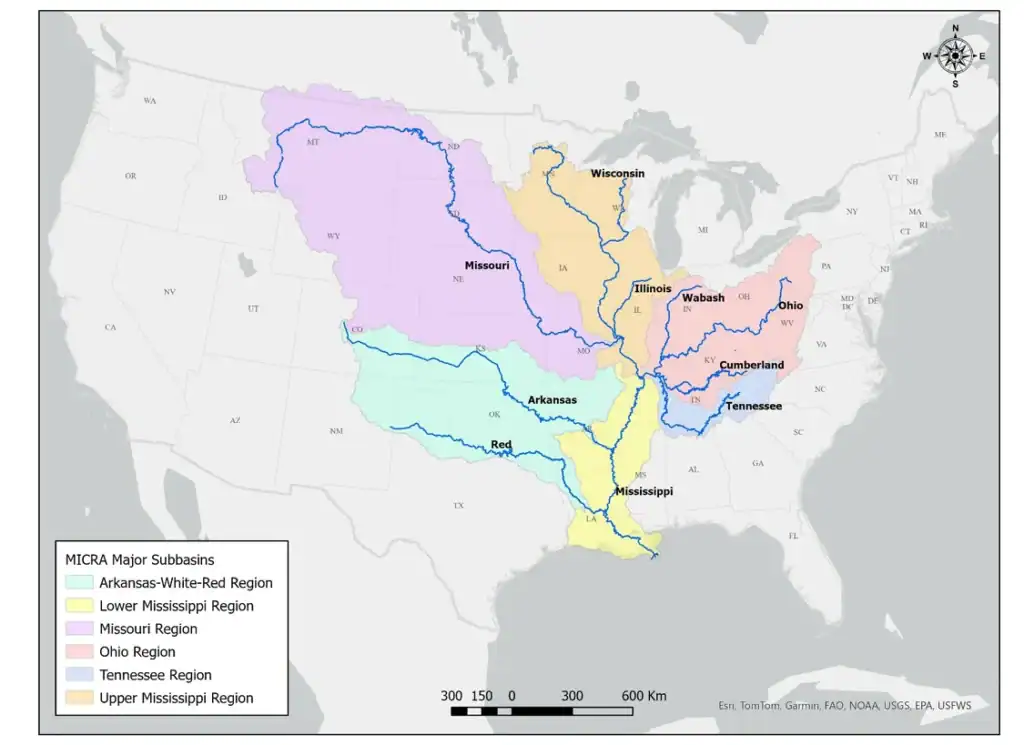
Recently, Oklahoma joined a 28-state program, offering anglers a $100 reward for each invasive black carp they catch and report. The project, called Keep, Cool, Call, is an effort by the U.S. Fish and Wildlife Service (FWS), funded by the Illinois Department of Natural Resources, and administered by Tetra Tech to track the spread of black carp in the Mississippi River Basin. Black carp escaped into the Mississippi River drainage due to high-water flooding events from private aquaculture facilities in the 1990s, according to the FWS.
The program recently expanded to include the Arkansas, Red and White river basins in Oklahoma, tributaries of the Mississippi River. In total, just about every state where the Mississippi River or its tributaries touch are involved. So anglers fishing in states such as Indiana, Tennessee, Illinois, Kentucky, Arkansas, Wisconsin and 22 others should be on the lookout — for ecological concerns, but also a payday.
Erika Sarvela, an invasive carp biologist for the Oklahoma Department of Wildlife Conservation, said anglers can earn a $100 bounty for each of the first 10 black carp they report each month. There have been no confirmed black carp catches in Oklahoma to date.
“Recreational anglers, including bowfishers, who happen to catch a black carp are eligible,” Sarvela said. “But they’ll need to follow the correct procedure to ensure they receive payment for their catch.”
To qualify for the reward, Oklahoma anglers who think they might have caught a black carp must humanely kill the fish and keep it on ice. Transporting a live invasive carp is illegal. Anglers must also record the location of the catch, with GPS coordinates, along with the type of fishing gear and bait used. They should also note habitat conditions such as water depth, temperature and current. The program requires photos of the fish’s head, mouth and its total length for identification.
In Oklahoma, all information should be emailed to the Erika Sarvela at erika.sarvela@odwc.ok.gov. The national FWS contact is Jeremiah Smith at jeremiah_smith@fws.gov. For Tetra Tech, reach out to Josh Mitchell at josh.mitchell1@tetratech.com. In Oklahoma, the fish must be kept on ice or frozen so the department can arrange for pickup and analysis. Different states have slightly different methods to collect black carp, so be sure to reach out to your state’s wildlife agency.
How to Identify a Black Carp
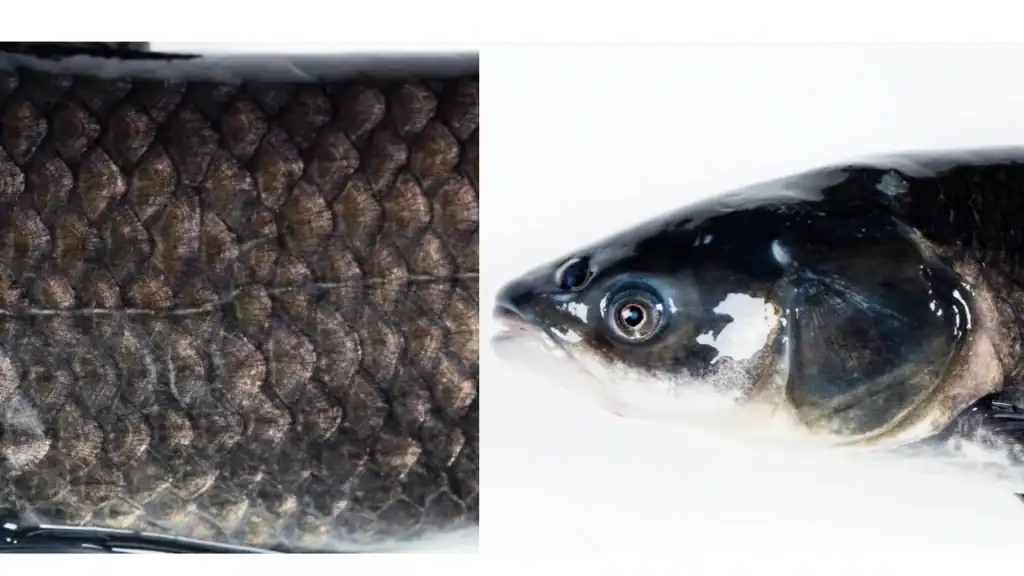
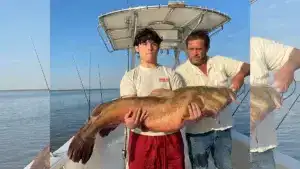
Sarvela noted that the reward is specifically for black carp, but anglers are still encouraged to report details about other invasive carp caught. Intrepid anglers in search of black carp should be sure not to misidentify other species as black carp. Similar-looking fish such as blue suckers, common carp, smallmouth buffalo and bigmouth buffalo are all native species, and potentially even protected in some areas.
Black carp and grass carp also look a bit alike. Here’s what to look for. A black carp has a longer and narrower head, darker coloration, and a nearly straight lateral line with “slight de-curvature midbody.” When a black carp is viewed from the top down, the upper jaw is not visible. The upper jaw on a grass carp is prominent and visible from the top down. Plus a grass carp has a lateral line that “initially declines near the length of the pectoral fin then continues straight along the body,” according to the FWS.