Until recently, fisheries managers have relied on methods such as netting, electrofishing, and creel surveys to understand what fish inhabit lakes, rivers, and coastal waters. But a rapidly advancing technology known as environmental DNA, or eDNA, is changing the way scientists can monitor fish populations. A new study published in Reviews in Fish Biology and Fisheries by researchers at Incheon National University suggests that eDNA may be one of the most effective tools ever developed for identifying fish species in aquatic ecosystems.
What Is eDNA?
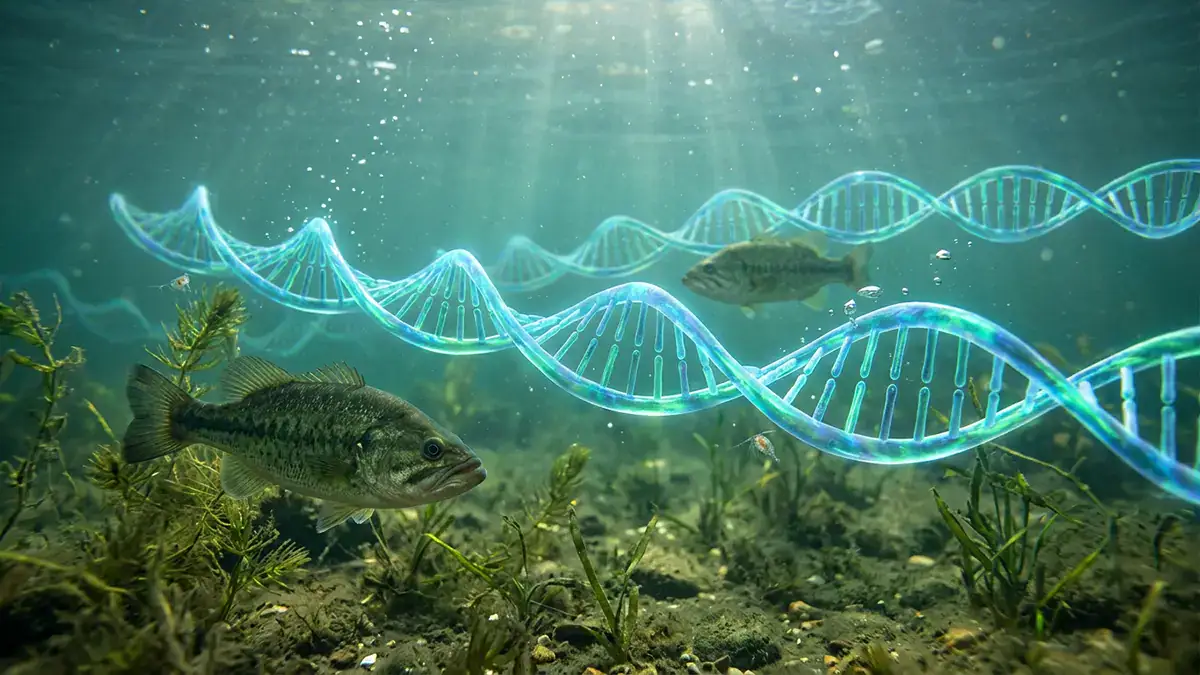
Environmental DNA refers to the genetic material that fish leave behind in the water through skin cells, mucus, waste, and other biological processes. By collecting and analyzing water samples, scientists can determine which species are present without ever catching or disturbing a fish. The method has gained significant attention in recent years because it allows researchers to survey aquatic environments quickly, efficiently, and with minimal impact on fish populations.
Researchers from Incheon National University in South Korea analyzed dozens of controlled experiments known as mock communities, where the exact species composition and DNA concentrations were already known. This allowed them to evaluate just how accurately eDNA metabarcoding can detect fish species and estimate their abundance. Their findings confirmed that the technology is highly effective when it comes to identifying fish diversity. Certain genetic markers, particularly those targeting the 12S rRNA gene, consistently delivered accurate species detection across a wide range of fish communities.
Why It Matters To Anglers
This is an important development because it means fisheries managers can obtain a clearer picture of the fish species living in a particular body of water. Rare species, newly established populations, and invasive fish may all be detected more effectively than with some traditional sampling methods. As a result, agencies can gain valuable information about the health and diversity of fish communities while reducing the need for more invasive survey techniques.
While eDNA excels at identifying which species are present, it remains far less reliable when it comes to estimating how many fish are actually there. Many people assume that higher concentrations of DNA in the water would indicate larger populations, but the relationship is not that straightforward. Different species shed DNA at different rates, and environmental factors such as water temperature, currents, spawning activity, and DNA degradation can all influence the results. Laboratory procedures can introduce additional variation as well.
Because of these factors, the researchers found only weak relationships between DNA concentrations and total fish biomass across diverse fish communities. In practical terms, an eDNA survey may reveal that smallmouth bass are present in a lake, but it cannot yet accurately determine whether the population consists of dozens of fish or thousands. The technology is currently much better at answering the question of which species are present than estimating abundance or biomass.
Another key finding involved the quality of DNA reference databases. To identify a species, scientists must compare collected DNA sequences against known genetic records. The review found that studies using locally curated reference databases achieved substantially higher identification accuracy than those relying solely on publicly available databases. This suggests that developing comprehensive regional DNA libraries will be critical for improving the accuracy and reliability of future eDNA surveys.
What This Means For Fisheries Management
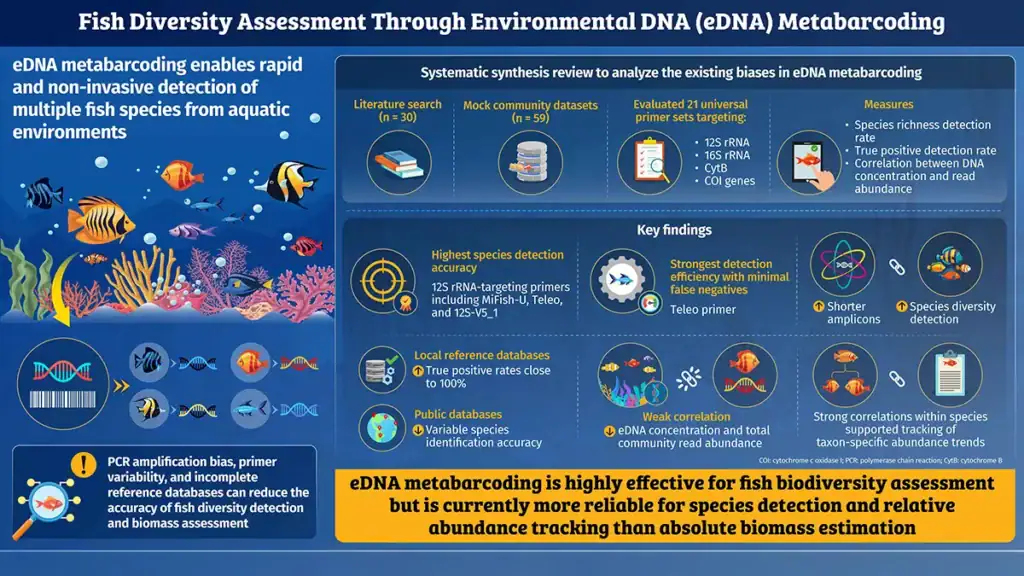
Kachiprath et al. (2026) | Reviews in Fish Biology and Fisheries I DOI: 10.1007/511160-026-10040-9
Courtesy Incheon National University
As eDNA techniques continue to improve, they could play a larger role in monitoring fish populations, detecting invasive species before they become established, tracking endangered species recovery efforts, and evaluating habitat restoration projects. Because water samples can often be collected more easily and with less disturbance than traditional survey methods, eDNA has the potential to make biodiversity monitoring more efficient and cost-effective.
But eDNA should be viewed as a powerful complement to traditional fisheries assessments rather than a replacement. While the technology can provide valuable information about which species inhabit a waterway, conventional sampling methods remain necessary for estimating population size, age structure, and overall biomass. Together, these approaches offer fisheries managers a more complete understanding of aquatic ecosystems and the fish populations that support recreational fishing opportunities.