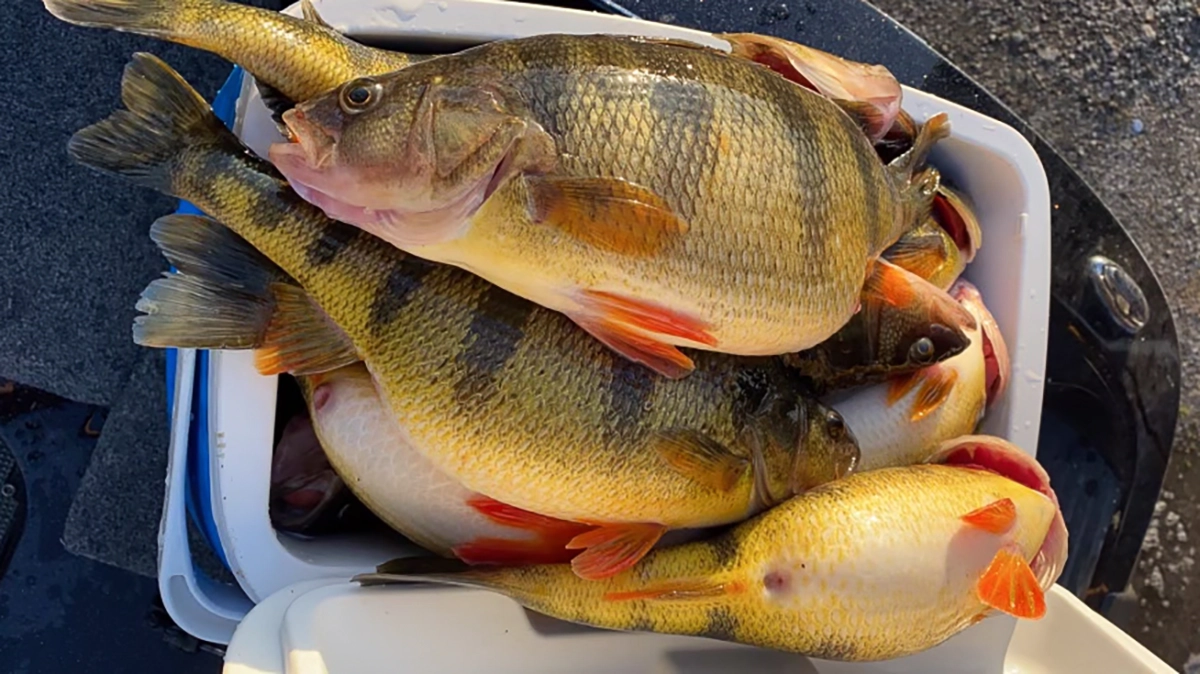
Old Timers will tell you they don’t grow ‘em like they used to. Good old days filled with impossible numbers of trophy catches landed from the shore. And your ice chest stacked full of fillets in just a morning of fishing. Is it true that the fishing really was better decades ago, bolstered by bigger fish?
Well, those old hands might be right, at least for the state of Michigan. In a recent study conducted by the University of Michigan, using data that covered 75 years and nearly 1,500 lakes, researchers found that several species were significantly smaller in 2020 than their typical size in 1945. Of note, younger fish are conclusively smaller for their ages.
“Climate change is altering the size of different organisms around the world, including fishes in lakes here in Michigan,” said Peter Flood, a postdoctoral research fellow at the University of Michigan School for Environment and Sustainability. “And most of those changes we’re seeing in Michigan fishes are declines in size through time.”
Flood and his colleagues tracked the sizes of 13 different freshwater species, including different age groups within those species. The fish included cisco, rainbow trout, brown trout, yellow perch, northern pike, walleye, black crappie, white sucker, rock bass, smallmouth bass, pumpkinseed sunfish, largemouth bass and bluegill. Together, the team found that, out of 125 species-age class combinations, 58 had changed size. Of those 58 that changed, 46 were smaller. Highlights from the study:
- For cold and cool-water adapted fish, length-at-age responses to increasing degree days and mean annual surface water temperature were usually in opposite directions.
- In several species (black crappie, rock bass, walleye, and northern pike), after the youngest age classes, the oldest age classes had the next highest mean annual decreases in length-at-age.
- For species in this study where adults increased or had no change in total length over time, while juveniles shrank, shrinkage may be related to density-dependent growth.
“The largest decreases in length over time were found in the youngest and oldest fishes,” Flood said. “Both of those groups have outsized roles in maintaining healthy fish populations and ecosystem functions and services.”
Why is it important for younger fish to be larger, even at the adolescent age? Well, they’re easier prey if smaller, which can limit the population of current and future generations, he said.
Changes in the size of individual gamefish and their populations also affect how the state manages its fisheries. The Michigan DNR sets limits on the size and number of fish harvested based on healthy populations; those regulations might change if it takes longer for fish to reach a certain size.
For those who wonder how to determine the age of a fish, check its scales closely. As the scales grow, they form ring-like patterns almost like a tree that can be analyzed to help determine age.
Overall, in this study, most age classes of fish were decreasing in length-at-age through time and as a function of increasing mean surface water temperatures. Additional factors beyond temperature, particularly food consumption, are important and may interact with warmer temperatures to influence fish growth, the study pointed out.
So give those graybeards at the docks a break. They’re not just telling fish stories. Fishing probably was better back in the day, and continued research on this topic in other states will likely reflect that. There’s a reason many IGFA fish records were broken years ago and those records continue to stand the test of time. For us fishing in the moment, let’s savor the extraordinary, oversized catches when they happen.
The 2025 study was published in the journal Global Change Biology and was supported by the U.S. National Science Foundation and Michigan Institute for Data and AI in Society.