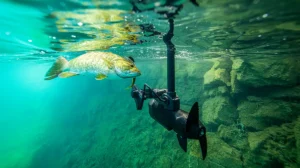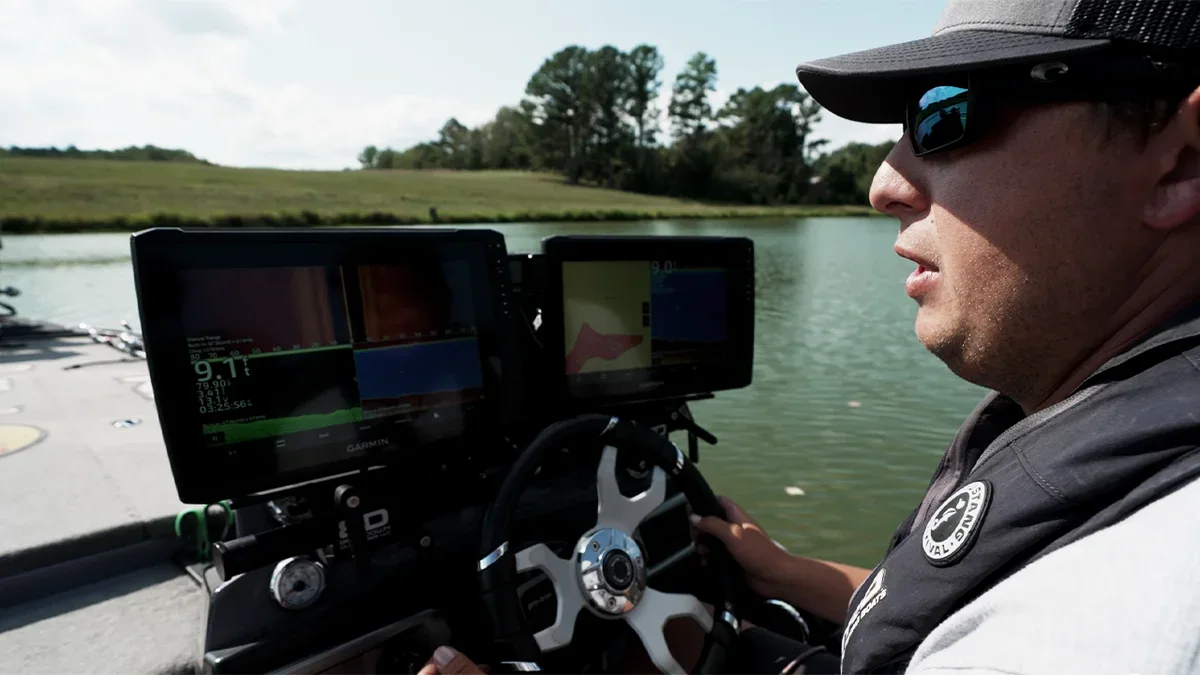
In this video, Cody Huff walks through the exact process he uses to read his graph and forward-facing sonar during every trip. Huff starts on a shallow flat and searches for small irregularities that hold fish. He looks for ditches, drops and hard spots, since these shifts in bottom composition create prime locations for bass.
Featured Product
- FISH FINDER – Garmin ECHOMAP Ultra 2 126sv Fish Finder/Chartplotter with Navionics+: Buy at Bass Pro Shops
- FORWARD-FACING SONAR (FFS) – Garmin LVS34 LiveScope Plus Live Scanning Sonar Transducer: Buy at Bass Pro Shops
- TROLLING MOTOR – Garmin Force Trolling Motor: Buy at Tackle Warehouse
- SHALLOW WATER ANCHOR: Power Pole 8 ft. Blades: Buy at Bass Pro Shops | Buy at Tackle Warehouse
- BOAT – Nitro Z21 XL PRO: Check out at Nitro
- MOTOR – Mercury Pro XS 250hp: Check out at Mercury
Positioning and Boat Control
Huff stresses the value of setting up with the wind in his face. This position helps him avoid blowing over the target. It also allows for better boat control and more accurate casts. As he approaches the ditch, he keeps the map zoomed in so he can judge casting distance. Meanwhile, he uses his forward-facing sonar to monitor fish location and boat proximity. This approach creates a clean presentation, which gives the fish the right look on the first cast.
Simple Forward-Facing Sonar Settings
Huff also explains his philosophy on sonar settings. He avoids complex tweaks and instead keeps everything simple. He performs a factory reset on new units, then turns off the grid overlay. After that, he sets his forward range between 100 and 120 feet. He also picks a color palette that fits local water clarity. He adjusts only two main controls: gain and contrast. Hard bottoms usually require lower gain, while soft bottoms handle more brightness. The same mindset applies to side scan and down scan. Huff notes that small changes often make structure easier to interpret, yet he still avoids unnecessary adjustments.
Targeting Fish With a Precise Cast
After Huff identifies the structure and confirms fish on his forward-facing sonar, he focuses on one final step: executing a precise cast. He stresses that accuracy matters more than speed, especially when fish sit tight to a ditch edge or a single rock. Therefore, he lines up each cast by watching how the fish react on the graph in real time.