Every angler has that moment on the water when something completely unexpected happens. For me, it’s been a pretty incredible year for a variety of species, including a meanmouth bass. But, on one of my open boat perch trips for my guide service, Natural Outfitters, we landed a fish that made us rub our eyes.
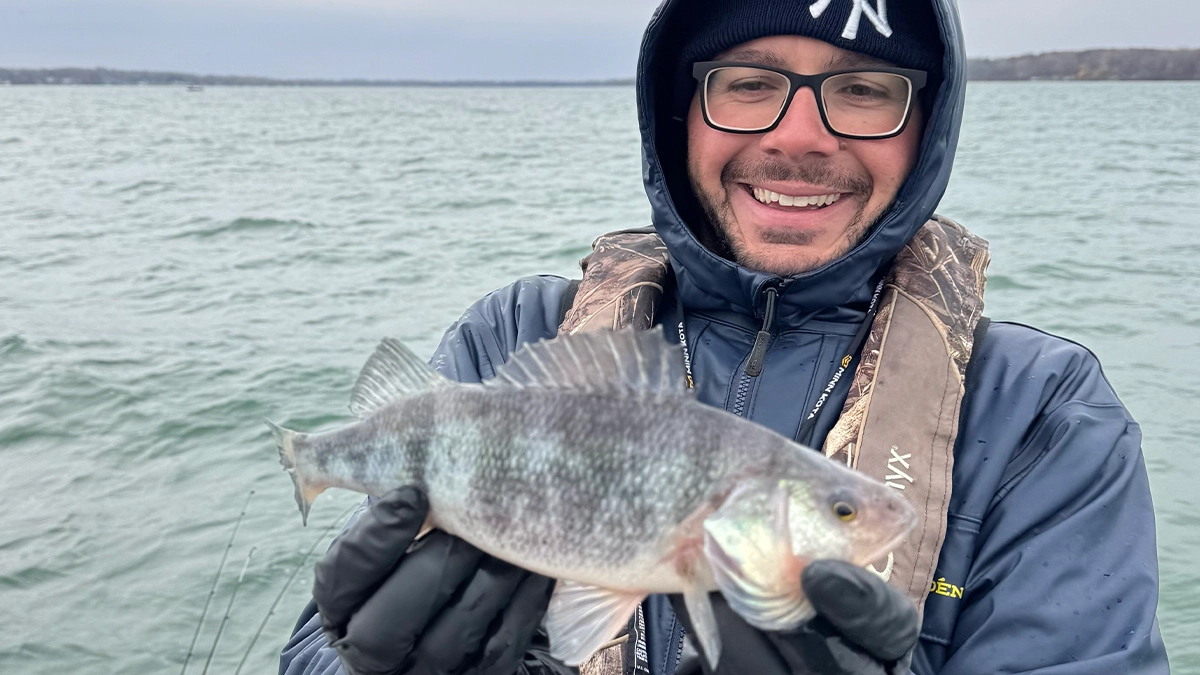
As the action slowed on the school we were on, I picked up a rod (which I don’t normally do on a charter) and started making a few casts around the boat to locate another school. First cast with a 6th Sense Party Minnow on a 3/16-ounce jighead slow-rolled along the bottom yielded a light bite, which usually means a good perch. As I set the hook, I knew it was a good keeper, but then something was off. It came up pretty pale, which is expected for the nutrient rich, stained waters of Cayuga Lake. But as it got closer, it had a distinct blueish hue to it — a blue perch!
Little did I know that strange blue shimmer ties into a much deeper lore involving other mysterious blue fish, including the famously now-extinct blue pike and often misunderstood “blue walleye” that some anglers claim to catch today. Here is a little bit about your favorite freshwater fish turned blue and why they are one in a million.
A Blue Yellow Perch
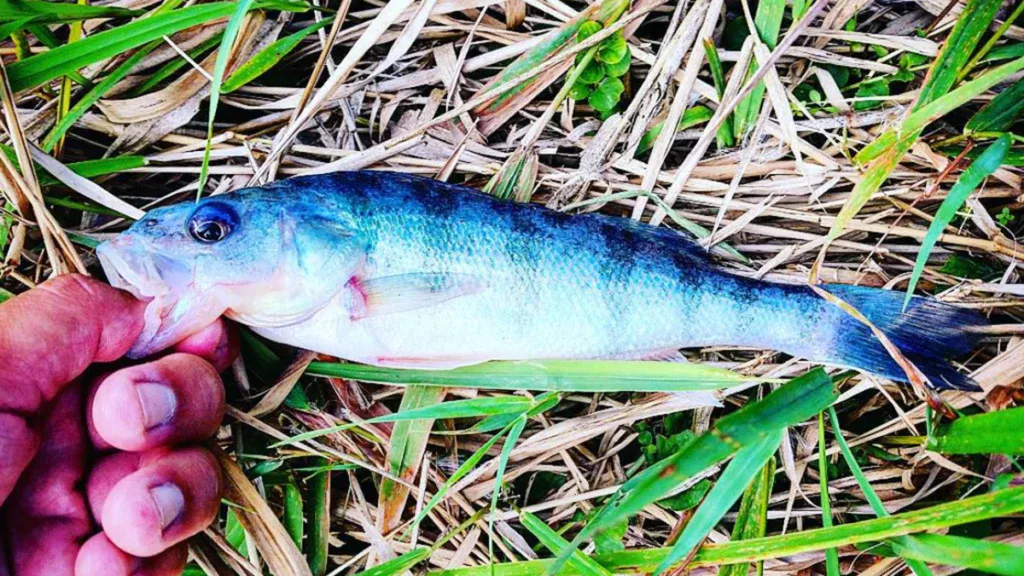
A blue-phase perch isn’t a separate species. It’s just a yellow perch born with a genetic mutation affecting its pigment cells. Likely a reduction in the yellow pigments that normally cover the iridescent layer beneath. Without that yellow layer, the fish’s sides reflect an electric blue sheen.
Common traits include:
- Deep blue or slate-blue coloring across the back and sides
- Faded vertical barring
- Normal yellow or orange fins
- Typical perch size and behavior
They fight the same and bite the same; you’d never know you had one until the fish hits the surface and reveals its metallic flash. Encounters are extremely rare, as some estimates place them at 1 in 50,000 perch, depending on the lake. These blue-phase perch have been reported across the upper Midwest, Ontario, and Northeast; pretty much anywhere perch populations are strong. They’re essentially a genetic lottery ticket, and catching one is a true angler’s trophy.
Blue Walleye Versus the Extinct Blue Pike
Whenever you mention a blue perch, blue walleye inevitably enters the conversation. And that’s where things get confusing, because anglers often mix up two very different things:
- Modern walleye with a natural blue sheen
- The extinct blue pike (Sander vitreus glaucus), a once-abundant species that disappeared decades ago
Let’s break down the difference, because it’s a story every freshwater fisherman should know. If you’ve been around walleye fisheries long enough, you’ve probably seen one: a walleye with a gorgeous blue-tinted back. These fish are not blue pike. They’re just a normal walleye with a natural coating of mucus containing a pigment called sandercyanin.
Sandercyanin is a protein that binds with bile pigments, producing a blue coloration when light hits it. Some walleye have more of it than others, causing:
- Blue sheen on the dorsal area
- Bright blue slime when the fish comes from colder water
- A striking steel-blue tone in photos
But once cleaned or cooked, the flesh is identical. These fish aren’t genetically distinct; they’re simply walleye with an unusually strong expression of the blue pigment, just like the blue perch. They’re relatively uncommon but not rare, plenty of fisheries across the Great Lakes, Minnesota and Canada produce them regularly.
The Lost Blue Pike: A Species Gone Forever
The blue pike, on the other hand, was its own species, not a color variant. Once abundant in the Great Lakes, especially Lake Erie blue pike were a highly sought after species. Blue pike were:
- Smaller than walleye (often 10 to 16 inches)
- More slender, with a streamlined build
- Silvery-blue with noticeably large eyes
- Known for soft flesh and massive historical commercial harvests
By the 1950s and ’60s, the population was collapsing due to overfishing, heavy pollution, loss of habitat, and the competition with new invasive species from overseas.The species was declared extinct by the 1980s, and despite rumors, photos, and hopeful anglers claiming otherwise, no verified blue pike have been documented since.
To this day, some walleye with a strong blue sheen get misidentified as blue pike—but genetically, the real blue pike is gone. It’s a sobering reminder of what’s lost when we don’t protect our fisheries.
How These Blue Fish Tie Together
Most fishermen will never see all three of these blue oddities in their lifetime:
- Blue-phase yellow perch — extremely rare genetic mutation
- Blue walleye — modern walleye with sandercyanin pigment
- Blue pike — a once-common species now extinct
Yet they all highlight how mysterious freshwater ecosystems can be. Even familiar species such as perch and walleye surprise us — sometimes with random genetic quirks or pigmentation differences. Fish like these captivate us because they’re rare, mysterious, and absolutely beautiful. And like stated above, many fishermen won’t ever get to see at least one of these in their lifetime.
I’ve been lucky to see a blue perch one other time in my life besides this one. Back in my college days, I caught another specimen during my freshman year in a small campus pond. And way more blue than my recent Cayuga perch. Of course, both of them were released to fight another day. It’s like a deer hunter shooting a white deer — it’s just bad karma.
That’s the magic of fishing. There’s always something new, even in waters you’ve fished your whole life. And once you see that flash of blue, whether in a perch or a walleye, you never forget it.